









Airport Tram: geotechnical design based on pressuremeter tests in the Brussels sandstone layers
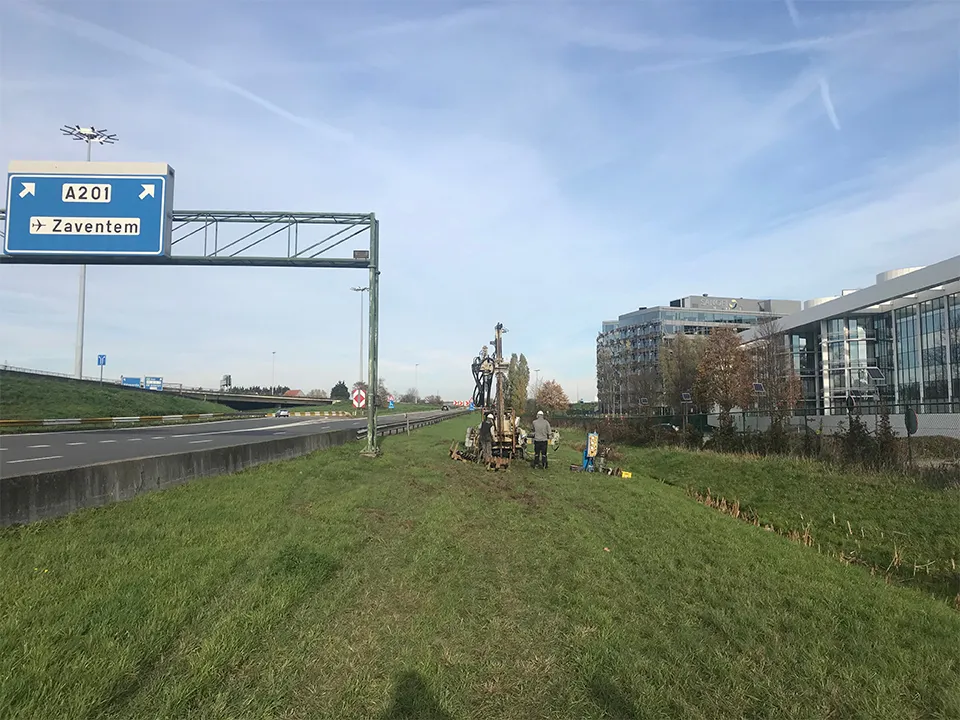
The new Airport Tram is being developed along the R0 in Brussels. The project is being delivered by De Werkvennootschap, an organisation that takes on major and complex mobility projects.
De Werkvennootschap engaged Geosonda, a company specialising in ground investigations for engineering & consulting projects, to carry out the geotechnical investigation for this project. Using cone penetration tests, boreholes and additional pressuremeter tests, Geosonda successfully mapped the heterogeneous subsoil, characterised by sandstone layers.
The Airport Tram will soon take you from Brussels North to Zaventem Airport in 30 minutes. This convenient 12 km tram line runs along Leopold III-laan and connects to the existing tram network inside the ring road. The Airport Tram will improve not only public transport links, but also cycling access. Companies in the airport region are currently geared towards car access, but with this project De Werkvennootschap aims to provide multimodal accessibility. The companies will be located at the intersection of 3 cycle highways (FR0, F201 and F202), 2 local railway stations (Diegem and Zaventem) and 4 tram stops.
Geosonda, one of the pioneers in geomechanical investigation in Belgium, was acquired by ABO-Group in 2010. Today it is a multidisciplinary company specialising in ground investigations for geotechnical, environmental and archaeological studies and engineering assignments. The company is currently carrying out the ground investigation for the Airport Tram. “In short, we carry out the geotechnical investigation, comprising preliminary research and several campaigns of on-site testing,” explains project manager Annick van Gansbeke. “Our findings are then reported to the design consultancy and the client, who decide whether any further investigation is needed. The project is currently in two parts: one involving ground investigation for the civil engineering structures, and the other for the infrastructure works. As for the civil engineering works, cone penetration tests have now been completed along the entire route. Boreholes and monitoring wells will be determined based on the results.”
Sandstone layers
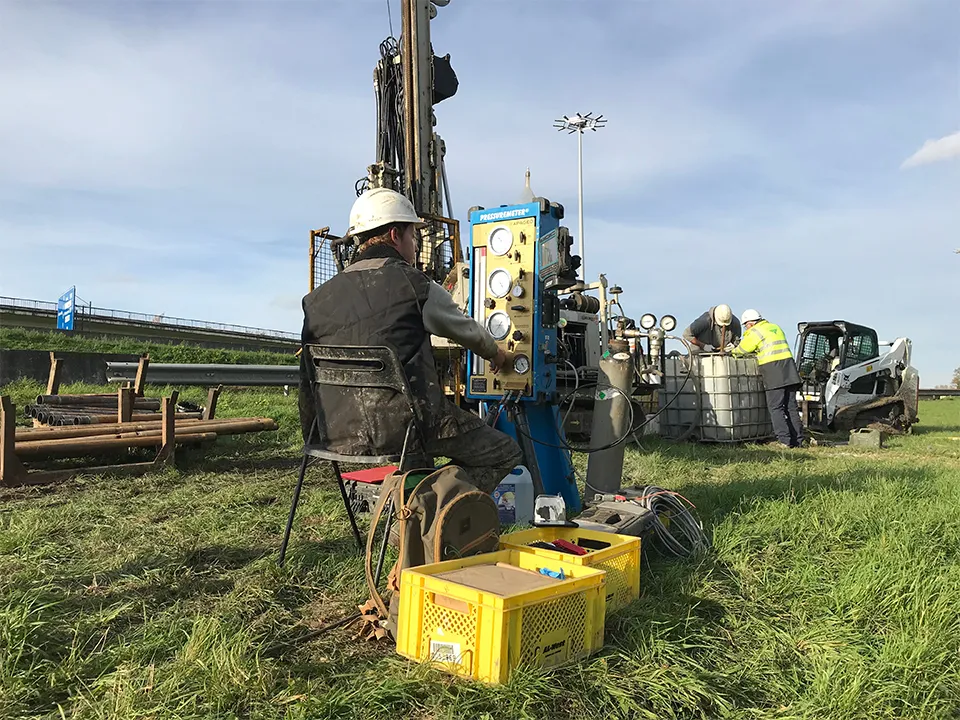
The project's biggest challenge is undoubtedly the heterogeneous subsoil, which contains numerous sandstone layers. As a result, cone penetration tests do not always reach the required depth. “When cone penetration tests came to a halt in sandstone, we worked with De Werkvennootschap and the design consultancy involved to find a solution,” says Stijn Huyghe, who works for Geosonda as an independent geotechnical expert. “We ultimately decided to carry out pressuremeter tests (PMTs). The benefits of these PMTs should certainly not be underestimated. They provide parameters that can be correlated with input parameters for Plaxis, software increasingly used to model large civil engineering structures. In addition, the WTCB plans to publish a guideline in the relatively near future for calculating the load-bearing capacity of piles based on PMTs.”
Not without risk
However, the decision to carry out PMTs in these sandstone layers was not without risk. “A PMT is preceded by a destructive borehole, which we use to drill through the sandstone layers,” explains Stef Bruynseels, geologist and Field Expert at Geosonda. “It is very important to produce a precisely calibrated borehole, so that the probe can be inserted accurately and makes uniform contact with the borehole wall. PMTs are carried out according to a set procedure, with a series of tests performed in succession before the probe is brought back to the surface. This process is repeated each time, while we stabilise the borehole walls to prevent soil from collapsing into the hole. The additional risk with sandstone layers is that the probe may break because of the heterogeneous ground. We have now carried out several tests in these soil layers, successfully.”
Multidisciplinary
The way Geosonda has tackled the challenges in this project is typical of the company. “Geosonda is powered by a highly enthusiastic and inquisitive team. We are eager to learn new techniques and are all innovative in our approach. We enjoy working on research and development projects, and when learning new techniques we can often turn to other companies within the ABO-group. That collaboration works very well. We have since become a highly multidisciplinary company, from deep sonic drilling to geophysical site investigations. We can now carry out a very broad range of techniques in-house. That is particularly useful for larger projects,” concludes Annick van Gansbeke.
Question about this story? Ask your question
Who worked on it
Luchthaventram in Brussel
- geotechnical investigationGeosonda
Keep following this
Get an email when a new story is published. No account needed.
- ProjectLuchthaventram
- ThemeUsing and protecting the subsurface
- SubjectGeneral
- CompanyGeosonda







