









A KLIP request alone is rarely enough to prevent excavation damage
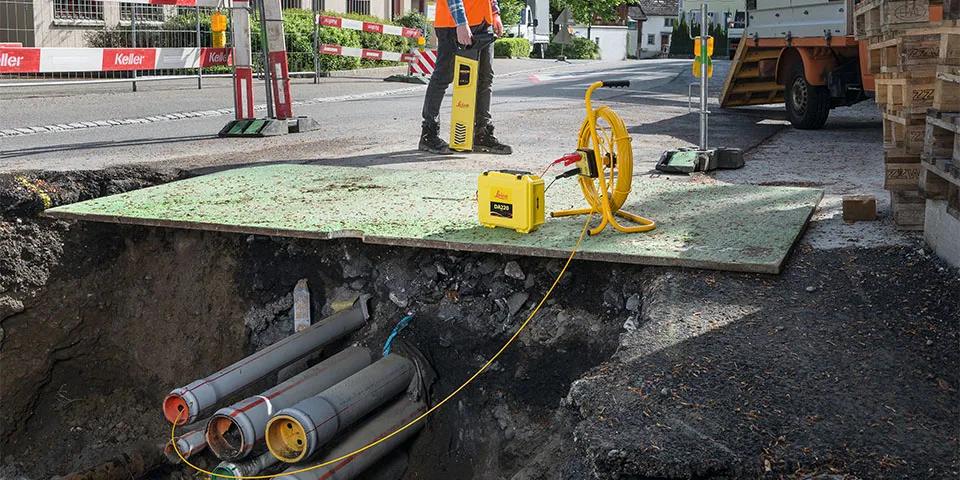
Excavation damage is anything but unusual on Belgian construction sites: every day, underground cables or pipes are struck during excavation somewhere. Yet they can often be detected easily using a cable locator or ground-penetrating radar. Some contractors still consider this step unnecessary, even though it can have serious consequences for worker safety and businesses’ finances.
For more than 30 years, surveyors, contractors, architects and engineering consultancies have turned to Lasertopo to hire and buy professional surveying equipment. Cable detection is an important part of its offering: contractors who want to make sure they do not damage anything underground use techniques during the preparatory phase to detect cables and pipes made from different materials. But not everyone takes this step. Some, for example, limit themselves to the mandatory KLIP request to cable and pipeline operators, assuming that a digital plan of the underground infrastructure will be sufficient.
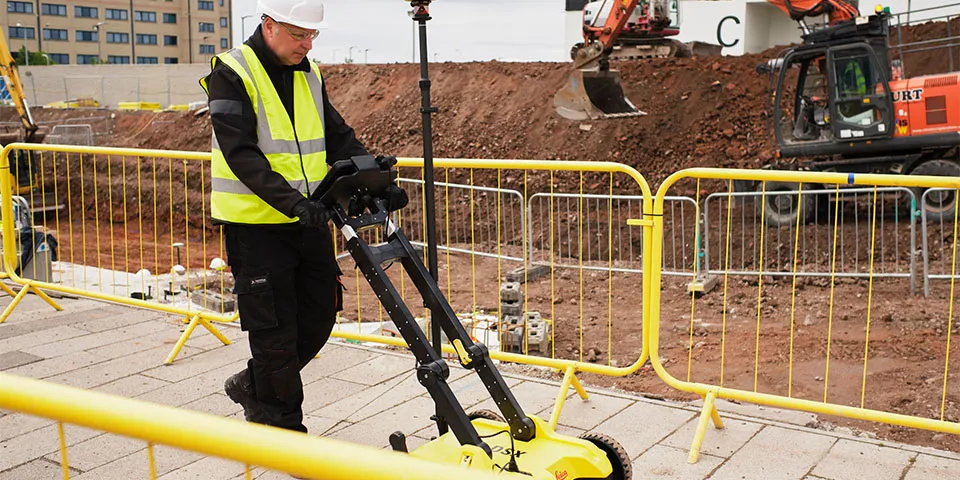
The new Leica DSX ground-penetrating radar, shown here in combination with an iCON gps, also maps underground pipes made from non-conductive materials.
3 steps
“Three steps are needed to prepare the site accurately,” says Kevin Delaplace, utility specialist Benelux at Leica Geosystems, one of the quality brands distributed by Lasertopo. “A KLIP request is only the first step: the plan gives you an overview of the infrastructure, but it is rarely 100% accurate. While data on newer infrastructure is generally measured accurately, this is not always the case for older infrastructure. It is therefore important to validate the data: first using traditional cable locators (step two), then with ground-penetrating radar (step three). This final step gives you the highest level of quality, so you can start digging with peace of mind.”
Detecting conductive materials
According to Delaplace, cable locators can find around 70% of underground cables and pipes: “Cable locators can detect and map all infrastructure made from conductive materials, with an accuracy of up to 5% of the depth. One useful feature of Leica cable locators is that they automatically adjust to the available signal: when the signal is strong, sensitivity is automatically reduced, and vice versa. This makes it easier for users to locate cables and pipes, increasing their confidence in the cable locator.”
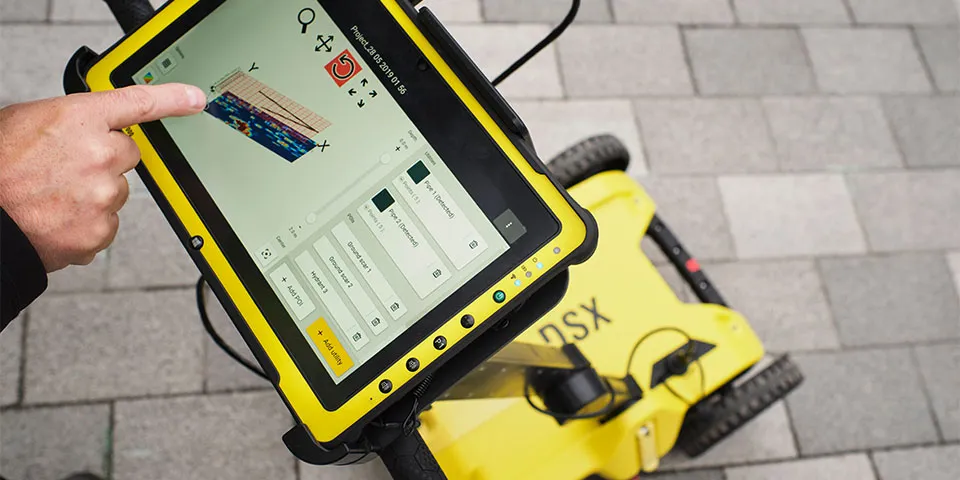
The Leica DSX results can be interpreted immediately on site.
Ground-penetrating radar for fibre-optic cables
Fibre-optic cables are particularly often damaged during excavation: “These cables are usually laid above other infrastructure, but as they are made from a non-conductive material, they cannot be detected with a traditional cable locator.” Ground-penetrating radar helps you avoid striking these cables and pipes too: “We have several solutions for this, with the Leica DSX as the highlight. It is our most accessible ground-penetrating radar system, and the data can be interpreted immediately on site. We have simplified the data display to such an extent that complex analysis work in the office is no longer needed afterwards. This, of course, saves contractors a great deal of time on site.”
Safety and cost savings
Using cable detection systems also improves worker safety by reducing the risk of physical injury caused by damaging cables. Moreover, the consequential damage caused by a single severed pipe far exceeds the cost of investing in a detection device. A high-quality, easy-to-use cable detection or ground-penetrating radar system enables contractors to avoid such problems. Through tailored training and demonstrations, the experts at Lasertopo and Leica Geosystems make it even easier for customers to get started with this equipment. “We have been a Leica Geosystems distributor for many years and know its products inside out,” says Fiona De Smet, business representative at Lasertopo. “That means we can advise customers on this important step in the preparatory phase better than anyone else.”
Een zakelijke vraag aan Lasertopo BVBA? Get in touch
Companies in this story
Keep following this
Get an email when a new story is published. No account needed.
- ThemeUsing and protecting the subsurface
- SubjectGeneral
- CompanyLeica Geosystems
- CompanyLasertopo BVBA







