









4 in 5 drivers know about the emergency corridor
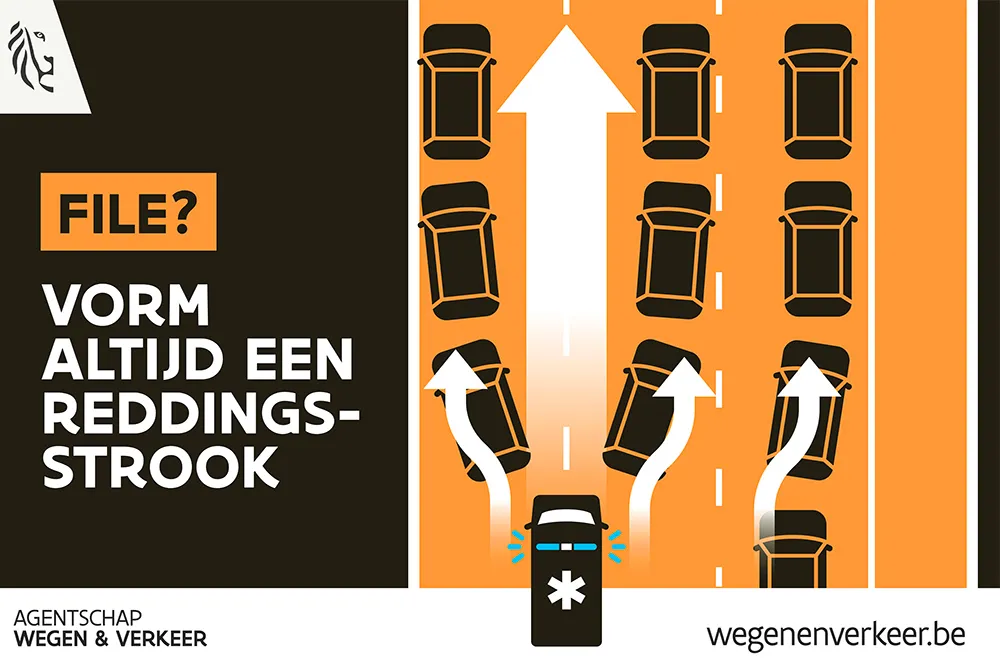
Agentschap Wegen en Verkeer (AWV) is launching another campaign to urge drivers always to leave a clear space between the left-hand lane and the other lanes when traffic is congested. Campaigns have proved effective, but the emergency corridor is still not a reality everywhere when traffic slows.
Since late 2020, drivers on Belgian roads have been required to form an emergency corridor in traffic queues on roads with more than one lane. As soon as traffic slows, drivers in the left-hand lane move as far left as possible. Everyone else moves as far right as possible without crossing the white lines, unless there is no alternative.
Emergency services and recovery vehicles use the clear space to reach the scene of an accident in one smooth manoeuvre. People in need of help can therefore be assisted much more quickly. Traffic disruption after an accident is also reduced, as recovery vehicles arrive sooner to clear the road. Drivers must keep the emergency corridor clear for as long as the queue lasts, including after the first emergency and recovery vehicles have passed through.
Awareness is growing, but behaviour is still lagging behind
This month, Flemish Minister for Mobility and Public Works Lydia Peeters and Agentschap Wegen en Verkeer (AWV) are launching another campaign about the emergency corridor. Campaigns work: two thirds (66%) of the people who saw the previous campaign now form an emergency corridor more often. Research also shows that awareness of the emergency corridor is increasing.
Minister Peeters is pleased that the sustained campaigns are paying off, but she also sees room for improvement: “4 in 5 of the Flemish people surveyed now say that they know the correct definition of the emergency corridor, and I believe this proportion will rise further after this campaign. Unfortunately, we see that a correct understanding does not always translate into correct behaviour on the road in traffic queues. Our new campaign will now focus even more on changing that behaviour.”
Seeing things from the road police’s perspective, from the air and in the queue
To further encourage people to leave a clear space in traffic queues, AWV and the Federal Road Police are sharing footage from the helicopter and from a police car. The footage shows how emergency vehicles have to search and manoeuvre to make their way through slow-moving traffic. Emergency responders, police officers and recovery services are also speaking out on social media about the importance of the emergency corridor.
The campaign is also appearing on more than 200 billboards along motorways and regional roads, while digital message signs are urging drivers to form an emergency corridor. “We are also very grateful for the mentions of the emergency corridor during traffic bulletins on the radio. Our evaluation shows that these mentions are very valuable in helping to raise awareness of the emergency corridor,” Minister Peeters adds.
Alongside blue lights, orange-yellow flashing lights can now also use the emergency corridor
As well as priority vehicles responding to an emergency, such as ambulances, fire engines and police vehicles, since last year vehicles called out by the public prosecutor’s office or the police to assist at an incident have also been allowed to use the emergency corridor. These include recovery vehicles and AWV service vehicles, for example. They must use their orange-yellow flashing lights.
Question about this story? Ask your question
Keep following this
Get an email when a new story is published. No account needed.
- ThemeFuture-proofing roads and railways
- SubjectGeneral







