Walking cues, desire lines and the child standard: Wegen en Verkeer updates guidelines on safe crossings
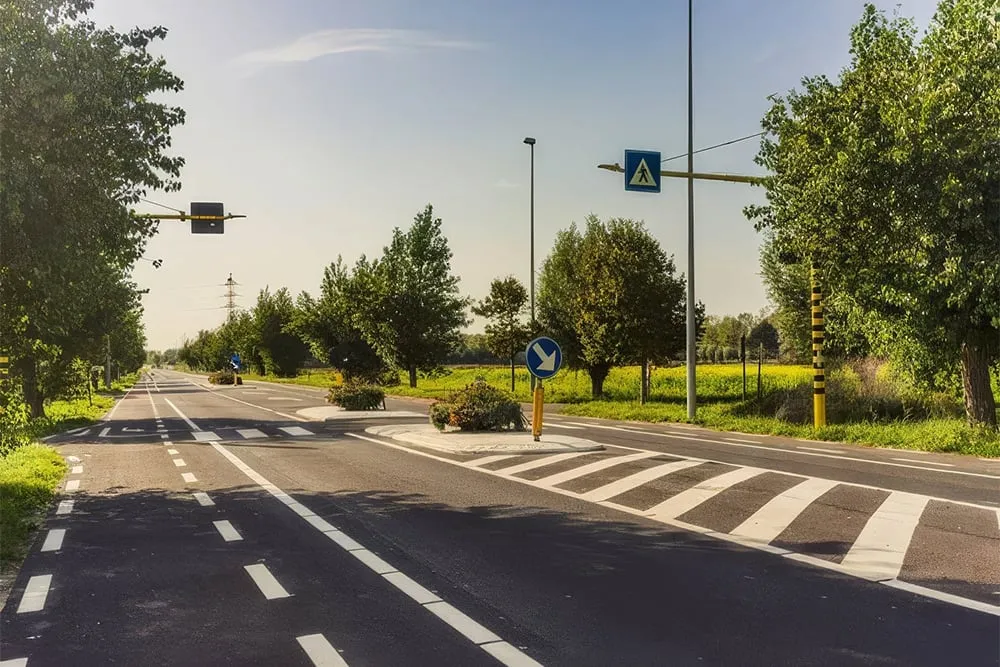
Agentschap Wegen en Verkeer (AWV) has published new guidelines on where different types of pedestrian crossing are needed. Road safety is the key requirement, but pedestrian comfort and designing for children are also becoming more important. One new rule is that conventional zebra crossings will no longer be installed on roads with a speed limit of 70 km/h or higher.
Agentschap Wegen en Verkeer (AWV) is working to provide safe pedestrian crossings across Flanders. During the previous legislative term, 275 crossings were fitted with additional lighting. Many of the more than 800 road safety quick wins have made crossings safer, for example by adding central refuges.
The type of crossing needed depends on the location. Conventional zebra crossings are not always the best option. A practical guide to design guidelines now sets out all the ways to cross safely. The guidelines take account of the need to cross and how easy it is to do so. In other words: where exactly do people want to cross, and what conditions are needed to make it safe?
Safe crossings require a tailored approach
“Installing zebra crossings without taking account of the surrounding area does not solve the problem. If conditions are unsafe, a zebra crossing can give pedestrians a false sense of security. Assessing where a crossing is needed and which type will ensure pedestrian safety is therefore a complex but very important task, which we are undertaking together with local authorities,” says the Flemish Minister for Public Works and Mobility. “These new guidelines now provide practical guidance for making the right decisions.”
The guidelines were drawn up following an intensive process involving various organisations and interest groups, including the Vlaamse Vereniging voor Steden en Gemeenten (VVSG), vzw Blindenzorg Licht en Liefde and Ouders van Verongelukte Kinderen-SAVE.
“If we want every child to be able to cross safely, safe crossings are vital,” says Roel De Cleen, traffic expert at Ouders van Verongelukte Kinderen-SAVE. “We are convinced these new guidelines will give the Flemish Government and local authorities an added impetus to focus more than ever on the safety of all vulnerable road users.”
Visibility, speed, number of lanes and road category as firm safety requirements
The guidelines describe various crossing facilities, from central refuges and carriageway narrowing to continuous pavements, (winged) zebra crossings, signal-controlled crossings and underpasses.
For each type of crossing facility, the guidelines set a maximum permitted traffic speed and requirements concerning the number of lanes, road type and visibility (how well pedestrians can see approaching vehicles, and vice versa). For example, zebra crossings will no longer be installed on roads with more than one lane in each direction or with a speed limit of 70 km/h or higher.
Designing from the pedestrian’s perspective
Alongside these firm safety requirements, AWV also considers how people want to cross. More than before, the focus is on the pedestrian’s perspective: what do pedestrians need to cross the road not only safely, but comfortably too?
“The principle of the ‘desire line’ is a good example: where do pedestrians actually need to cross? Pedestrians prefer not to take a detour, and the familiar ‘desire paths’ are a good example of this. Aligning crossings with these routes also makes pedestrians’ movements more predictable for drivers, which improves safety,” explains Kathy Vandenmeersschaut, Director-General of AWV. The new principle of ‘walking cues’ also takes its lead from pedestrian behaviour. Lowering kerbs encourages people (‘nudging’), without requiring them, to use particular crossings.
Other ‘softer’ criteria to consider when choosing a crossing location include nearby destinations such as schools and bus stops, traffic volumes and the needs of particular groups, such as children or people with impaired vision. The guidelines also set maximum waiting times: in built-up areas, pedestrians should not have to wait longer than 10 seconds to cross.
The child standard as a guiding principle
Children’s behaviour is also now central to the design guidelines. The assessment framework takes account of their abilities and limitations, with the aim of meeting the ‘child standard’. “A crossing must be easy for children to understand, so that they can use it independently, gradually, as they grow.
“Traffic infrastructure that is clear to children and young people benefits the road safety of all road users. ‘Can my child cross here independently and safely?’ is therefore the most important question when designing and assessing a crossing facility,” the minister explains.
Question about this story? Ask your question
Keep following this
Get an email when a new story is published. No account needed.
- ThemeFuture-proofing roads and railways
- SubjectRoad construction