Smooth traffic during Oosterweel works thanks to seven modular bridges
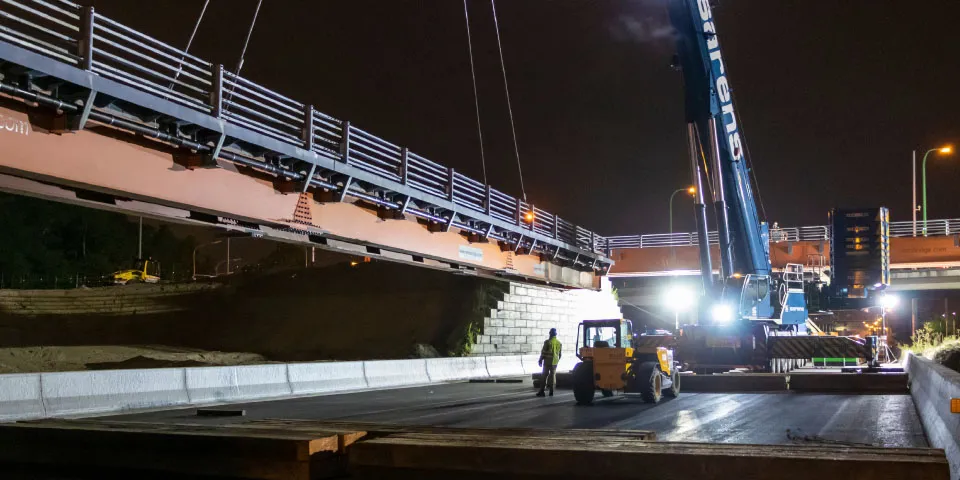
In July, Dutch company Retro Bridge installed five modular bridges for the THV Civiel Linkeroever (Mobilis, CIT Blaton, Artes Roegiers) to ease traffic disruption during the Oosterweel works on the Left Bank.
This brings the total to six, as a large pedestrian and cycle bridge was also installed over the E34 last year. “And in spring 2021, a very large Retro Heavy Bridge, TB03, is also scheduled to be installed,” says Han Kastermans, managing director of Retro Bridge.
Text | Niels Rouvrois Image | Retro Bridge
The modular bridges were installed within and alongside the interchange near Zwijndrecht, on the eastern side of Antwerp. The overall project involves the first of five sub-projects for the Oosterweel connection, which reconstructs and completes the Antwerp Ring Road. “The joint venture will renovate and modify the interchange on the Left Bank so that it can easily be connected to the new tunnel under Antwerp, which will complete the Oosterweel connection,” says Han Kastermans. “The junction includes several connecting roads to the E17 and E34, which will be reconstructed or realigned. Traffic flow must, of course, be maintained, which is why the temporary bridges are needed.”
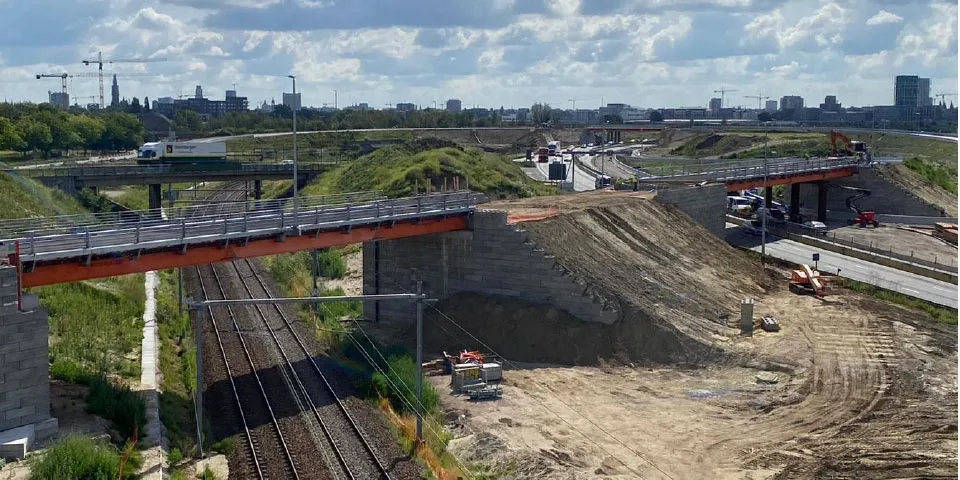
The modular bridges were installed within and alongside the interchange near Zwijndrecht, on the eastern side of Antwerp.
Five additional bridges
In 2019, Retro Bridge had already installed a pedestrian and cycle bridge over the E34, more than 300 m long. Han Kastermans: “Then, in July this year, six more temporary bridges were added at the junction in Zwijndrecht. Some cross the E17 as you exit the tunnel, while others are alongside it as flyovers. The six bridges installed range in size from a Retro Beam Bridge (RBB) measuring 10.5 m by 28.8 m, and a Retro Light Bridge (RLB) measuring 31.5 m by 7.5 m, to three Retro Heavy Bridges (RHB), measuring 37.5 m by 7.5 m; 40.5 m + 13.5 m by 7.5 m; and 40.5 m by 7.5 m. The RBB is ideal for short spans of up to 19 m, with no option to connect spans. The RLB is the ideal solution for spans of up to 31.5 m. The Retro Light Bridge can be connected to other spans, as can the RHB, which can accommodate a clear span of up to 48 m. Both can carry the same heavy loads. We will certainly be installing another large RHB in April 2022, called TB03.”
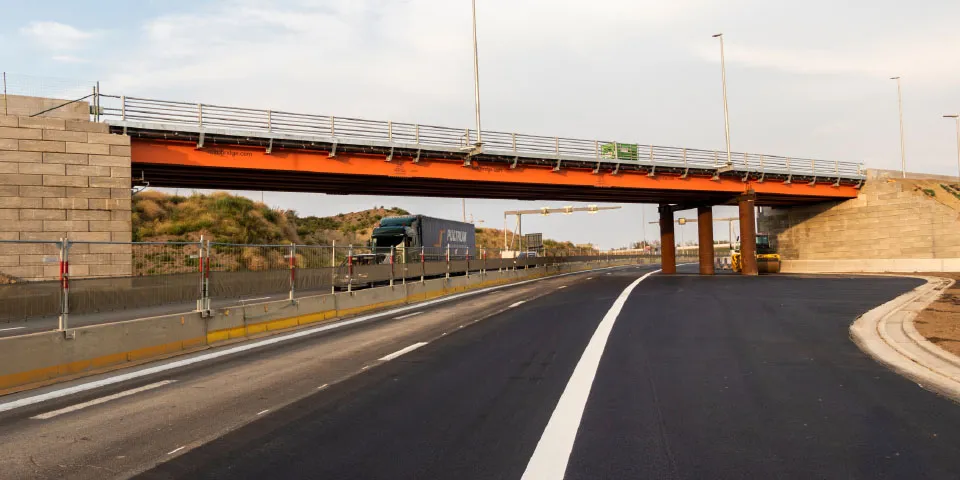
In June and July, Dutch company Retro Bridge installed five modular bridges to ease traffic disruption during the Oosterweel works on the Left Bank.
Reuse
The modular bridge systems will remain in operation until 2023, with some staying in place until 2025. “After that, we will dismantle them and move them to another project. Our modular bridges are in place for between 60 and 265 weeks. That is the maximum rental period. For the RLB and RHB, we have two standard system sizes: 10.5 m and 13.5 m long, and 2.5 m or 3 m wide. Multiple units can be placed side by side to provide the required clear width. We generally prepare the individual spans to the required length at our yard, then transport them to the site by lorry. A crane lifts each span into place on its two supports. Retro Bridge has established itself as a leading player in installing temporary bridges on and over motorways. We meet all the demanding requirements of the Eurocode, including in Antwerp, where particularly heavy LM3 loads were specified. This project is certainly one of the larger jobs we carry out. We are talking about 2,000 tonnes of temporary bridges, which is substantial.”
New type of safety barrier
Retro Bridge had to manufacture mainly new components for the seven bridges. “The main challenge was coordinating the return schedule for existing components with the production of new ones. For these bridges, three quarters of all the components are entirely new. But we knew in advance that we could handle it, and that proved to be the case. The client also stipulated that the safety barriers on the temporary bridges had to be developed to meet the H2W2 containment level. We did not have this type of barrier, so we developed one ourselves for temporary bridges on motorways. Several experts were involved in the design, including Technisch Buro De Heer from Vlaardingen, the Liège-based GDTech and DAV NORDIC A/S from Denmark. Since we had to develop a completely new safety barrier anyway, we also incorporated a drainage system, a unique design. That is one of Retro Bridge’s strengths. We deliver what is requested, contribute our ideas and can offer something extra,” concludes Han Kastermans.
Question about this story? Ask your question
Keep following this
Get an email when a new story is published. No account needed.
- ThemeExtending the life of bridges and tunnels
- SubjectRoad construction