N8 redesign study gathers pace
Text Sweco / Niels RouvroisImage Sweco
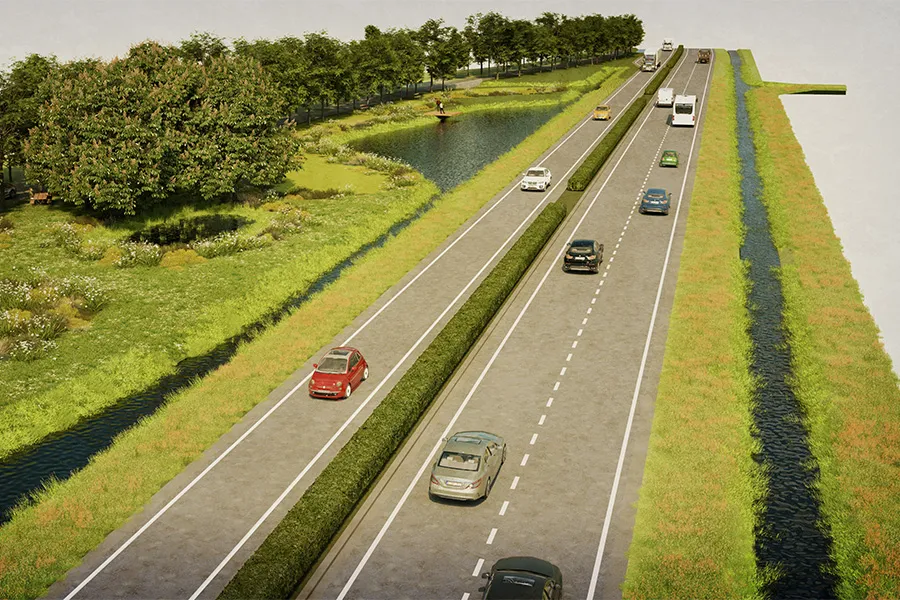
Engineering consultancy Sweco is hard at work on the study for the comprehensive redesign of the N8 in the municipalities of Alveringem, Lo-Reninge and Vleteren. Over an 11 km stretch from the Veurne/Alveringem boundary to the centre of Oostvleteren, the regional road will be made safer and more practical. Klaas Wittebolle: “Our commission covers the full study for the redesign of this road, from preliminary design through to completion of the works, covering roads, drainage and structures. The clients are AWV West-Vlaanderen, Vleteren and Alveringem.”
The project has a turbulent history, with more than 50 years of disagreement over what needed to be done. Klaas Wittebolle: “By engaging in dialogue with all the key stakeholders from the outset of our study and systematically looking for solutions that benefit all parties, we reached consensus on the preliminary design for the entire route within a single calendar year. We are now finalising the design phase, after which the land acquisition files will be prepared and an environmental permit application submitted for the first part of the project. Meanwhile, preparations are also under way for the construction phase, including coordination with utility companies.”
Road safety and traffic flow
The road has long suffered from poor traffic flow, and very serious, sometimes fatal, accidents occur regularly. The high volume of slow-moving agricultural traffic and the many side roads and accesses are major contributing factors. Klaas Wittebolle: “That is why the road is to be upgraded to a 2+1 layout, with an alternating overtaking lane. Parallel roads will also be provided to avoid direct accesses onto the main road. Every 2 km, there will be a signal-controlled junction where the parallel roads connect to the main road.”
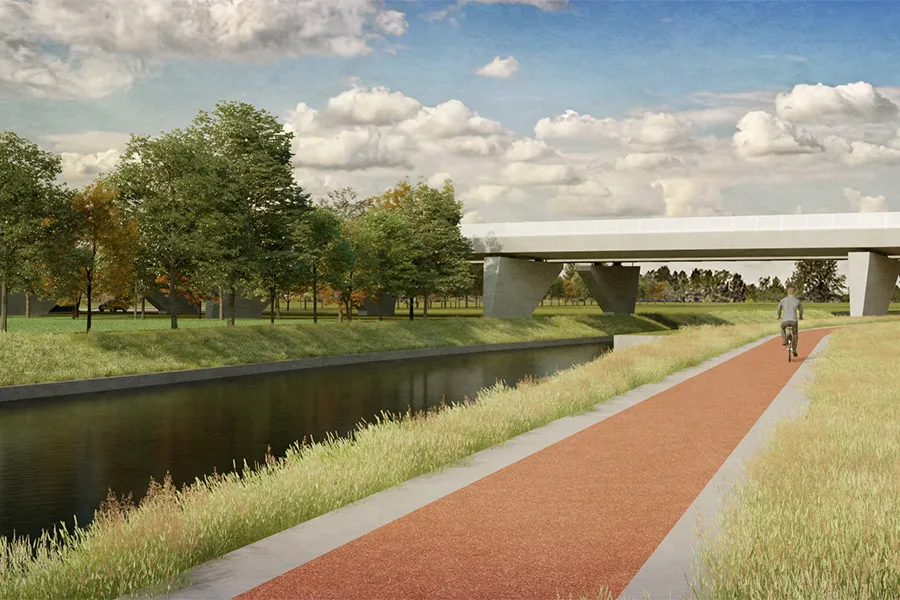
A cycle highway will be built along the entire route as part of the F38 Ieper-Veurne. Particular attention is being paid to safe crossing points, good connections to the surrounding cycle network, cycling comfort and creating an enjoyable journey, with plenty of greenery and water along the route. Klaas Wittebolle: “This project will significantly improve facilities for pedestrians, cyclists and bus services, encouraging sustainable travel. Many other features also contribute to the project’s sustainability, including more space for water and nature, low-maintenance materials and minimal earthworks.”
Blue and green
In recent years, the project area has been severely affected by both flooding and prolonged drought. Gert Logier: “The future drainage system for the N8 addresses these challenges through maximum infiltration in unsealed central reservations and verges, many kilometres of swales, increased water storage capacity in the IJzervallei, retention basins along the intersecting watercourses, and a water abstraction basin for farmers.”
The design provides for the replanting of the characteristic rows of trees along the Ieper-Veurne road, most of which have disappeared over the past century, with a mix of climate-resilient species. Native greenery will also be planted around the retention basins, and nature in the IJzervallei will be restored. The future N8 will thus be flanked by a continuous green corridor and valuable stepping stones for wildlife.
Three new bridges and greener village gateways
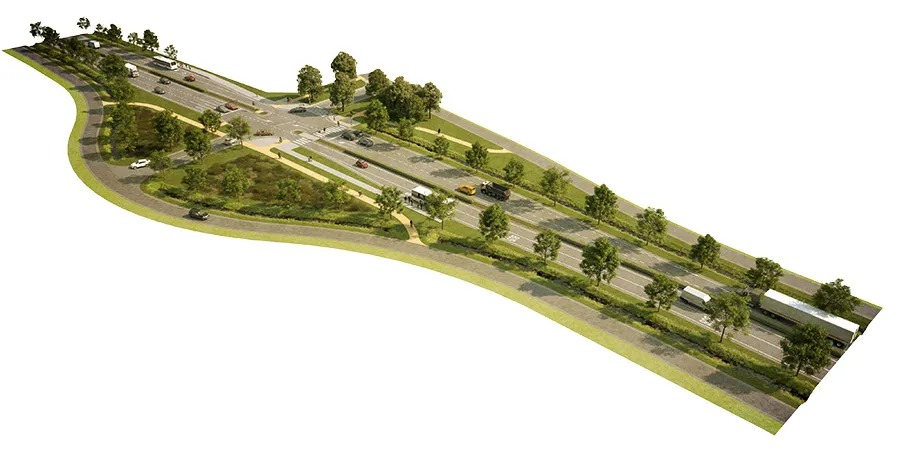
To keep traffic moving in both directions throughout construction, the existing bridge will be replaced by 2 new road bridges. A cycle bridge will also be built. Klaas Wittebolle: “The three bridges over the IJzer will have a restrained, monumental design that restores the open landscape of the IJzervallei. The road bridges, each with two lanes, will be built from post-tensioned in-situ concrete. The cycle bridge will consist of steel crossbeams and a composite deck, and will be anchored as a cantilever to the western road bridge. Within the project area, the N8 passes through the village centres of Hoogstade and Oostvleteren. The public realm in these village centres will also be upgraded as part of the redesign of these stretches.”
Securing permits
Permit applications are becoming increasingly complex. Sweco Belgium has therefore set up a team of around 10 specialists, including an environmental expert, an urban planner and a lawyer. Gert Logier: “These colleagues have a thorough knowledge of the regulations governing permit applications and how they are applied in practice. The team advises us on every aspect of the permitting process, maximising the chances of success.”
Close to clients and multidisciplinary
“Projects of this kind, involving many different disciplines and stakeholders, are right up our street. We have all the disciplines in-house: surveyors, BIM designers, landscape architects, civil engineers, EIA specialists, hydraulic engineers, site supervisors, sustainability coaches, communications specialists … This means we can work very efficiently and quickly. With offices in every region, we are also close to our clients and stakeholders, and projects are handled by people who know the area well. For complex challenges, we can also draw on expertise from across our international Sweco Group. On sustainability, this enables an ongoing exchange of best practices and innovative techniques. We are highly committed to delivering future-proof projects that clients, users and local residents can all be happy with,” concludes Klaas Wittebolle. ■
Question about this story? Ask your question
Keep following this
Get an email when a new story is published. No account needed.
- ThemeFuture-proofing roads and railways
- SubjectRoad construction