Emergency services seek 7.9 million ‘rescue lane assistants’ in new Wegen en Verkeer campaign
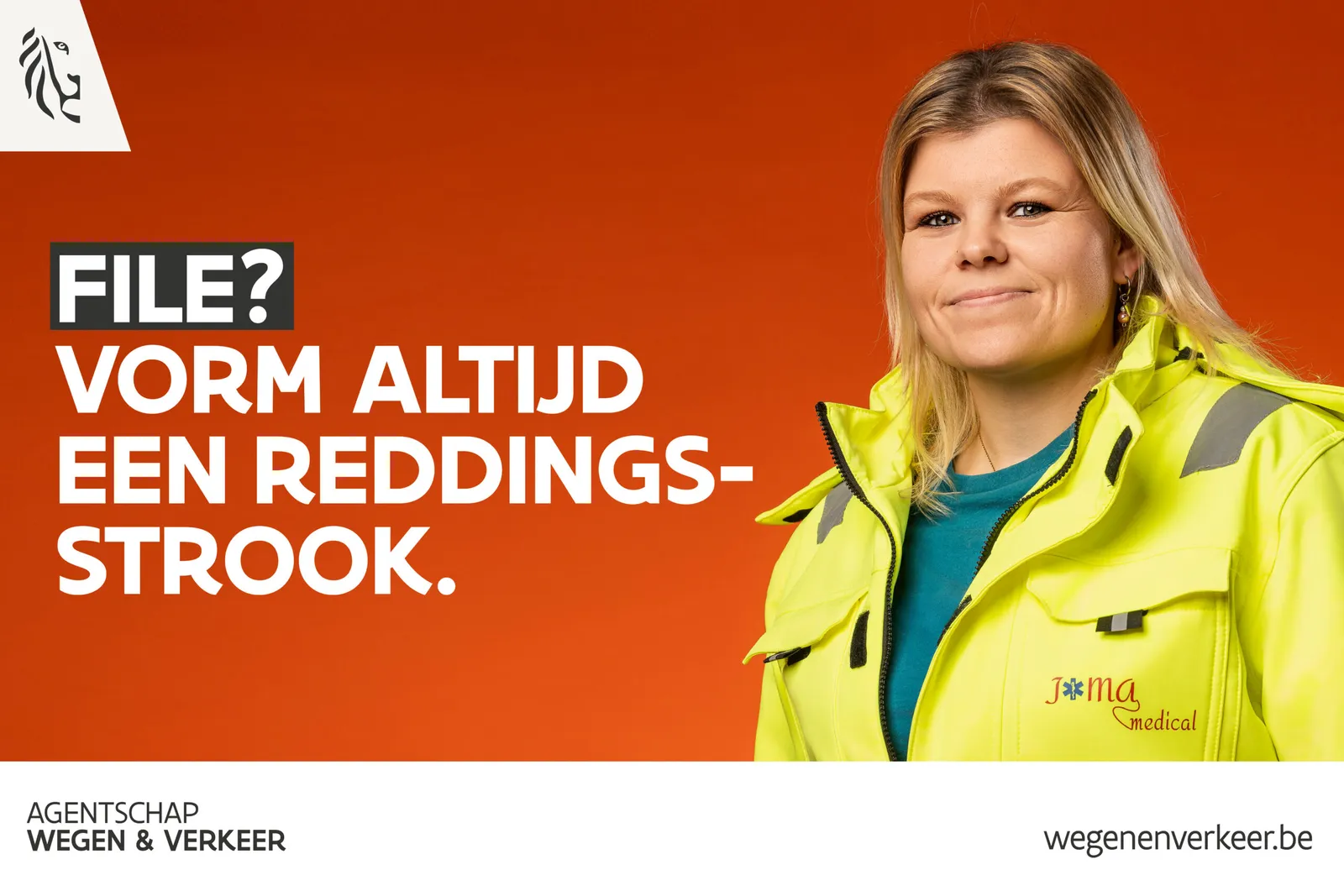
Agentschap Wegen en Verkeer (AWV), together with the fire service, police, recovery operators and ambulance crews, is calling on drivers to always form an emergency corridor in traffic jams. Too few people know about this clear lane or form it as soon as traffic slows.
Still not an automatic response in traffic jams
More than 5 years after it was introduced into the Belgian Highway Code, only just over half of people in Flanders (53%) know how and when to form an emergency corridor. Flanders nevertheless scores better than the other regions. This emerged from a recent Vias study.
“Our evaluations show that our campaigns have had a clearly positive effect on awareness of the emergency corridor, but drivers are still confused about when to form one. Too few people create the clear lane as soon as traffic slows, and only do so when emergency services arrive,” explains Flemish Minister for Public Works and Mobility Annick De Ridder. “So don’t wait until you see the flashing lights: form an emergency corridor whenever there’s a traffic jam,” she stresses. “In built-up areas too.”
In the Highway Code since 2020
Since 2020, drivers have been required to form an emergency corridor as soon as traffic slows on roads with two or more lanes. Vehicles in the left-hand lane must move as far to the left as possible, while the others must move as far to the right as possible.
This creates a clear lane that emergency and recovery vehicles, with either orange or blue flashing lights, can use to reach the incident in one smooth manoeuvre. Motorcyclists may also use the emergency corridor.
Wanted: emergency corridor assistants, no application required
For the seventh year running, AWV is campaigning for the emergency corridor with roadside posters, a social media campaign and digital message signs. The emergency corridor has also featured in VRT traffic bulletins for several years. Impact assessments show that this has greatly increased awareness of the emergency corridor.
New to the campaign are emergency service workers, the federal road police and recovery operators, who make it clear in an attention-grabbing appeal that anyone can become an ‘emergency corridor assistant’. There’s no need to apply for the role. The only requirements are a category B driving licence and the ability to recognise a traffic jam. In Belgium, no fewer than 7.9 million people meet these requirements. AWV has also published the job advert on its channels.
Question about this story? Ask your question
Keep following this
Get an email when a new story is published. No account needed.
- ThemeFuture-proofing roads and railways
- SubjectRoad construction