Billions saved through sustainable composite bridge repairs
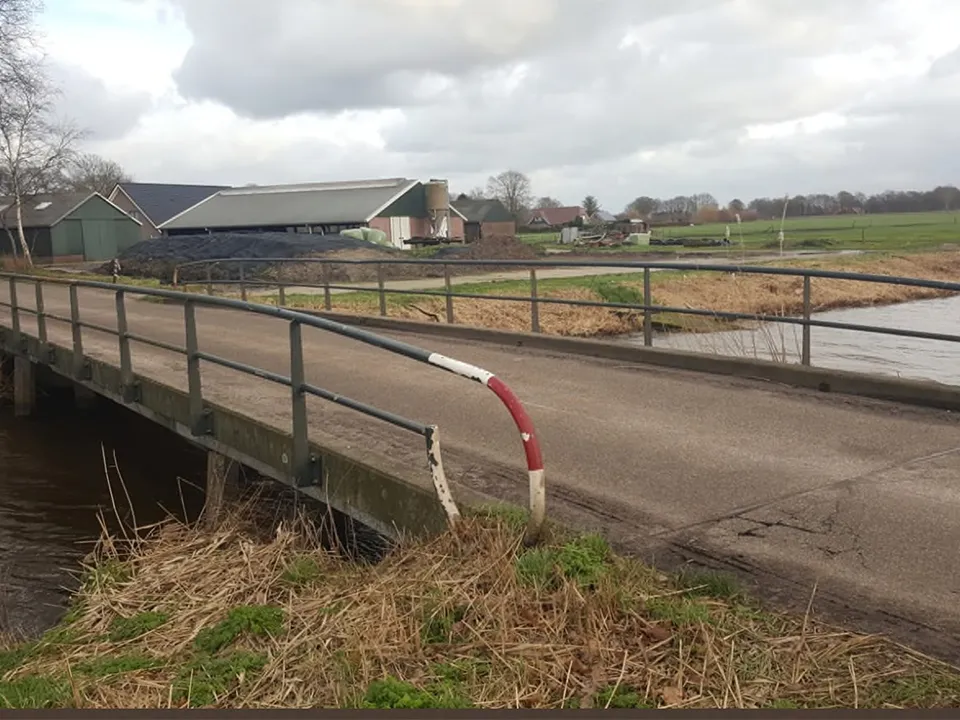
Damage caused by concrete cancer, increased loading or the ingress of de-icing salts. These are just some of the causes of bridge damage.
Bridges across the country are in urgent need of repair, and SUREbridge, Sustainable Refurbishment of Existing Bridges, offers a sustainable composite-based alternative. “Research has shown that a composite deck is 2.4 times stronger than the original concrete,” says Jan Swyngedouw, business unit manager at CGK Group.
CGK Group, originally specialising in the manufacture and supply of chemical storage materials, has established itself as a plastics specialist over the years, serving sectors ranging from industry and construction to infrastructure and maritime. A key pillar of CGK Group’s business is glass-fibre-reinforced polymer (GFRP) bridges. GFRP is increasingly being chosen for pedestrian and cycle bridges in public spaces instead of more traditional concrete or steel. But composites are not only an excellent material for new bridges, they are also highly suitable for repairs. Rather than demolishing bridges and building new ones, SUREbridge offers a sustainable solution.

Infravation
A partnership between ten European countries, the United States and the European Commission is promoting innovations to improve infrastructure under the name Infravation (Infrastructure Innovation Programme). Launched in 2016, SUREbridge is one of Infravation’s key initiatives. Rijkswaterstaat, Chalmers University of Technology (Malmö, Sweden), AICE Consulting S.R.L. and the University of Pisa worked closely together on the project. Using InfraCore® Inside technology from Rotterdam-based company FiberCore Europe, the capacity and functionality of existing concrete bridges can be increased. Their service life is significantly extended, with little or no maintenance required in the years ahead.
InfraCore® Inside
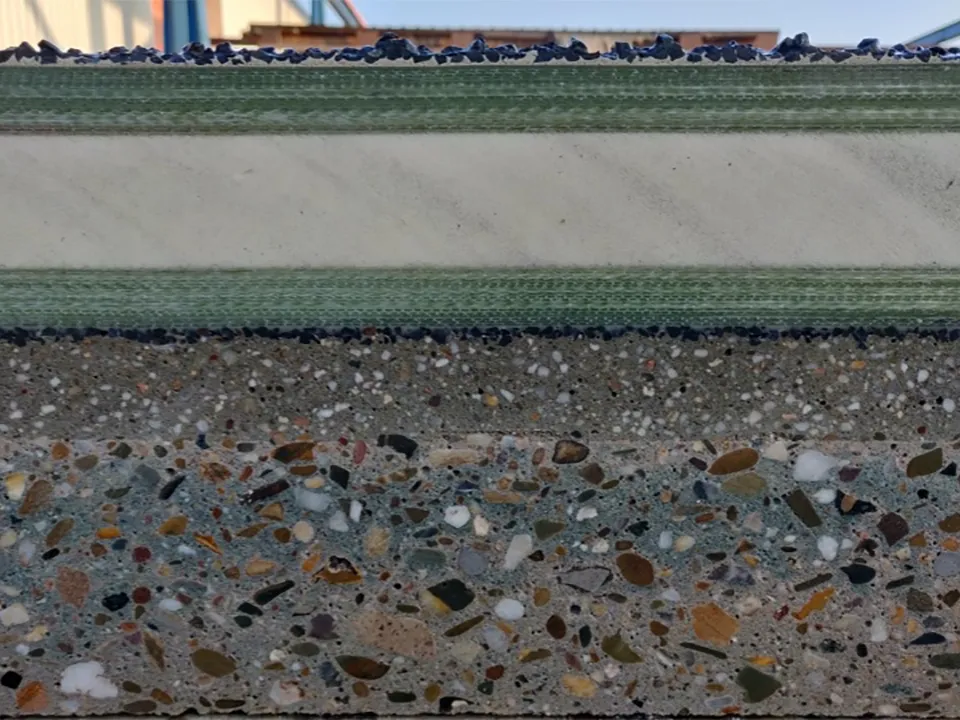
“InfraCore® Inside,” explains Jan Swyngedouw, “is a patented technology based on the principle of a continuous structural connection of glass or carbon fibres between the top and bottom faces of the structure, preventing delamination. It is therefore not a sandwich construction. In recent years, extensive research has been carried out as part of SUREbridge into the potential of composites for bridge repairs. The technology is also suitable not only for repairs, but for extending bridges, for example by adding a cycle or footpath.”
Rather than demolishing the bridge, its underside is reinforced with carbon fibre if necessary. A composite deck made using InfraCore® Inside technology is bonded to the top with epoxy mortar. Jan Swyngedouw says: “Tests showed that under heavy loading, the carbon fibre breaks first, followed by the concrete structure, and the composite deck breaks last. This only happens at a load 2.4 times the maximum load of the original concrete.”
Catching up
The excellent laboratory results led to a pilot project in the Netherlands, where the technology was applied not to a bridge but to a concrete slab. Here too, tests proved that the composite deck easily withstands the concrete breaking under heavy loading. The deck is more than twice as strong as the bridge’s original strength. “It is no surprise that the Netherlands is already further ahead in this area than Belgium,” says Jan Swyngedouw. “Belgium has a lot of catching up to do with its northern neighbours when it comes to new composite bridges. There are already 1,000 composite bridges in the Netherlands, for example, compared with just 20 in Belgium. The Netherlands is also leading the way in repairs. The municipality of Hardenberg will renovate the bridge on Toeslagweg in Loozen rather than replace it, using the unique SUREbridge method to add a composite layer to the bridge.”
SUREbridge has developed a tool that can be used for a fee to prepare design calculations and assess the value of a composite repair. The design tool is already available. Interest in the approach is also growing in Belgium. A C-Bridge working group is currently active in Belgium, in collaboration with Ghent University, WTCB and stakeholders interested in composite bridges, not composite repairs. “CGK is of course a member, alongside provincial authorities, Expertise Beton & Staal, construction firms, engineering consultancies and several major steel fabricators. The aim is to help engineering consultancies and engineers learn to prepare their own design calculations for composite bridges,” concludes Jan Swyngedouw.
Question about this story? Ask your question
Keep following this
Get an email when a new story is published. No account needed.
- ThemeExtending the life of bridges and tunnels
- SubjectRoad construction