Albert Canal | New bridges
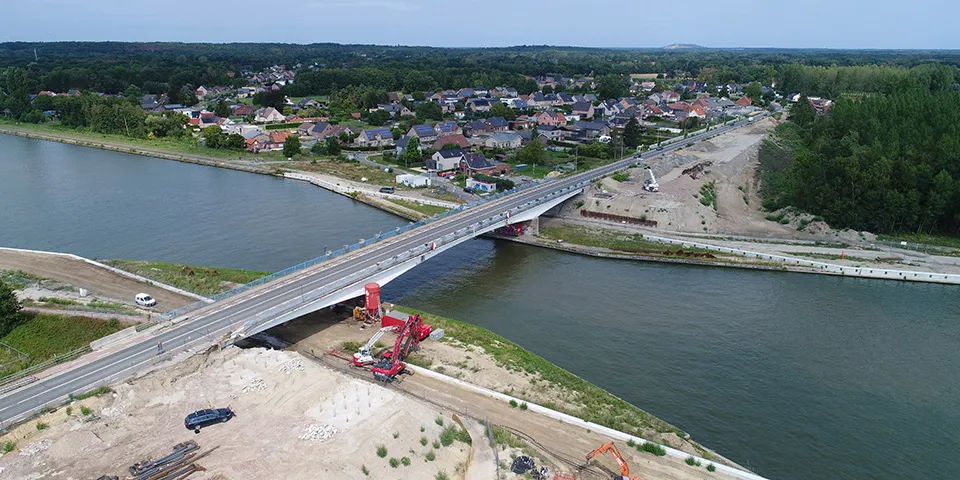
Albert Canal bridge-raising sub-project on schedule
The Albert Canal Bridge Raising PPP project, cluster 1, is progressing well and remains on schedule. Just over a year ago, the temporary partnership Via T Albert, made up of Franki Construct, Kumpen, Aswebo (all Willemen Infra), Hye and Aelterman, began work on the contract to raise seven bridges between Herentals and Eigenbilzen. The contract is part of a larger project whose ultimate aim is to raise a total of around 60 bridges over the Albert Canal. This will increase the capacity of Flanders’ most important waterway, which carries almost 40 million tonnes of goods a year, by 25 %.
The project forms part of the Tallinn Declaration, signed on 17 October 2013 by the European Commission, France, the Netherlands, and the Flemish and Walloon Regions. The partners undertook to take all appropriate measures to further develop inland navigation along the North Sea-Mediterranean Corridor by 2030. The Declaration lists specific projects, including the raising of 63 bridges over the Albert Canal. More specifically, the navigational clearance along the entire length of the canal is to be increased to 9.1 metres. Flemish Minister for Mobility Ben Weyts aims to curb road freight traffic and prepare for the anticipated growth in goods traffic, partly as a result of the further development of the terminals on Antwerp’s Left Bank. “Transporting even more freight by road is not an option, so we are investing heavily in alternatives such as our waterways. By raising the bridges over the Albert Canal, we are offering businesses an attractive alternative to road haulage,” he explains. It is an attractive option because the raised bridges will allow vessels to carry more containers, increasing the waterway’s capacity by 25 %.
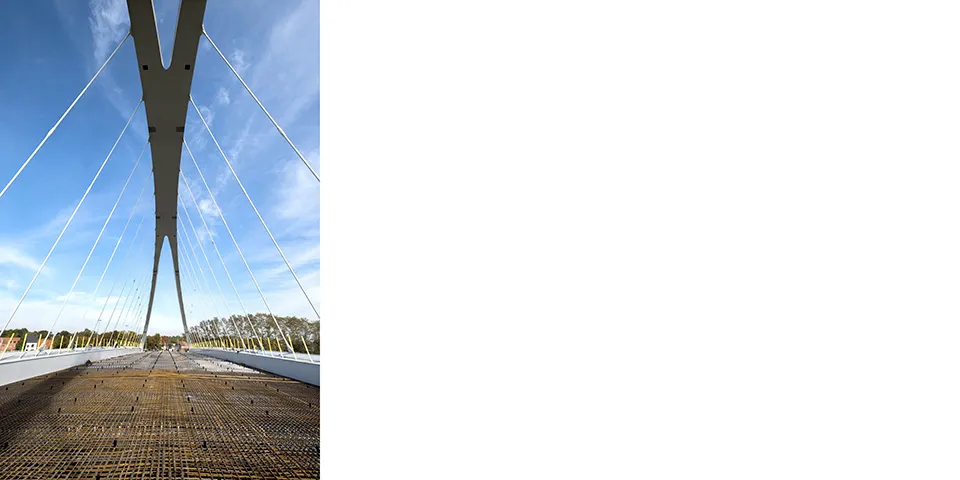
The new bridge at Herentals-Lier.
May 2020
A year ago, De Vlaamse Waterweg and Via T Albert, the temporary partnership set up specifically for this project and made up of Franki Construct, Kumpen, Aswebo (all Willemen Infra), Hye and Aelterman, signed a contract for the Albert Canal Bridge Raising PPP project, cluster 1. This first cluster covers the bridges at Eigenbilzen, Zutendaal, Stokrooie, Kwaadmechelen Zwartenhoek, Eindhout, Geel-Stelen and Herentals-Lier. It is a DBFM contract, so the partnership is responsible not only for construction, but also for design, financing and maintenance over a 30-year period. Construction began just under a year ago and is due to be completed in May 2020. Greisch, BM Engineering, Infrabo, TML and Omgeving are carrying out the principal studies for the contractor as subcontractors, covering steel construction, civil engineering, drainage and roads, minimising disruption and integrated design quality respectively. BM Engineering, for example, is responsible for the studies and design. The concrete quay walls are being renewed at every bridge site to remove constrictions in the Albert Canal, over a total length of 3 kilometres. For each bridge, BM is also preparing the construction designs for the abutments, including embankments and retaining structures for the approach ramps, and for the piers.
The seven new bridges will be steel arch bridges of the same design. Flanders is also investing in combined pumping and hydropower installations at the six lock complexes on the Albert Canal, and the canal is also being widened and deepened in some places.
Many stakeholders
Sven Somers of Franki Construct, project director, on the site: “Planning and constant consultation with stakeholders are crucial to this project if disruption is to be kept to a minimum. Unlike work on, for example, a motorway, this affects every type of traffic: shipping, cars, cyclists, pedestrians and trains. Various cables and pipelines also had to be relocated in consultation with the utility companies. Given the tight schedule for renewing all the bridges on time, it is a difficult balancing act.”
“That is why, wherever possible, we assemble the entire bridge on a site next to the one being replaced, then install it in a single operation, which naturally causes the least disruption,” adds Katleen Renier (Hye). She is head of work preparation and delivery for the project cluster. “However, this approach is not possible everywhere, because there is not always a suitable assembly area, or high-voltage cables make it too dangerous to install the entire bridge in one piece. Another challenge is simply the fact that you are working above and alongside a canal.”
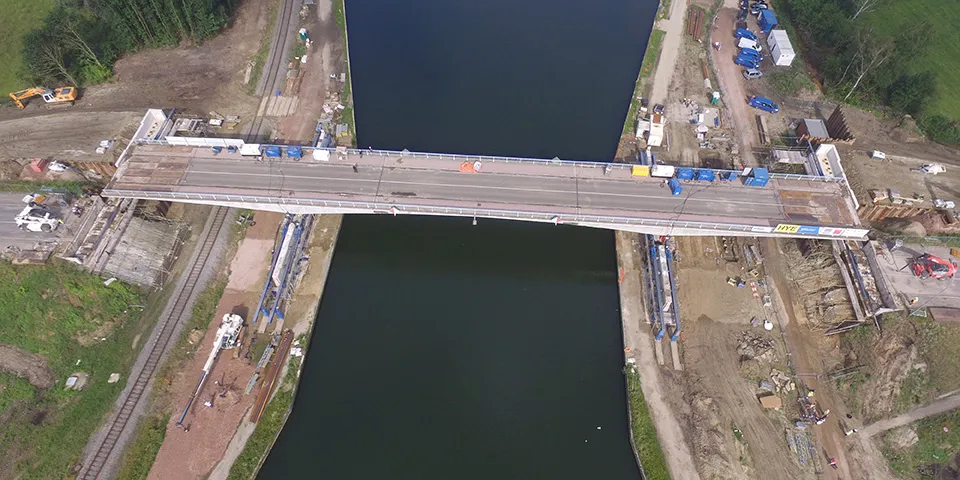
The old bridge at Geel-Stelen was temporarily moved so that work could be carried out on the new bridge in its original position without disrupting traffic.
Inspection gantry
“Because this is a DBFM contract, our work does not end when construction is complete,” says Sven Somers. “We are also responsible for maintenance over a 30-year period. We have already provided a special maintenance gantry, which we will use to inspect and repaint the undersides of the bridges at regular intervals. Our aim is to take as much of the burden as possible off De Vlaamse Waterweg.”
“And we will do so with full commitment, because our cooperation with De Vlaamse Waterweg is going extremely smoothly, and we have every confidence that it will continue that way,” concludes Katleen Renier.
Question about this story? Ask your question
Keep following this
Get an email when a new story is published. No account needed.
- ThemeExtending the life of bridges and tunnels
- SubjectRoad construction