A visit to the test site for road marking products
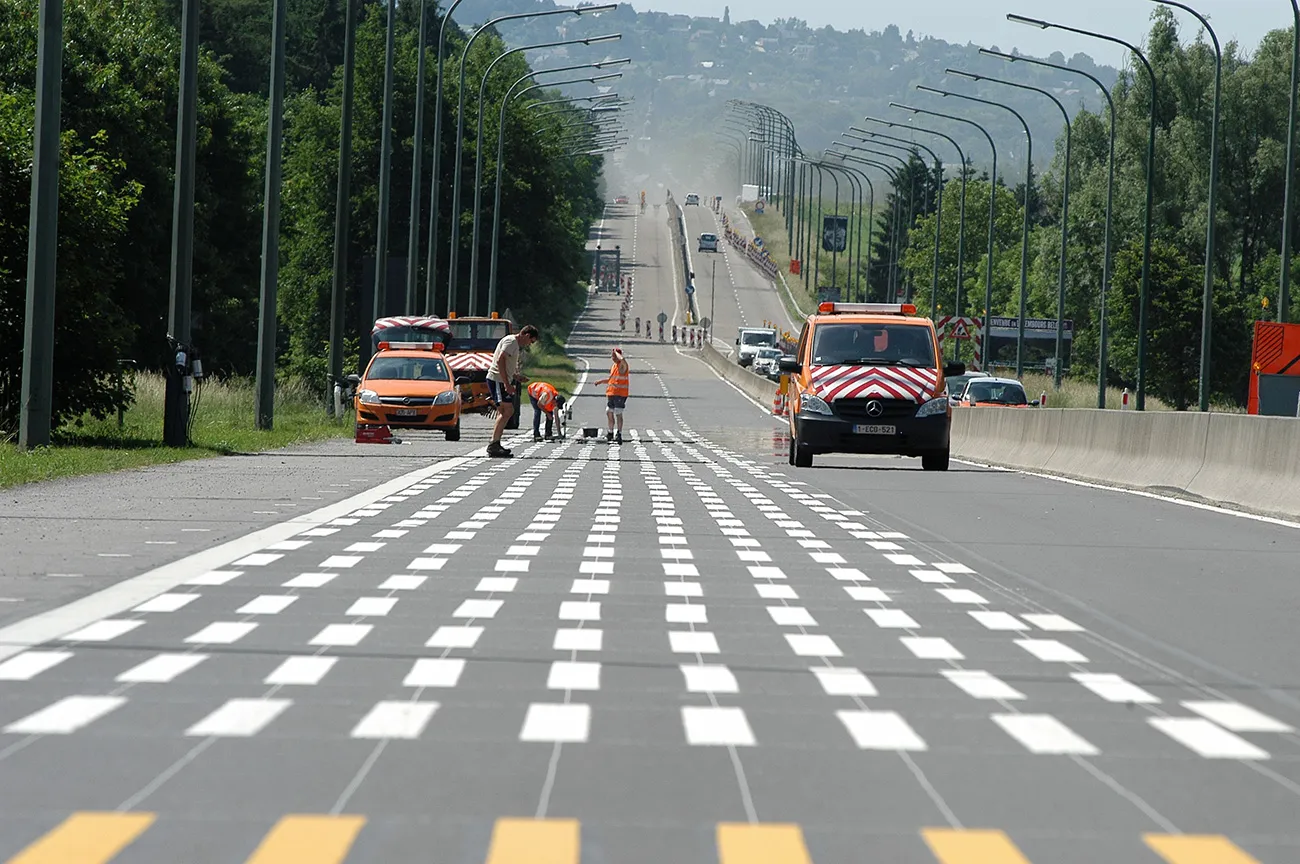
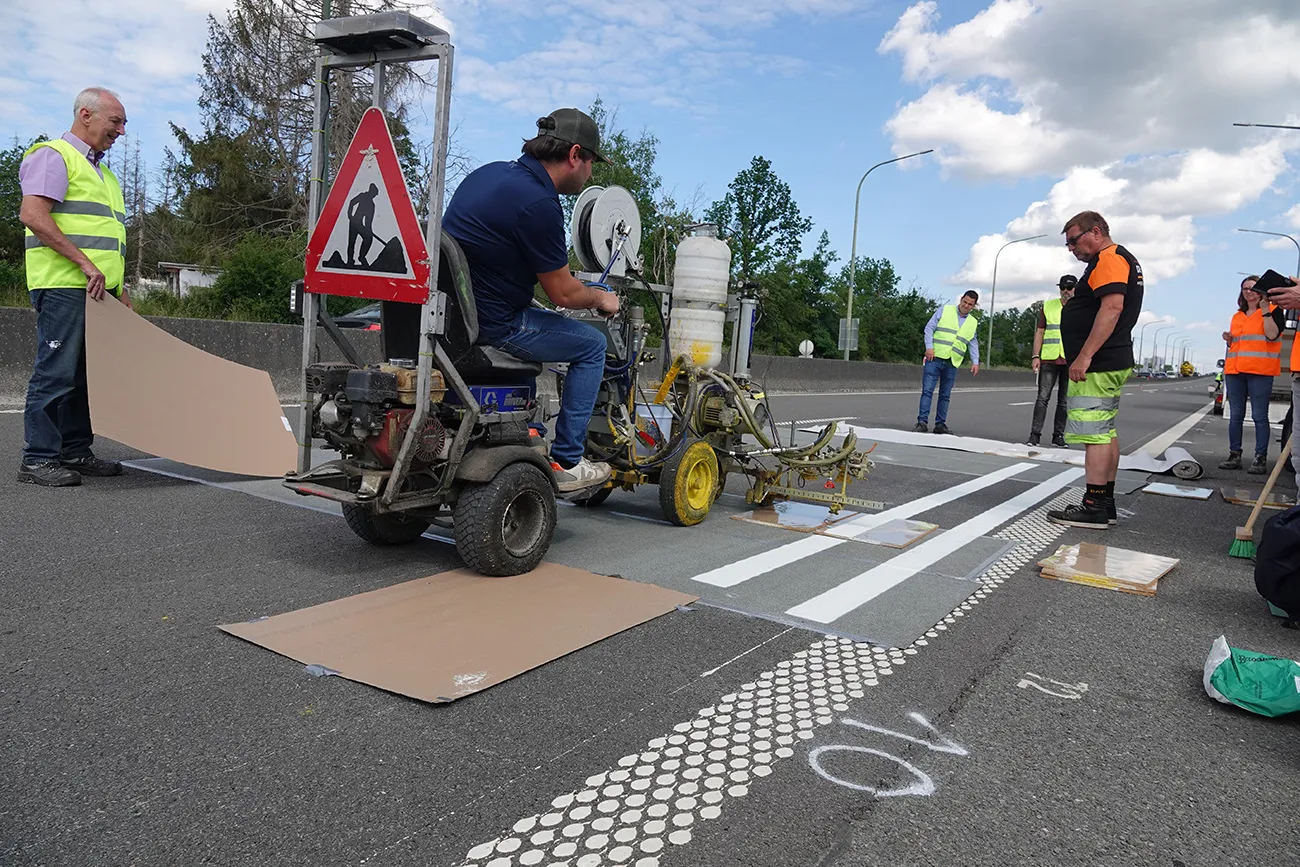
On 31 May 2022, a special temporary worksite was set up on a short stretch of the N63 between Marche-en-Famenne and Liège, near Baillonville. Road marking systems have been tested there since 2007, with a view to their approval in Belgium’s three regions. Working with SPW, COPRO assessed 22 systems from five different manufacturers over two consecutive days. This precision work essentially served as an entry exam for BENOR certification of these products.
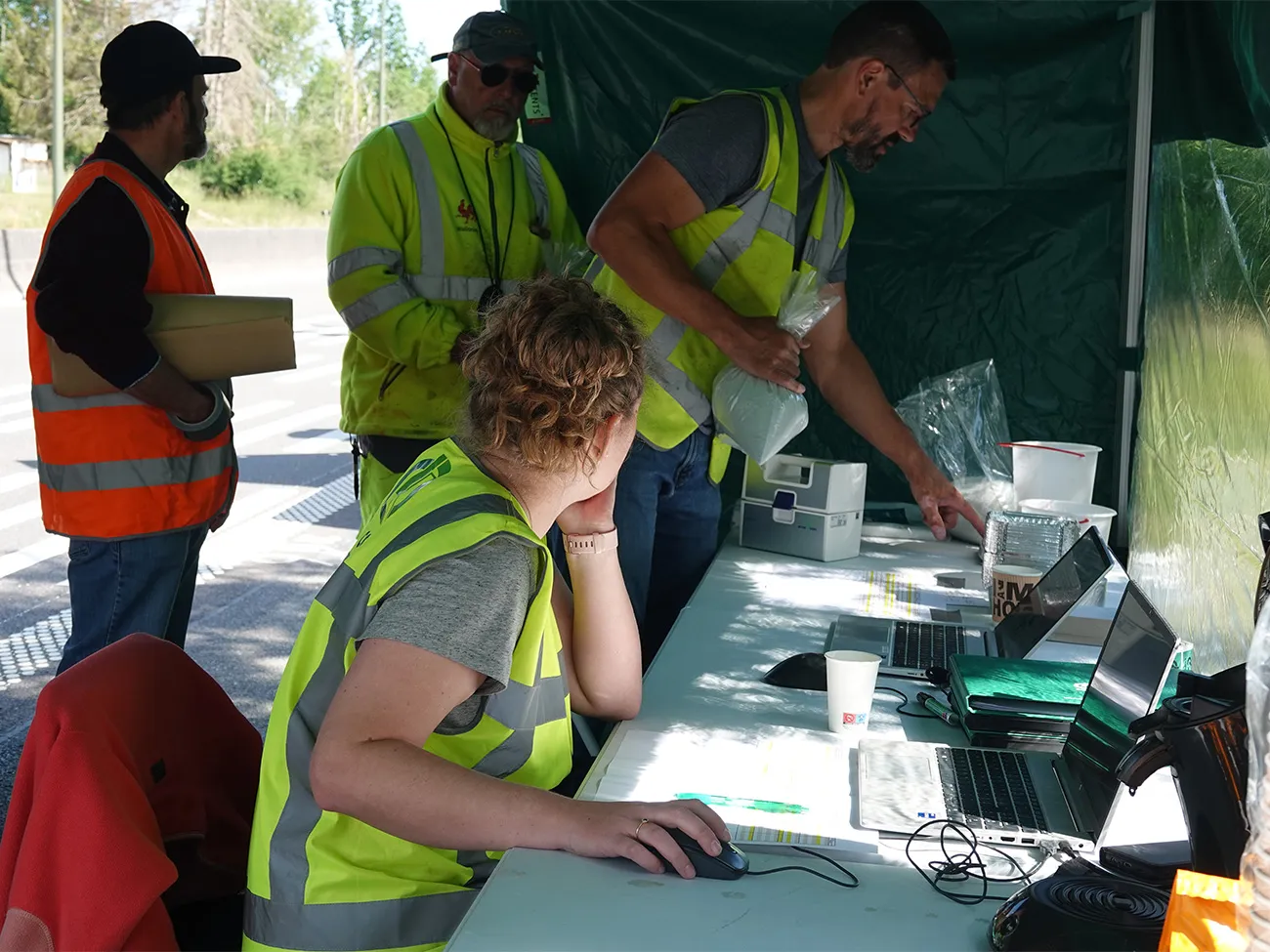
It was a somewhat surreal sight: over several hundred metres, the carriageway was ‘decorated’ with nine parallel white lines, each 15 cm wide and 2.5 metres long, showing varying degrees of wear. The markings also differed slightly in texture, and in colour: some of the lines were yellow. Nearby stood a canopy where COPRO staff were busy with scales and a computer, alongside a number of vans and strange construction machines, with drivers and accompanying personnel.
The host of the event was Gauthier Michaux, an engineer at SPW Mobilité & Infrastructure and coordinator of the Baillonville project. He was on site with eight SPW colleagues to support COPRO in organising the two-day event. He, in turn, was assisted by Erik De Bisschop, road equipment adviser at the Flemish government’s Agentschap Wegen en Verkeer. As Gauthier Michaux points out: “The three regions of our country have agreed that the tests carried out in Baillonville should lead to approval at national level.”
A strict testing procedure
However, this national harmonisation does not (yet) extend to European level. For example, a marking system approved in Belgium is not automatically approved in France, and vice versa, because testing methods vary from country to country. This is why Baillonville is hosting products from manufacturers of various nationalities, only one of which is Belgian. Each hopes to have its products approved for use on public roads in Belgium.
The standard specifies that the tests must be carried out on asphalt. The four performance criteria measured are daytime visibility (or visibility on lit roads), night-time visibility (reflectivity under headlight illumination), skid resistance and colour (white must fall within the European standardised spectrum). After an initial measurement by COPRO, around ten days after the road marking has been applied, further measurements are taken after approximately 1 million and then 2 million vehicle wheel passes. A counting system is integrated into the road surface at the start of the worksite. Around 1 million wheels pass over this section of the N63 each year.
The yellow markings are assessed after just 100,000 passes, as they are intended for roadworks, which are temporary by nature.
The long road to certification
The field tests in Baillonville are just the first step in the extensive certification process, which is managed by COPRO. Koen Van Daele, Certification Manager at COPRO: “The requirements that markings must meet are set out in the specifications of the three regions. In addition, the technical prescriptions (PTVs) describe the expected performance of the different types of marking: road paints, thermoplastics, cold plastics and preformed markings. The periodic measurements in Baillonville enable COPRO to check whether a marking system meets the requirements of the specifications and the PTVs. If a manufacturer’s system fails these tests, the procedure ends there. If, on the other hand, the product is approved, the manufacturer can decide whether or not to continue with the certification procedure. If the answer is yes, COPRO has the samples from Baillonville analysed by an approved laboratory. COPRO then compares the results with the requirements in the PTV. If the marking system meets these requirements, it can be certified and a technical approval document is drawn up. Finally, the manufacturer completes a technical data sheet on the COPRO Extranet, including the recommended application rate, which is validated by COPRO. Only then, after a period of around two years, is the certification procedure fully completed.”
From that point on, the product can be manufactured, supplied and applied on public roads. It is up to the regions to check that the contractor in question complies with the various parameters set out in the technical data sheet. The good news is that certification remains valid until the manufacturer withdraws the product from the market or replaces it with a new version. COPRO also carries out two inspections each year at the production facility where the product is manufactured. The aim is to ensure that the product being manufactured is identical to the certified product.
Joris Spruyt, technical director at ACB, the only Belgian manufacturer present in Baillonville this year: “It is impossible to obtain approval for every product tested, as they are still at the experimental stage and need to be improved from year to year. We also need to be patient, because the products we are having tested today will not reach the market for another two years. However, we are confident of a positive outcome.”
Erik De Bisschop: “This approval procedure is very valuable to Agentschap Wegen en Verkeer, as it enables our colleagues who draw up the specifications to check easily whether or not a particular marking meets the required performance levels. This can save a great deal of time during the tendering process.”
Future (r)evolutions
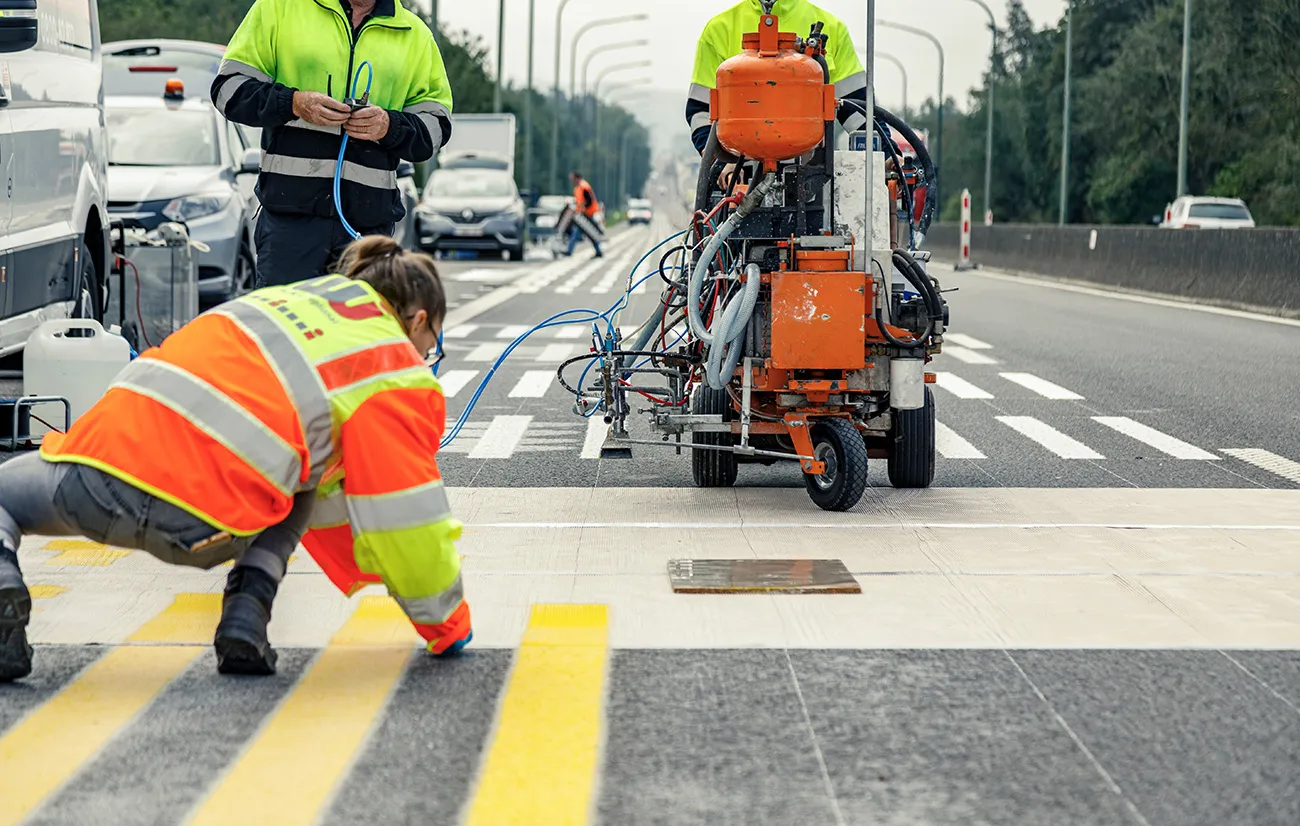
Although the switch to LED technology for road and vehicle lighting has no effect on the requirements for road markings, some notable developments are taking place. In Wallonia, for example, the political aim is to ensure that road paints used from 2023 onwards contain no solvents (in other words, only water-based road paints will be permitted). Erik De Bisschop: “No similar measures are currently in the pipeline in Flanders. On the other hand, it is important to stress that road markings will not become less important in the future, quite the opposite! They are a constant source of information about the road. This is crucial, among other things, for the guidance of autonomous vehicles.”
Een zakelijke vraag aan Copro? Get in touch
Companies in this story
Keep following this
Get an email when a new story is published. No account needed.
- ThemeFuture-proofing roads and railways
- SubjectRoad construction
- CompanyCopro