









Zuiderterras at Steenplein in Antwerp gets a new waterproof deck
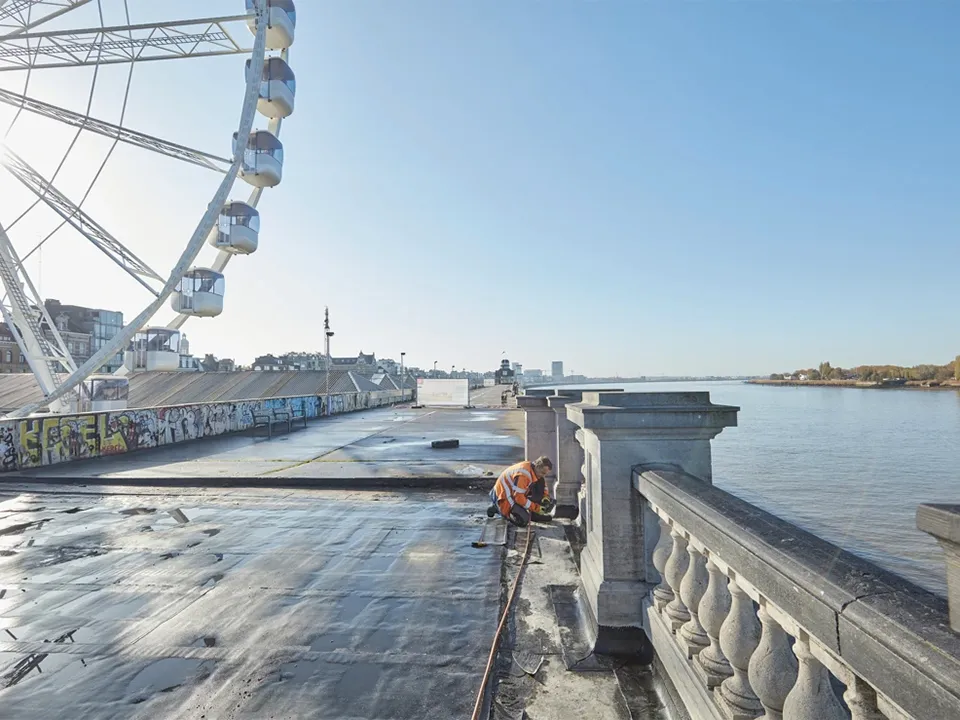
The roof waterproofing on the slope leading to Zuiderterras at Steenplein has been refurbished, partly to resolve water leaks.
The refurbishment had to leave the appearance of the square completely unchanged and preserve its historic value. The work was carried out by building contractor Bouwwerken De Raedt Ivan, under the direction of Wim De Meulemeester, project manager at AG Vespa. Products and technical advice for the waterproofing were provided by BMI Belgium. The work is due to be completed by the end of 2020, so Antwerp residents will soon be able to enjoy a New Year’s walk with views of the Scheldt.
The present-day square took shape in 1880, when the Scheldt was straightened and much of the old medieval city was demolished. Het Steen and its surroundings are now due for a new lease of life.
“As a city, we believe it is important to restore historic places in Antwerp to their former glory, so that people from Antwerp and visitors to the city can meet friends, go for a walk or enjoy the sunset over the Scheldt there, both now and in the future. The area around Steenplein is one such place, and deserved a thorough refurbishment,” said Claude Marinower, Alderman for Public Realm.
A challenging assignment
Water was infiltrating in several places beneath the slope, where there are public toilets, an Antwerp by Bike cycle store and a storage room for the city’s cleaning services. Renewing the roof waterproofing across the entire area of 630 square metres was therefore the only option. The existing waterproofing was old and could have developed further defects over time. In addition, the waterproofing was covered by a mosaic cobbled surface, making it impossible to identify the defects visually. The requirements for protected heritage also presented an additional challenge.
“We began the work with a preliminary investigation using probes to get an idea of what needed to be done. The choice of suitable materials and construction details was made in consultation with framework contractor Bouwwerken De Raedt Ivan and supplier BMI Belgium, which was involved throughout the process from the outset,” said De Meulemeester.
Bouwwerken De Raedt Ivan is a general building contractor specialising in roofing technology and civil engineering structures. This is De Raedt’s 60th assignment as a framework contractor. BMI Belgium is best known as a roofing products manufacturer, but also has many years of expertise in waterproofing terraces, car parks and other surfaces. BMI Belgium is the largest manufacturer of all types of roofing and waterproofing products, and can draw on an extensive civil engineering division.
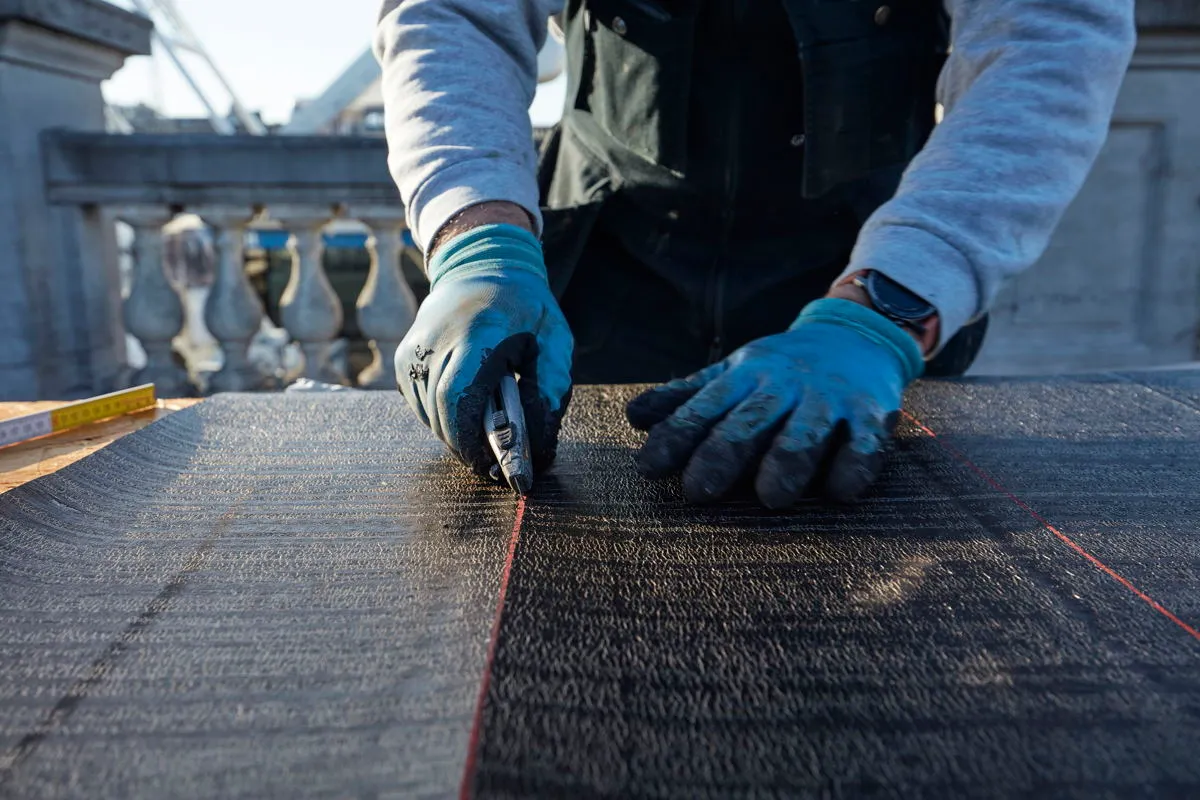
Waterproofing
Initially, the plan was to remove the existing roof waterproofing so that work could be carried out on the concrete roof deck. The old bituminous waterproofing was also relatively thick, so removing it would have reduced the build-up height, leaving more room for the cobbles. The new bituminous roofing system had to be suitable for the loading imposed by the mosaic cobbled surface, pedestrian traffic and occasional heavier vehicles.
“The original plan was to apply Siplast primer to the concrete substrate, followed by a first waterproofing layer and then a protective top layer. It soon became clear during the work that removing the existing waterproofing was not realistic. It could even have caused serious damage to the building,” said Wim Goossens, spokesperson for Bouwwerken de Raedt Ivan.
In the end, it was decided to retain the existing waterproofing. It was removed only in the perimeter zones of the slope and the upper surface, to ensure reliable waterproofing, a neat junction and more room for the cobbles. The build-up and approach were adjusted as the work progressed.
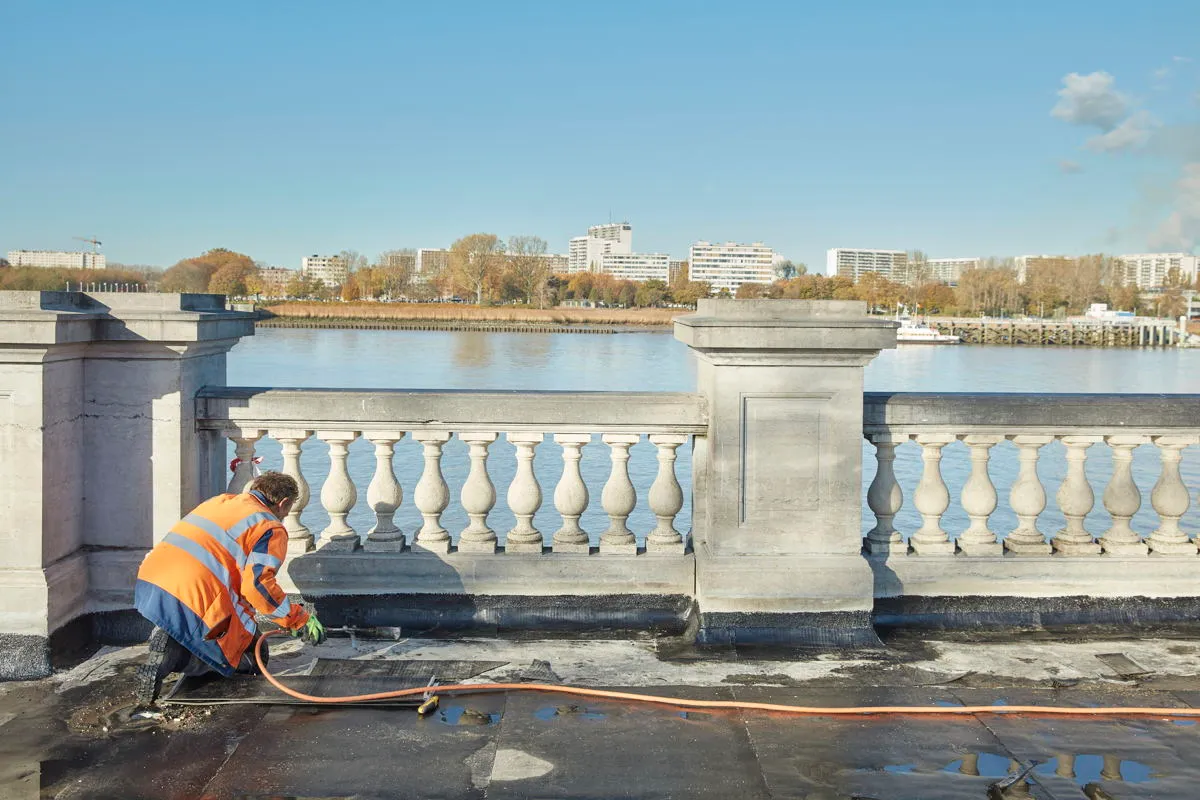
Preflex in hot bitumen
“In the perimeter zones, we started by applying Siplast primer so that the first waterproofing layer, Preflex, could be easily torch-applied on top. However, after several tests, we decided to use hot bitumen across the main area for optimum adhesion. We could not use a conventional primer because the existing waterproofing was heavily contaminated and old,” said Peter Gielis of BMI Belgium.
A first waterproofing layer of Preflex was applied in the hot bitumen. This layer was also mechanically fixed on the sloping surface to prevent it from slipping. Mistral C was used as the top layer. Liquid waterproofing product Profi-dicht was used in small corners and along edges. The edge detailing required careful, precise work because, under the protected heritage guidelines, the waterproofing could not extend above the cobbles.
As a final step, the slope was repaved with the original mosaic cobbles, so Antwerp residents will soon be able to enjoy another pleasant walk with views of the Scheldt.
Question about this story? Ask your question
Who worked on it
Zuiderterras in Antwerpen, renovation
- construction companyBouwwerken De Raedt Ivan
- supplierBMI Belgium
Keep following this
Get an email when a new story is published. No account needed.
- ProjectZuiderterras
- SubjectGeneral
- CompanyBouwwerken De Raedt Ivan
- CompanyBMI Belgium







