“The challenges are significant, but together we can turn the tide”
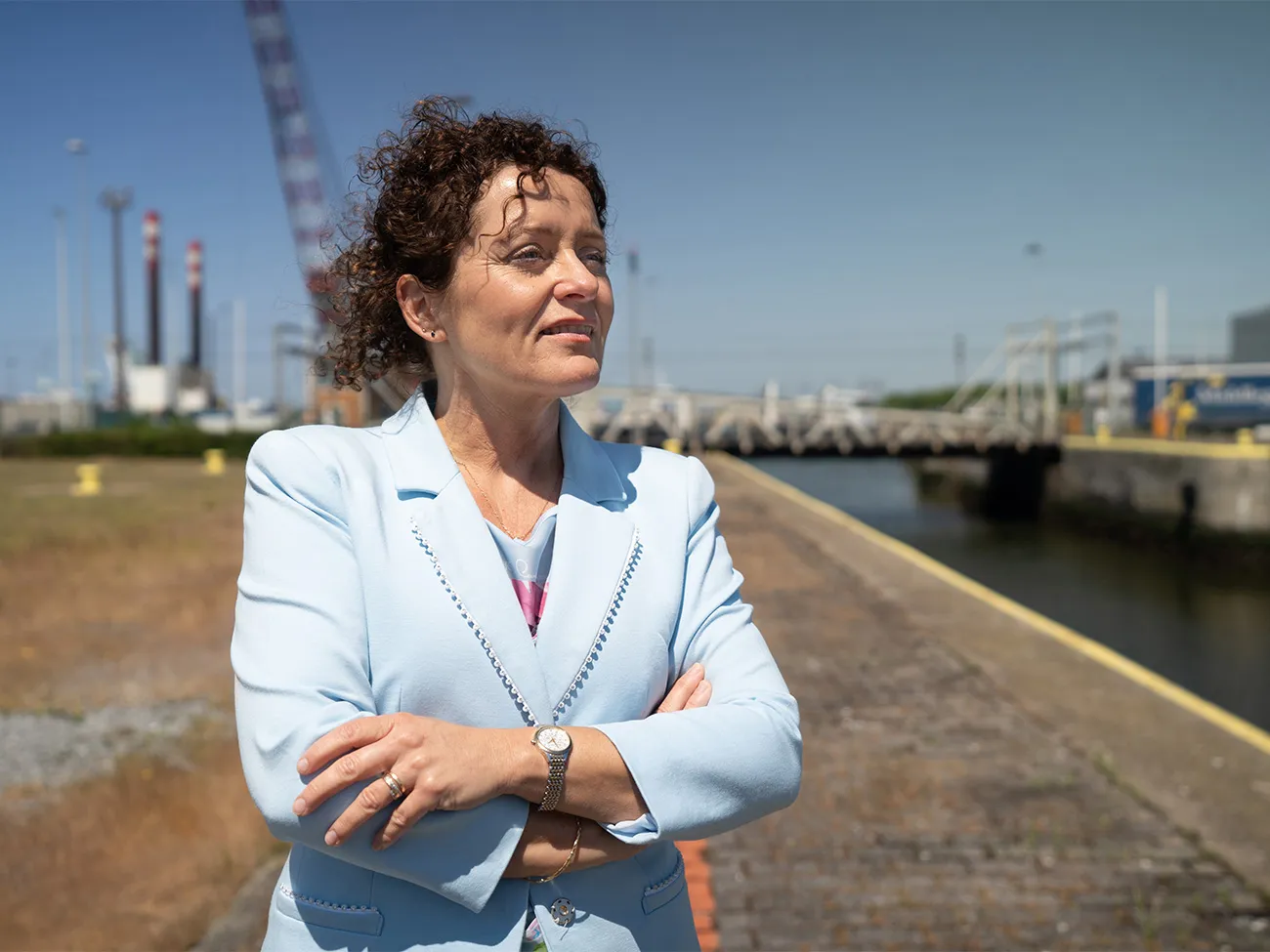
Lydia Peeters, Minister for Mobility & Public Works, is determined to take on the challenges facing mobility and public space over the coming years. For this anniversary edition, Grond/Weg/Waterbouw secured an interview with the minister. It was an optimistic conversation about ambitions, innovation, sustainability, safety, investment and much more. The minister also had a lovely end-of-year wish: “A healthy order book for every contractor, large and small, so that next year we can once again work together with my various administrations and your readers towards a safer, more prosperous and even more sustainable Flanders.”
There is no getting around it. For much of the past 20 months, our lives have been shaped by Covid. How great (or small) has the impact of Covid been on mobility policy to date?
“The impact has been significant, but not always negative when it comes to mobility. We have seen a genuine cycling reflex among people in Flanders: many have (re)discovered the bicycle. We need to build on this trend, which is why I am investing 650 million euros in comfortable and safe cycling infrastructure in 2021-2022, a record amount. As for public transport, we have indeed seen a loss of ticket revenue. Our task now is to win passengers back. Despite Covid, the Flemish ports and the nautical chain also remained 100% operational. However, global economic shocks, such as disruption to international shipping and shortages of chips and other components, are being felt.”
In this respect, is the Flemish Resilience recovery plan a good example of the sector’s resilience? Rather than sitting back, it immediately got back on its feet and sought out opportunities?
“Absolutely. The construction sector is an important player in helping to get the flywheel turning and make a difference in terms of employment, innovation and sustainability.”
Under this recovery plan, around 885 million euros has been made available for the Mobility and Public Works policy area for 2021 and 2022. This is on top of the regular investment budget of more than 2 billion euros. How will this money be spent in 2022?
“The budget is divided among 4 major areas of work: road safety, cycling, sustainability and reforms. This means a budget of almost 300 million euros for each of the first 3 areas. Infrastructure projects have traditionally been an important driver of our economy. These investments mean that a great deal of work will be carried out across Flanders in the coming years. They will bring a revival in the construction sector and boost the economy. The selected initiatives also vary in scale, meaning that the revival will be felt by both large and small contractors, as well as by engineering consultancies and road and waterway construction companies.”
Providing an appropriate response to all the economic, social, technical and climate-related challenges is a major and difficult question for many sectors today. What role can mobility and public works play in this?
“Given that traffic emissions account for more than a third of total greenhouse gas emissions in Flanders, it is essential to make transport greener. But we also need to increase the number of sustainable journeys. Action on both fronts is essential if we are to achieve a 40% reduction in CO2 by 2030. We are also continuing to invest in combined mobility. Climate and weather changes are bringing new challenges in any case, including for road construction. Innovation and sustainability are key to formulating an appropriate response to these challenges, which are both economically and socially urgent. For example, by making our road infrastructure more sustainable and innovative, we can prepare for the mobility of the future. Sustainability has also become increasingly important in road construction as a way of reducing the environmental footprint of infrastructure projects.”
“It is important to focus on the circular economy and innovative, sustainable materials, machinery and techniques. The Flemish Government is also stepping up the fight against drought and water scarcity through the Blue Deal. An intensive plan involving large-scale investment, regulatory changes and more than 70 measures will be rolled out over the coming years. We are also moving towards more sustainable public procurement. In addition to the price and quality of tenders, we want to incorporate the sustainability aspect in future. We are taking the necessary steps, including through several pilot projects, to explore how this can be incorporated into future contracts put out to tender.”
Asset management of bridges and tunnels, our waterway infrastructure (a very topical issue following the recent floods), safety … What do you see as the biggest challenges in mobility at the moment? Are all these issues equally important, or do we need to set priorities?
“It is my ambition to tackle the historic maintenance backlog affecting bridges, tunnels and retaining walls, among other structures, which are collectively known as civil engineering structures.
Flanders has 2,777 such structures, most of which date from the 1960s and 1970s. Many are severely outdated, putting safety at risk. Since safety is absolutely paramount for me, I am making a major effort during this legislative term to repair and replace them. To clear the backlog efficiently, I am working to a 2020-2030 action plan, with 1.6 billion euros allocated during this legislative term for renovation, maintenance and modernisation.”
“As regards water infrastructure, it is important that we are prepared for extreme weather events and climate-related challenges. That is why De Vlaamse Waterweg nv is working with the Flanders Hydraulics Research to develop a ‘what-if scenario’. The initial analysis is very alarming. The damage is estimated at 2 billion euros, with 50,000 to 100,000 people potentially affected. We need to prepare for frequent periods of (extremely) heavy rainfall, so we are setting up a multidisciplinary panel of experts chaired by Henk Ovink. The total cost of the flood protection projects still planned for navigable waterways managed by De Vlaamse Waterweg nv is estimated at 1.3 billion euros. That figure is almost equal to the social cost in Wallonia following the flood disaster. I am therefore firmly in favour of accelerating efforts to clear the historic backlog in water safety and flood management. The key projects in this respect are further investment in the Meuse shared by Flanders and the Netherlands, the Sigma Plan (including the Scheldt, Demer and the Scheldt Quays), the Dender and a number of flood management projects elsewhere in Flanders.”
“The safety figures are poor. Even in 2020, a year with ‘low traffic levels’, there were 241 road deaths in Flanders. Four in ten were vulnerable road users. In 2020, 75 cyclists and 30 pedestrians died in traffic. A reactive approach alone, addressing dangerous locations and problem areas, is no longer enough. I also want to continue taking a proactive approach to problem areas. That way, we can prevent certain locations from ever making it onto a list of dangerous locations. By then it is too late again, and several people have already had to die before action is taken. That is why I have already asked local authorities to report problem areas along school routes on regional roads.”
What role can digitalisation play in this? How can technology improve mobility and make it safer?
“With MIA (Mobility Innovation Approach), we are taking things a step further. The MIA pilot projects, for which we have provided 12 million euros, will test new technologies to detect and address risky situations proactively. The aim is to roll out this approach across Flanders following a positive evaluation. Significant investment in road safety is indeed needed, but you cannot bring back someone killed in a crash with a million euros. The families of victims do not care about those figures. For them, it is all too late. Let us try to get ahead of the problem now. When you close the door behind you in the morning, you should be able to open it again in the evening. Everyone should get home safely. No one deserves to die on the public road.”
Digitalisation and technology cost money, and money is limited. Is it difficult to strike a balance between investment in innovation and digitalisation on the one hand, and (highly) urgent projects on the other?
“I truly believe that data and data connectivity are the new asphalt when it comes to mobility. Not only can they help us improve road safety and ensure smooth traffic flow, this open mobility ecosystem also allows different players and stakeholders to use the data to offer smart mobility solutions. As part of MIA (Mobility Innovation Approach), we are also using technological innovations to improve road safety, both in collaboration with the Mobility Research Centre (IMOB) at Universiteit Hasselt and through the DMOW Data Science Team. Drones and camera technology will be used to proactively monitor traffic situations so that adjustments can be made if necessary.
This will help us prevent numerous accidents at these locations and keep them off the list of dangerous locations in the first place. Prevention is better and cheaper than cure. So resources will certainly also be allocated to digitalisation and technology during this legislative term, often in collaboration with the Agency for Innovation. We are also using digitalisation to prevent fraud involving documents relating to driving lessons. In this sector, paper documents are still often used, for example to obtain a provisional driving licence. The first steps towards digitalisation have now been taken here too, making it virtually impossible to commit fraud in the near future.”
What are your absolute priorities for the remaining years of this legislative term?
“Cycling, road safety and sustainability are the three priorities of my policy, and that will remain the case in the years ahead. I want to increase cycling’s share of functional journeys in Flanders to 20% by 2025 at the latest. In terms of road safety, I want to reduce the number of road casualties by 25% by 2025 and by 50% by 2030, achieve zero pedestrian and cyclist deaths by 2040, and reach Vision Zero by 2050, although I keep saying that, in my view, this target is far too distant. Every day, we must strive for zero deaths or serious injuries in traffic.”
Looking to the near future, are you optimistic and determined about mobility in Belgium, or are alarm bells ringing loudly at the moment?
“The challenges are significant, but when I look at the Flemish Climate Plan and the ambitions it sets out, I am convinced that by working together we can turn the tide. I believe in optimism about progress.”
What positive and motivating end-of-year message would you like to leave us with?
A healthy order book for every contractor, large and small, so that next year we can continue working together, my various administrations and your readers, towards a safer, prosperous and even more sustainable Flanders.
Question about this story? Ask your question
Keep following this
Get an email when a new story is published. No account needed.
- SubjectYearbook