









Unique European recycling project: first load of plasterboard sets sail from Moen
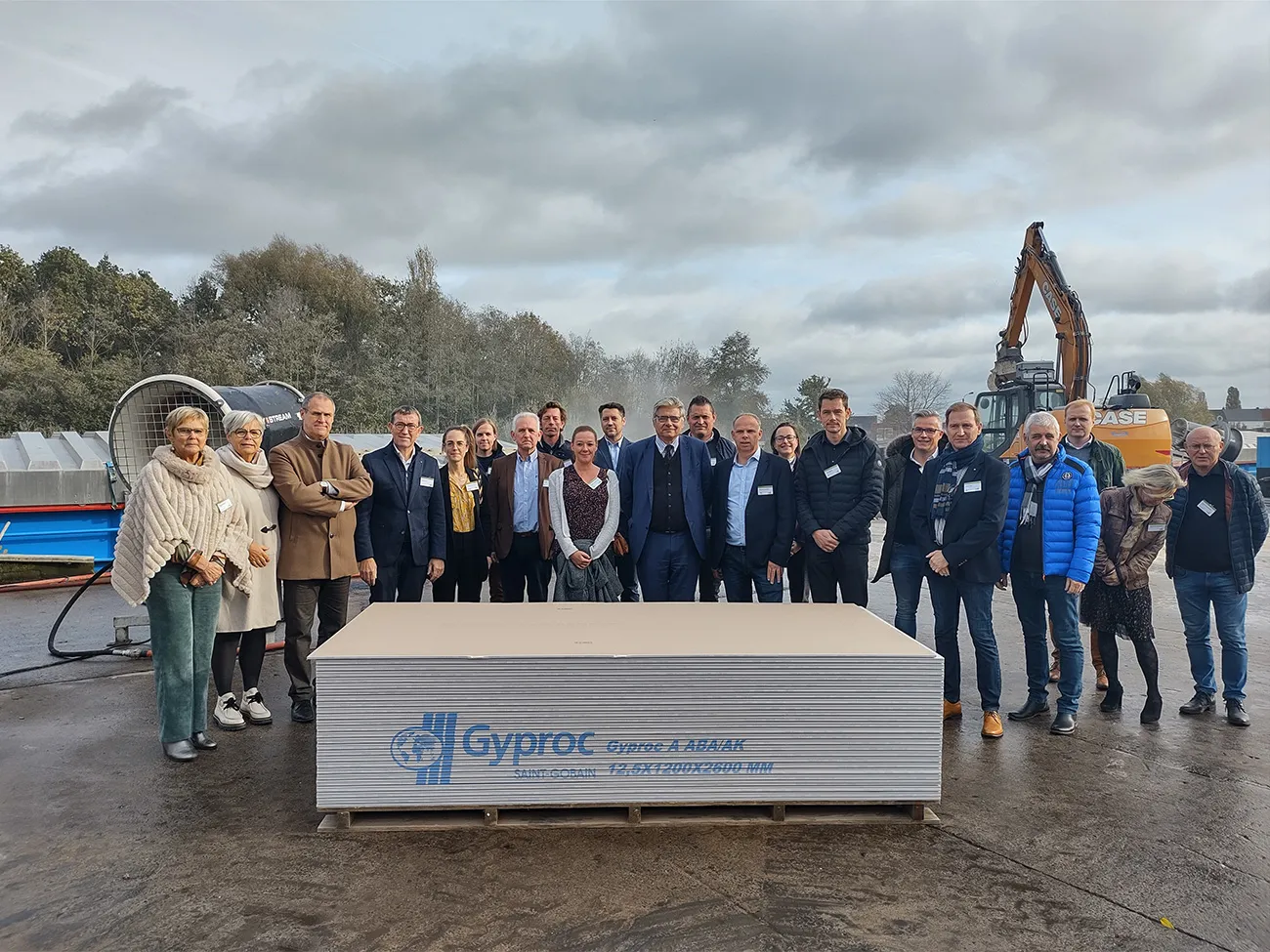
Waste management intermunicipal association Imog is part of a unique project using inland shipping to transport material through the ‘circular gypsum’ recycling process. The project is a collaboration between Saint-Gobain/Gyproc, New West Gypsum Recycling, Multimodaal.Vlaanderen, Rebel and Imog, transporting end-of-life plasterboard by water to the recycling plant. On Monday 7 November, a full load will leave Imog’s unloading quay in Moen for Kallo, where the Saint-Gobain and New West Gypsum Recycling sites are located. The departure will be attended by provincial executive Jean de Bethune, Imog chairman Rik Soens, Imog managing director Johan Bonnier and all the project partners.
Covered storage for collected plasterboard
To reuse waste as a raw material in a production process, supply and demand must be aligned. This is where hubs such as the one in Moen play their part in the circular economy. Material from various sources is consolidated and accumulated there until a full shipload can be dispatched and incorporated into the recycling and production process for manufacturing new plasterboard.
As part of this initiative, Imog built a new covered storage area at its materials centre in Moen with grant funding. This allows all the plasterboard to be stored in weatherproof conditions until it is shipped to Kallo via the inland waterways. The cover was completed at the end of September and has recently become operational.
With this investment, waste management intermunicipal association Imog is demonstrating that it is ready for the future. Imog aims to position itself as a hub or central collection platform. In this way, material is consolidated and transported by water to Kallo in large loads. This is a 200 km round trip that is no longer made by lorry. A full load saves around 40 to 110 lorry trips, depending on the size of the vessel. Today, 590 tonnes of end-of-life plasterboard are being shipped. The load departing today will keep 85 container transport movements off the road.
Baanbreker 2022 nomination
Imog, specifically CEO Johan Bonnier, has been nominated for the Baanbreker 2022 award in the election organised by Multimodaal Vlaanderen. This advisory service supports and connects businesses, shippers and logistics service providers as they seek smart, sustainable transport solutions. Its aim is to raise standards across the sector. With the honorary title ‘Multimodale Ambassadeur 2022’, Multimodaal Vlaanderen recognises a professional who has helped bring about a major or minor change in mindset within their company, the sector, Flanders or Europe. Voting is open until 12 noon on 14 November.
Modal shift saves 85 lorries per shipload
At the New West Gypsum Recycling plant, the boards are prepared for re-entry into Saint-Gobain/Gyproc’s production chain. Saint-Gobain is the only company in the Benelux to recycle plasterboard and convert it back into the same product to a high standard.
Around 65,000 tonnes of gypsum waste are generated in Belgium each year. New West Gypsum Recycling recycles as much of this end-of-life plasterboard as possible so that Saint-Gobain can return it to its production chain, an approach known as the cradle-to-cradle principle.
This unique European recycling project is made possible by these five partners:
- Saint-Gobain/Gyproc
Founded in 1957, Gyproc België is the market leader in gypsum solutions for interior and shell construction finishing. Plasterboard is manufactured at its headquarters in Kallo. From there, the company also distributes wet plasters and boards to the Belgian, Dutch and French markets.
Gyproc offers innovative, comprehensive solutions to its customers, from construction professionals, tradespeople and property developers to DIY enthusiasts. Gyproc is committed to delivering maximum comfort, safety, sustainability and design freedom. The company directly employs around 240 people in Belgium and is part of the French group Saint-Gobain, a global leader in building materials.
More information at www.gyproc.be
- Multimodaal.Vlaanderen
Multimodaal.Vlaanderen is part of VIL and is an independent advisory service that has supported and connected shippers and logistics service providers since 2017 in their search for alternative, more sustainable transport solutions. Its goal is to work with businesses to drive the shift towards smart, efficient and sustainable transport choices.
More information at www.multimodaal.vlaanderen
- Imog
Imog is an intermunicipal partnership responsible for collecting and processing waste in eleven municipalities in South West Flanders, serving almost 250,000 residents. It operates several facilities across two sites, in Harelbeke and Moen, and an extensive network for separate collection, including door-to-door collection, 16 recycling parks and 300 glass banks. It employs around 200 staff and a much larger number of contractors. Through its strapline, ‘Waste…a source of raw materials and energy’, Imog is an essential link in implementing circular economy policy.
More information at www.imog.be
- New West Gypsum Recycling
New West Gypsum Recycling (NWGR) was founded in Canada in 1985. NWGR has streamlined its processes and business model and established itself as a world leader in recycling gypsum waste in a fully closed chain, a 100% closed loop. It now has the capacity to recycle almost 1 million tonnes a year. NWGR aims to increase this figure by continuing to invest in technology to improve process efficiency and quality, and reduce costs.
More information at www.nwgypsum.com
- Rebel
Rebel was appointed as external project coordinator to ensure professional support for the project team during the grant application process and the successful rollout of the pilot project in the short term. Rebel developed the grant application and, during the rollout of the pilot project, is primarily responsible for submitting the appropriate reports to the government (MOW). Rebel also developed a calculation model that illustrates the project’s impact on negative external effects, including the number of lorry trips avoided and the reduction in CO2 emissions…
Question about this story? Ask your question
Keep following this
Get an email when a new story is published. No account needed.
- ThemeMaterials with a lower environmental impact
- SubjectGeneral







