









The 5 key recycling trends in construction: reuse, upcycling, cradle to cradle and more
38% of all waste ‘produced’ in Belgium comes from the construction sector. This is an amount that cannot be ignored. Modern construction trends are responding to this problem. Construction waste can be reused in various ways. Which of these are most valuable from the investor’s and environmental perspectives?
Reuse and superuse
Reuse simply means using materials that have already been used once again. To reduce energy costs, reuse is based on making as little intervention as possible in the processed material, keeping processing costs relatively low. This includes reusing a range of materials, from timber to ceramic tiles, rubber, glass and ready-made elements such as window frames.
The concept of superuse then emerged from reuse. It means treating a building as an organism that undergoes transformation. Its life cycle is not limited to the process of construction, operation and demolition.
Instead, when it can no longer be used in its current form, it is transformed into another object to meet users’ needs. The transformation uses recycled materials, and all activities are carried out as locally as possible to reduce the carbon footprint.
An example of superuse is the revitalisation of the Hoogvliet residential area near Rotterdam, where the building frame was retained and the façades renovated and rebuilt using production waste from nearby companies.
Upcycling
Until recently, upcycling was mainly seen in the fashion and interior design industries. Tables made from wooden pallets and dresses made from plastic bottles, showcased in modernist galleries and at fashion shows, have found their way into everyday life. The trend of processing waste to create new value is reaching ever further into all areas of life, including the construction sector.
In construction, upcycling primarily means processing building materials in such a way as to obtain a new product with better performance, while minimising energy consumption, explains Emmanuel Gregoire, Managing Director at Aluprof Belgium NV. It is a new approach to recycling which, in its original form, involves transforming a material into the same material, just as we do with aluminium, he adds.
One example is the so-called Pretty Plastic material. These façade tiles are made by processing PVC window frames and gutters. The first building to use this unusual material is the Sint-Oelbertgymnasium in the Netherlands. Other materials of this kind include K-Briq bricks made from landfill waste and Polli-Brick made from plastic bottles.
As well as processing materials, upcycling also means using them boldly in atypical ways. There are many examples: The Circular Pavilion in Paris, where part of the façade is made from used wooden doors, and Enabling Village in Singapore, built from shipping containers and concrete pipes.
Alongside recycling, upcycling is a highly important trend in the construction sector because the volume of construction and demolition waste is very high, and the environmental costs are enormous, says Emmanuel Gregoire.
Upcycling not only helps you make use of materials that have become redundant, but can often also enable you to build economically. This is the case when shipping containers are used for housing. The challenge with upcycling, however, is to make newly constructed buildings or building materials energy-efficient, durable and safe, the expert adds.
Cradle to Cradle
The concept of sustainable development based on a circular economy is one of today’s key trends, and not only in the construction sector. The idea, inspired by nature, of processing all waste into raw materials makes it possible to reduce waste and make the economy independent of the consumption of the earth’s limited natural resources.
In the construction sector, cradle to cradle is primarily a technological loop, namely processing materials into products. This is a challenge because not all building materials can be used in this way. Choosing materials in line with the principles of the circular economy demonstrates care for nature and the living environment of future generations.
It is worth noting that Cradle to Cradle certification also takes account of the return on investment. Many European countries are planning to transition to a fully circular economy over the coming decades. For Belgium, which is performing very well in this area, the target is 2050.
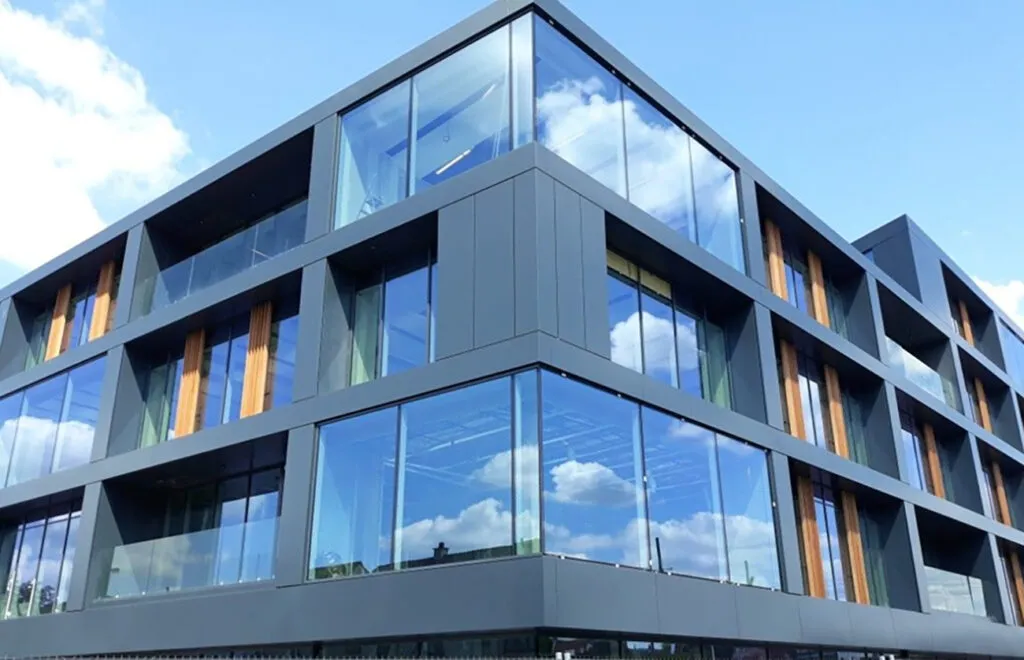
Aluprof façade systems such as MB-70, MB-SR50N HI+ and MB-86 SI have achieved Cradle to Cradle Bronze certification, confirming that they meet the requirements of a circular economy.
Downcycling
The next trend aimed at reducing construction waste is downcycling, whereby processing a material produces a raw material or product that can be reused. Unlike upcycling, however, the resulting product has slightly poorer performance.
At present, most recycling activities in the construction sector focus on downcycling. According to UNEP (United Nations Environment), 91% of construction waste in Brussels, approximately 560 thousand tonnes, undergoes this process, explains Gregoire. This involves certain limitations, because downcycling cannot be carried out indefinitely. Sooner or later, the processed material is no longer suitable for further use. Against this backdrop, aluminium, which can be processed almost infinitely to produce material of the same quality, is a perfect solution, adds the Aluprof manager.
Let’s Build a better future
All the trends mentioned above share one overarching goal: reducing the amount of waste, easing the burden on Mother Nature and reducing the use of its natural resources, as well as improving the energy performance of buildings and helping to reduce their carbon footprint. In the face of the current climate crisis, all these trends are important, but it is certainly worth prioritising materials that enable recycling in its highest forms, upcycling or reuse, and that are also adaptable, renewable, non-toxic and energy-efficient, while allowing flexible use. Aluminium is one such material.
Question about this story? Ask your question
Keep following this
Get an email when a new story is published. No account needed.
- ThemeMaterials with a lower environmental impact
- SubjectGeneral







