









Test infrastructure for European Hyperloop completed
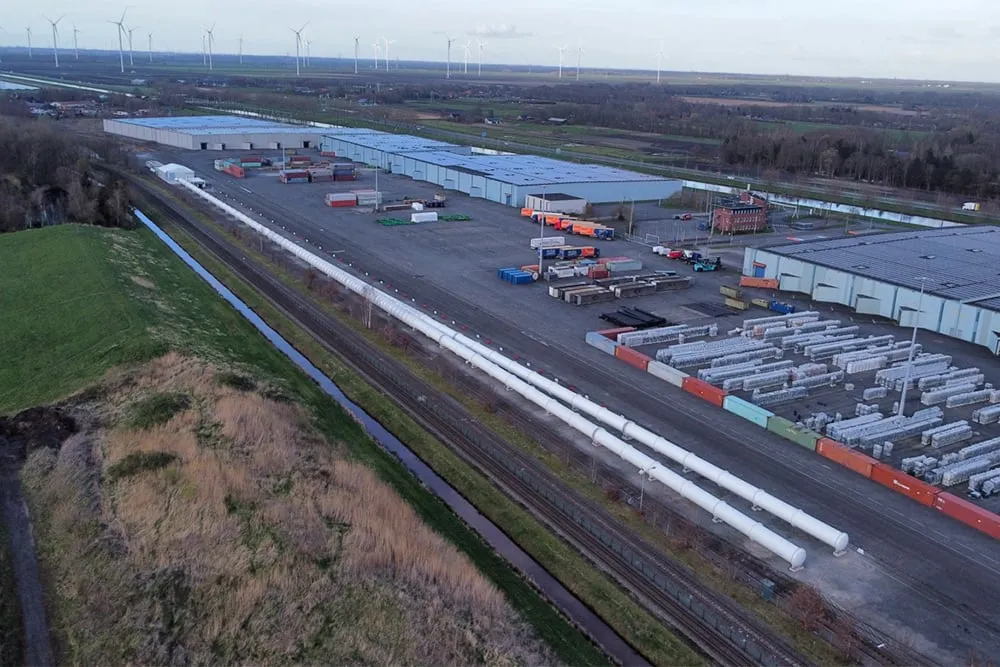
Denys was responsible for installing and assembling prefabricated hyperloop tubes
The 420-metre test track for European Hyperloop has just been completed in Groningen, the Netherlands. Construction company Denys was responsible for installing and assembling the prefabricated hyperloop tubes. Testing can now begin on this promising transport system of the future, for both freight and passengers.
The concept of a hyperloop, or vacuum train, is not new: the idea of building railways using air pressure was already proposed around 1800. However, it was not until 2012, when Elon Musk brought it up again, that this transport system using pressurised tubes became the subject of serious scientific research.
12 years later, a new milestone has been reached: in Groningen, the European Hyperloop Center (EHC)[1] is opening its test infrastructure, a 420-metre test track that includes a track switch. As a specialist in complex tunnel projects, among other things, construction company Denys was responsible for installing and assembling the prefabricated hyperloop tubes.
Maarten Vanneste, innovation manager at Denys, explains: “Our teams have extensive experience in assembling this type of infrastructure. As always, we work with the utmost precision and are therefore very pleased to have been able to contribute to this promising project. Energy consumption is particularly low: transport by hyperloop is estimated to be 10 x lower than travelling by car or plane.”
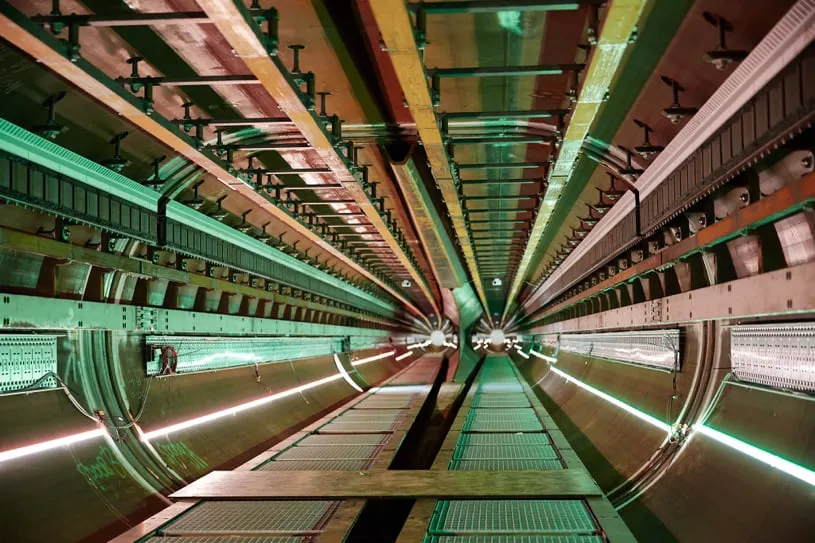
Marinus van der Meijs, director of Technology and Engineering at Hardt Hyperloop, a leading player in hyperloop technology, is equally enthusiastic: “The European Hyperloop Center is the perfect facility for validating and further developing this technology. This infrastructure allows us to demonstrate essential technologies such as magnetic levitation, propulsion, stabilisation and even a track switch, at speeds of up to 100 km/h.”
The EHC test infrastructure was specifically designed to replicate real-world conditions and marks a crucial moment in the development of hyperloop. “This state-of-the-art facility is the result of the efforts and expertise of all the partners involved,” adds Sascha Lamme, director of the European Hyperloop Center.
Global interest
Interest in hyperloop technology is growing worldwide. At continental level, the European Commission has proposed including hyperloop in TEN-T policy, with the support of the European Parliament. This policy aims to improve connectivity between EU Member States. A feasibility study for a hyperloop pilot route has recently begun in Italy. And in India, plans are also underway to conduct a hyperloop pilot in 2026.
The European Hyperloop Center is also part of a European research infrastructure cluster, together with a hyperloop test facility in Switzerland, DemoTube (which is only 120 metres long). Combining the results from both hyperloop test facilities should accelerate the development of hyperloop technology.
[1] The EHC is part of the Hyperloop Development Program (HDP), a public-private partnership of more than 25 partners working to advance hyperloop technology.
Question about this story? Ask your question
Keep following this
Get an email when a new story is published. No account needed.
- SubjectGeneral







