









Sweco studies 70 km of hydrogen pipelines in Flemish ports for Fluxys Belgium
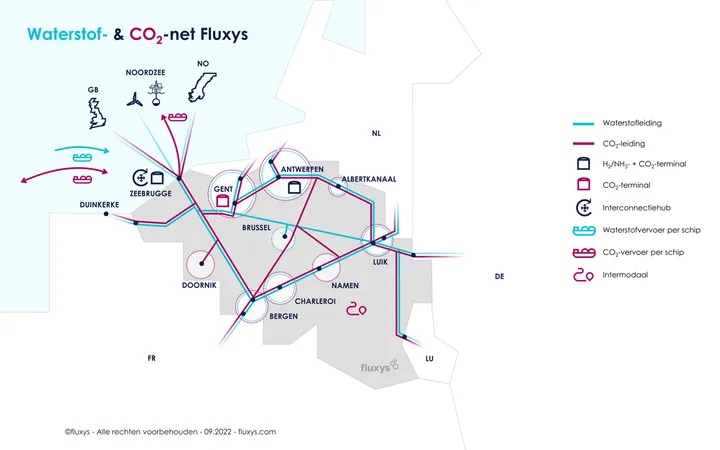
Engineering and architecture firm Sweco is working for infrastructure company Fluxys Belgium on the feasibility study and preliminary research for several hydrogen routes in Ghent and Antwerp. We are also responsible for, among other things, the design, the project EIA and safety coordination.
Fluxys Belgium is gearing up to develop the hydrogen and CO2 infrastructure needed to decarbonise the Belgian and north-west European economies. Working with industry, various partners and neighbouring operators, the infrastructure company is making preparations for terminal projects and for the construction and conversion of pipelines within and between Belgium’s industrial zones and to neighbouring countries.
The aim is to have the first hydrogen and/or CO2 network connections ready for industry in 2026. In this context, Fluxys Belgium awarded Sweco the contract for a comprehensive study of around 70 km of hydrogen pipelines in the ports of Ghent and Antwerp. This puts the knowledge and expertise available in our country, and promoted by the Flemish Hydrogen Vision, in the spotlight.
Erwin Malcorps, Business Area President at Sweco Belgium, says: “Sweco has extensive experience in designing and obtaining permits for wind farms and green hydrogen projects, both in Belgium and abroad. Our teams are ready to take on the complex projects that will enable the climate and energy transition. We have in-house experts dedicated to hydrogen projects, covering everything from energy production, transport and distribution to end users. As an engineering partner, we want to help make a difference with this project, towards a sustainable and energy-independent economy and society.”
Tom Van Den Noortgaete, Division Director Energy & Environment at Sweco Belgium, explains the transition: “Transporting hydrogen and green molecules is an essential link in our energy transition. Our country needs a great deal of hydrogen to make our chemical cluster and sectors that are difficult to electrify carbon-neutral. In its Recovery and Resilience Facility (RRF) plan, Belgium has committed to supporting the development of at least 150 km of hydrogen and CO2 transport pipelines.”
Hydrogen is thus becoming an important part of a redesigned energy system. With the infrastructure we are studying for Fluxys Belgium, the ports of Ghent (North Sea Port) and Antwerp (Port of Antwerp-Bruges) will play a pioneering role as European hubs.
Question about this story? Ask your question
Keep following this
Get an email when a new story is published. No account needed.
- SubjectGeneral







