









‘Sewerage’ becomes ‘municipal water management’
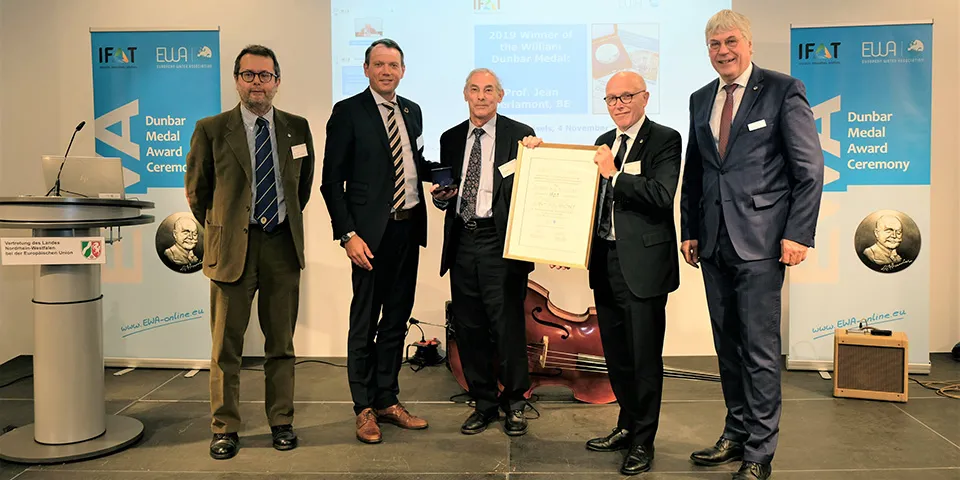
The effects of climate change call for sustainable water management and a carefully developed stormwater plan. “To be climate-resilient, water must be treated as a guiding factor from the very start of a planning or design process, not as a problem to be solved at the end”, says VLARIO chair and KU Leuven professor Jean Berlamont, who received the biennial DUNBAR MEDAL from The European Water Association (EWA) in October.
Sewers are built to carry wastewater to wastewater treatment plants (WWTPs). Most sewer systems in Flanders, as in the Netherlands, are combined systems. “That means rainwater is also carried away along with wastewater”, explains Jean Berlamont. “This makes overflows necessary during heavy rainfall, to discharge excess stormwater directly into surface water, mixed with wastewater that the WWTP cannot treat.”
Tackling the causes
This pollutes the streams and rivers that had become considerably cleaner after the WWTPs came into operation, on average 7 to 10 times a year. This must be avoided in order to meet the requirements of the EU Water Framework Directive. Until recently, the solution was to provide substantial storage capacity in the sewer system or at the overflow. “Rather than remedying the effects, namely pollution of the receiving surface waters, we would do better to tackle the causes”, says Jean Berlamont.
“Choosing separate sewer systems for all new or renovated sewers means less stormwater enters the wastewater or combined sewer system, reducing the frequency and/or volume of overflows. Storing rainwater locally, using it in the home or allowing it to infiltrate helps tackle local flooding and, above all, improves groundwater levels. In many parts of Flanders, groundwater levels have fallen significantly, partly due to dry summers. This in turn puts water supplies at risk, for example for agriculture and horticulture, and, in the longer term, for drinking water.”

Jean Berlament, VLARIO chair and professor at KU Leuven.
Storing stormwater
The effects of climate change call for a further paradigm shift. Jean Berlamont explains: “To prevent local flooding during more intense storms, we need to store stormwater temporarily where it falls, on individual plots or at neighbourhood level. To secure water supplies during dry periods, we need to allow as much stormwater as possible to infiltrate, again at plot level or at neighbourhood or municipal level. To do this, a municipality needs a stormwater plan that sets out in broad terms where water will be stored and where it will infiltrate.”
A guiding factor
That plan must be the starting point for spatial planning and the planning of open space. This calls for the right mindset. “To implement sustainable water management and be climate-resilient, water must be treated as a guiding factor from the very start of a planning or design process, not as a problem to be solved at the end. Sewer construction should therefore no longer be a purely hydraulic or civil engineering project, but must be integrated into much broader spatial policy, becoming a matter of municipal water management”, concludes Jean Berlamont.
Question about this story? Ask your question
Keep following this
Get an email when a new story is published. No account needed.
- ThemeSpace for water and green infrastructure
- SubjectGeneral







