









Roerdomp Bridge over the Kalkenvaart
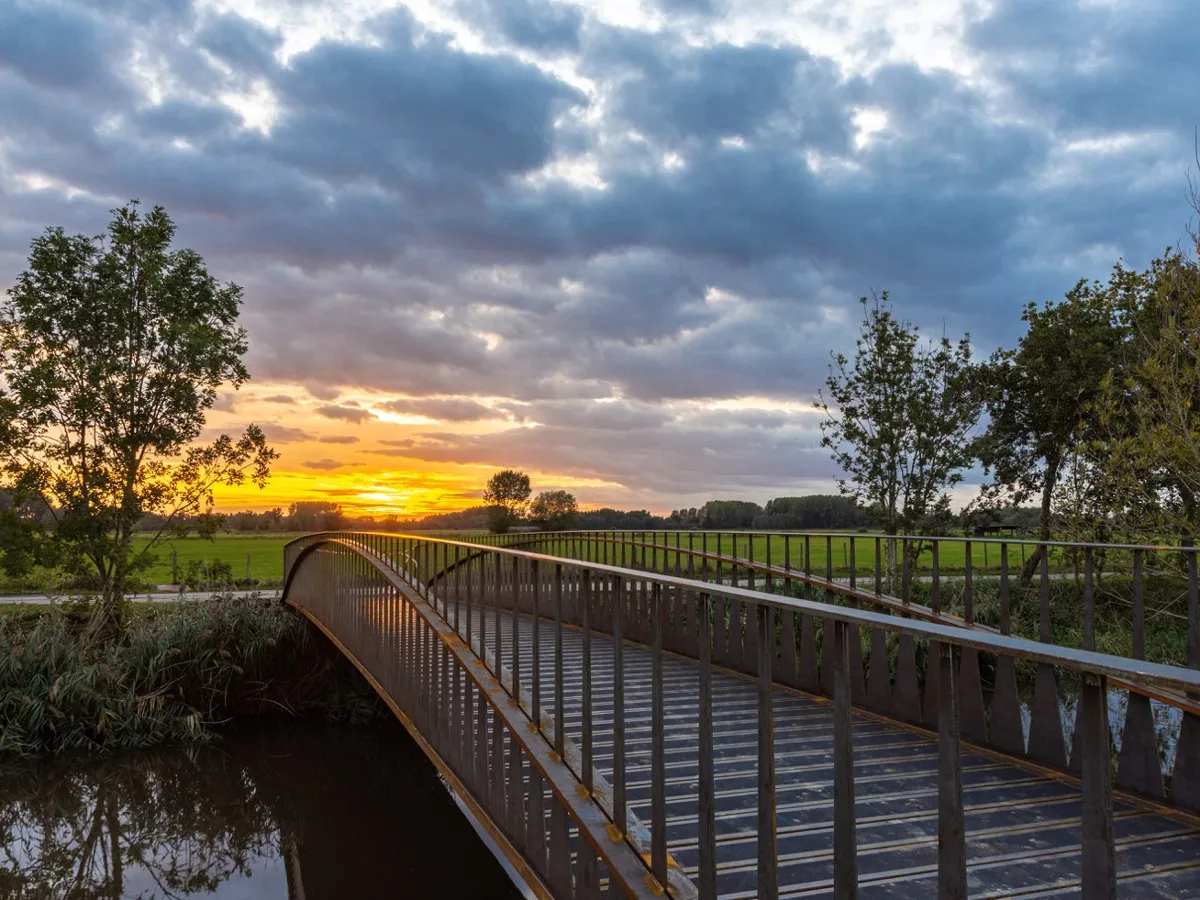
The Roerdomp Bridge was installed in October. This elegant weathering steel structure is the only crossing over the Kalkenvaart in the area, opening up new opportunities for walkers and cyclists to explore the unique Kalkense Meersen.
The Kalkense Meersen nature reserve covers an area of approximately 1,000 hectares across the municipalities of Berlare, Laarne, Wetteren and Wichelen. It is one of the most beautiful nature reserves in East Flanders, welcoming cyclists and walkers with open arms. The area is part of the Sigmaplan, which aims to protect against flooding from the Scheldt and its tributaries, while also supporting the development of riverine nature.
Crossing
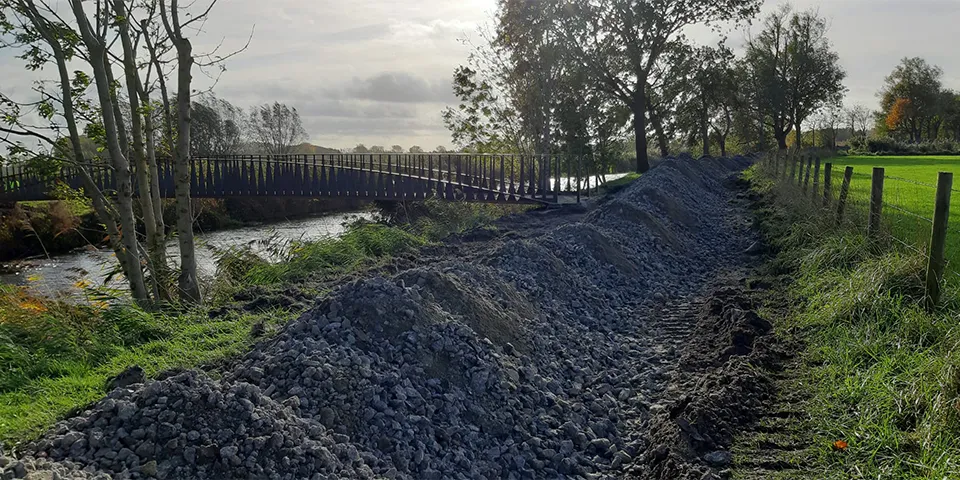
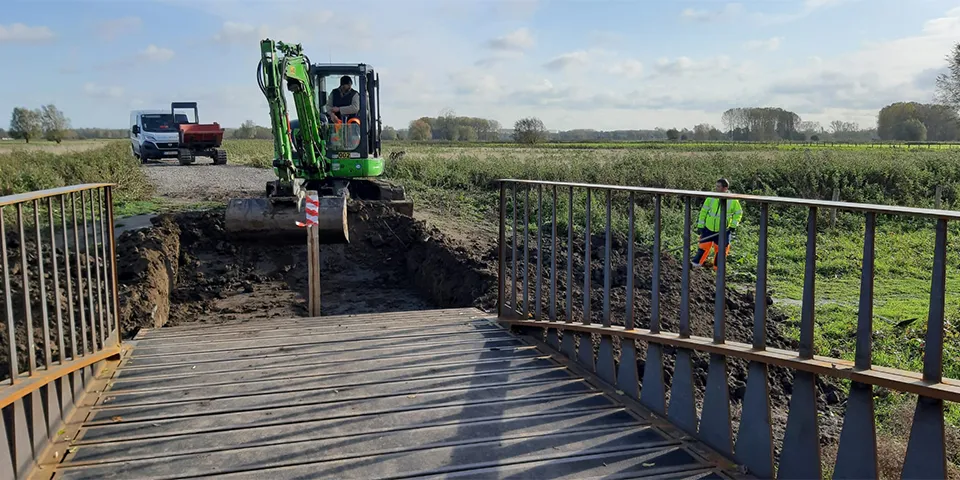
To show the general public the area’s most beautiful spots and its wonderful flora and fauna, the meadows have a network of surfaced and unsurfaced paths and walking trails. However, the area is divided from north to south by the Kalkenvaart, which somewhat limits access and opportunities to cross. For this reason, people have long been looking for a way to cross the canal. The Tragelweg alongside the old Scheldt was also restored earlier for this purpose. The aim is to keep through traffic off the Kalkenvaartweg. A tractor barrier will therefore also be installed, allowing access only to pedestrians, cyclists and agricultural vehicles. A new bridge for pedestrians and cyclists has recently been built over the canal, on the Wichelen/Laarne boundary.
Contractor
The Flemish government’s Agency for Nature and Forests opted for a design-and-build contract. In this case, the contractor is responsible for the entire process, from design, technical calculations and permit applications through to construction and installation. This type of contract offers advantages in terms of planning, cooperation between the parties involved and cost control. However, it does not make choosing a contractor any easier. Bidders are given considerable freedom in their approach, design and choice of materials, such as wood, plastics and various metals, which also has an impact on the price.
To ensure an objective selection, several panels were consulted, with representatives from the municipalities of Laarne and Wichelen, the Agency for Nature and Forests, the Flemish Land Agency and De Vlaamse Waterweg nv. They assessed the bids against various criteria, including design, sustainability and suitability for the surroundings. For the engineers on the panels, technical merit was also a specific consideration. Price, of course, played a part too. Based on the combined score, the bid from Servais Engineering Architectural, working with Ateliers Melens Dejardin, was selected.
Servais Engineering Architectural (SEA) (https://servais.partners/) was founded by engineer-architect Vincent SERVAIS after a 25-year career as partner, director and Director of Design at Bureau Greisch. Vincent’s previous projects include the pedestrian and cycle bridge “La belle Liégeoise” and the pedestrian bridges in Lourdes. The team also included structural engineer Christophe Peigneux (SEA) and Prof. Arthur De Roover (UGent) as its Dutch-speaking partner.
The ATELIERS MELENS & DEJARDIN have been based in Jupille-sur-Meuse (Liège) since 1932. Gérard DEJARDIN has been the company’s managing director since 2007. The company is certified in metalworking and the construction of metal support structures, and also specialises in creating monumental works of art and architecture.
Design
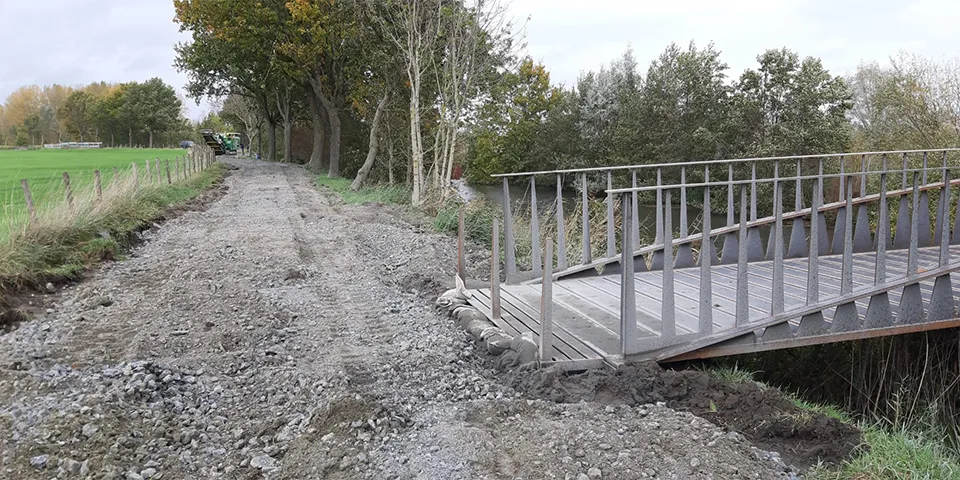
The design submitted by SEA is distinguished by its use of weathering steel (also known as Corten steel https://nl.wikipedia.org/wiki/Cortenstaal). When exposed to the elements, this metal forms a layer of rust that acts as a ‘skin’ and prevents further oxidation. The resulting rusty-brown colour allows the bridge to blend into the landscape. The finished structure is a slender, 25-metre-long pedestrian bridge with a non-slip surface made of epoxy resin containing quartz granules. Its distinctive design incorporates the load-bearing structure into the parapet in the form of a truss with triangular elements, intersected by a compression arch. This gives the whole structure a striking aesthetic.
Roerdomp
The bridge has now also been given a name. The tender included a digital simulation of the bridge with an image of a flying bittern. It was a perceptive choice, as this heron-like bird is a target species for the Sigmaplan in the Kalkense Meersen. During the design and construction phases, Roerdomp Bridge was quickly adopted as a working name, and it stuck.
The structure, weighing just 11 tonnes, was installed on 6 October. During the past week, the first walkers and cyclists in the Kalkense Meersen have already shared positive reactions, both in person and on social media. The bridge has also proved an instant favourite with photographers.
Question about this story? Ask your question
Who worked on Roerdomp-brug
- ContractorServais Engineering ArchitecturalIn this story
- de staalstructuurAteliers Melens-DejardinMentioned in Corten steel footbridge blends seamlessly into nature
Keep following this
Get an email when a new story is published. No account needed.
- ProjectRoerdomp-brug
- ThemeExtending the life of bridges and tunnels
- SubjectGeneral
- CompanyServais Engineering Architectural







