









Removing traffic lanes could greatly improve air quality on Belgiëlei
Dimitri Voordeckers (UAntwerpen) sought solutions to the street canyon effect
(Relatively) narrow streets flanked by tall buildings, with cars happily chugging along. Antwerp city centre has numerous street canyons: places where exhaust fumes linger because of a lack of natural ventilation. Dr Dimitri Voordeckers (UAntwerpen) spent four years looking for solutions to the problem. Using a simulation model, he found a way to improve air quality on Belgiëlei by up to 20%.
“In principle, a street canyon is simply a street with building facades on both sides of the road,” says Dr Dimitri Voordeckers, a doctoral researcher with UAntwerpen’s Research Group on Urban Development. “That in itself need not be a problem, but when the buildings are too tall in relation to the street, natural ventilation is restricted. This is particularly an issue when there is a lot of traffic, as polluted air lingers. Peak pollution levels are generally found on the pavement, where exhaust fumes are blown towards.”
More greenery, less clean air
On the basis of an extensive literature review, Voordeckers came up with a range of solutions to mitigate the street canyon effect. “As a rule of thumb, building facades should be interrupted at least every 100 metres by a small park, an intersection or another open space to ventilate the air.”
Numerous other spatial interventions can also reduce the harmful effects. “One example is planting trees. But more greenery in the streetscape does not necessarily mean cleaner air. It is important to plant smaller trees with relatively open canopies. In summer, there is a risk that the tree canopy will trap exhaust fumes. This blocks air circulation, producing the opposite of the desired effect.”
Belgiëlei as a test case
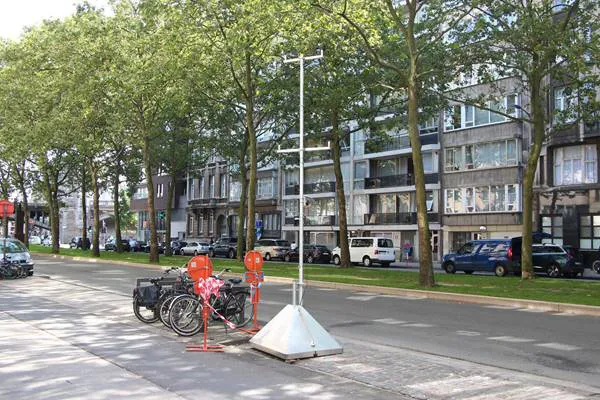
To put some measures to the (virtual) test, Voordeckers simulated them using a scientific model. He chose Belgiëlei in Antwerp as his test case. “At present, Belgiëlei has two pairs of lanes, separated by a row of trees on the tram reservation. If cars were restricted to a single lane on one side of the road, polluted air would be able to escape from the canyon more easily. This would reduce exhaust concentrations on Belgiëlei by 8%, even allowing for additional congestion that could arise on the street as a result of the change to the traffic layout. Air quality improved by as much as 20% in parts of the pedestrian zones.”
Remarkably, the more measures the doctoral researcher took in addition to rerouting traffic, the smaller their positive impact on air quality. That is because the problem of air pollution extends beyond street canyons, both literally and figuratively. “Ventilation in a street can only be as beneficial as the air it brings in,” Voordeckers explains. “Antwerp city centre is enclosed by the Ring. Exhaust fumes emitted there rise and are then blown through the city. Tackling the canyon effect must therefore be part of a broader environmental policy.”
Question about this story? Ask your question
Keep following this
Get an email when a new story is published. No account needed.
- SubjectGeneral







