









Recovering rubble and excavated soil independently
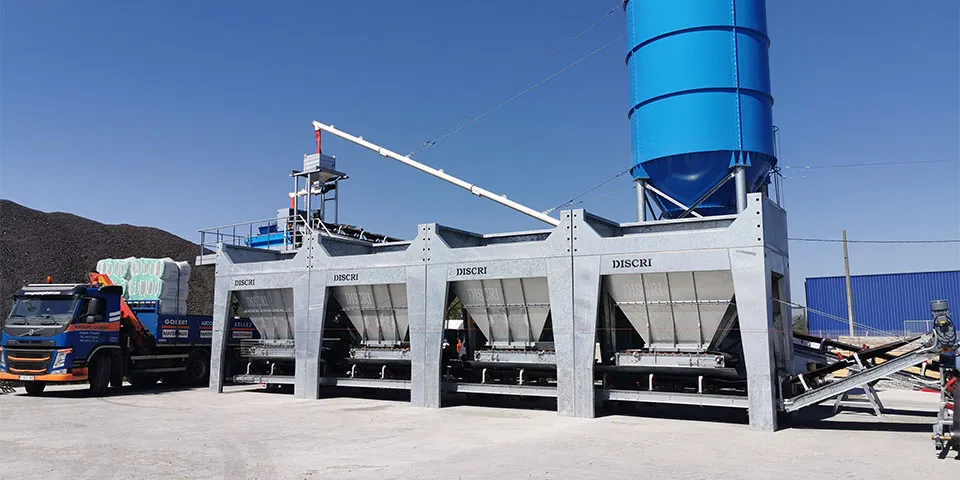
With an operating area covering the Benelux and northern France, DisCri has focused in recent years on the design, manufacture, installation and maintenance of mixing plants for recovering rubble and excavated soil. Its evolving concept gives users control of the situation and offers a degree of versatility and autonomy that is rare in the sector.
Jean Crispeels, founder of DisCri and passionate about innovation, has spent years working tirelessly to turn the strict requirements of modern regulations into opportunities for his customers, all SMEs specialising in construction, roadbuilding and recycling.
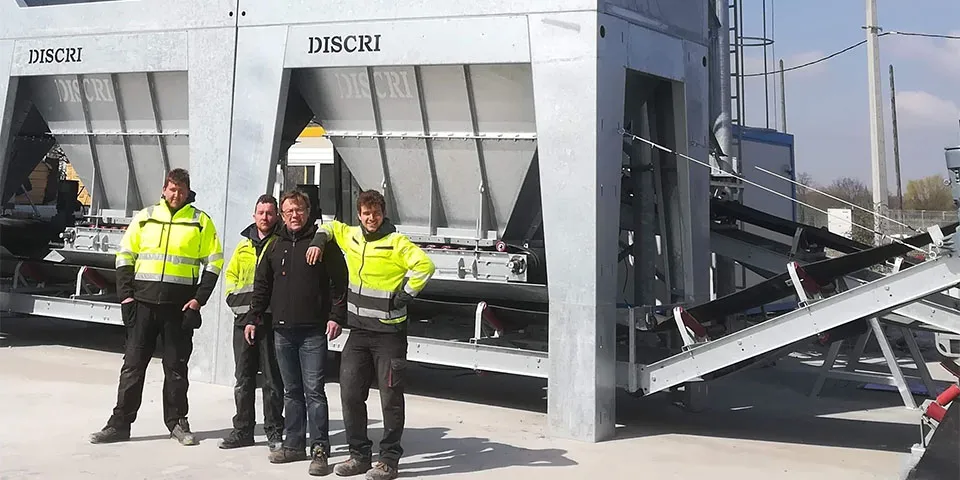
DisCri has a young, dynamic team.
Customers demand versatility
In the past, the demolition and earthmoving market suffered from a severe shortage of medium-sized plants that would enable contractors to streamline the entire recycling process for excavated soil and rubble. DisCri therefore developed a high-performance system capable of processing the widest possible range of products and aggregates. Jean Crispeels: “All my plants can process soil and lime, or sand and cement, in the same way, because my customers generally work with both materials. There are not many European players that can offer this.” The robust, durable plants are made from hot-dip galvanised sheet steel at least 5 mm thick, so they can withstand heavy use.
A DisCri plant has a footprint of just 120 m².
To serve SMEs in the construction, infrastructure and recycling sectors even better, DisCri also needed to develop a modular concept. This allows customers to start with a small plant and then expand as their market activities grow, at a modest cost. All components are standard, and the controls are intuitive, enabling customers to operate independently even in an emergency. The accompanying software is compatible with tablets and smartphones, and even allows users to operate the plant wherever and whenever they choose.
DisCri also has mixing buckets in its range.
The advantages of continuous systems
Although DisCri also offers batch systems, it mainly promotes continuous systems because they are more energy-efficient. They also make it possible to achieve high output with a relatively lightweight plant. In addition, continuous systems are much better suited than large batch plants to the new requirements for excavated soil and demolition materials. Current regulations stipulate that demolition materials must be recycled, making the mixing process much more complex. Continuous technology is suitable for processing larger aggregates, which is ideal for recovering recycled materials. Jean Crispeels: “Recycling centres also do not know how to handle fine, highly heterogeneous and heavy fractions, which are therefore not viable in a concrete batching plant. Continuous systems make it possible to recover them after all.”
But Jean Crispeels is not resting on his laurels and is already working on new projects: mobile, high-performance machines for processing lime-rich soils or cement rubble, which can be used directly on site.
Question about this story? Ask your question
Keep following this
Get an email when a new story is published. No account needed.
- SubjectGeneral







