









Podcast: In conversation with Dries Van Haut, Chair of SIGMA
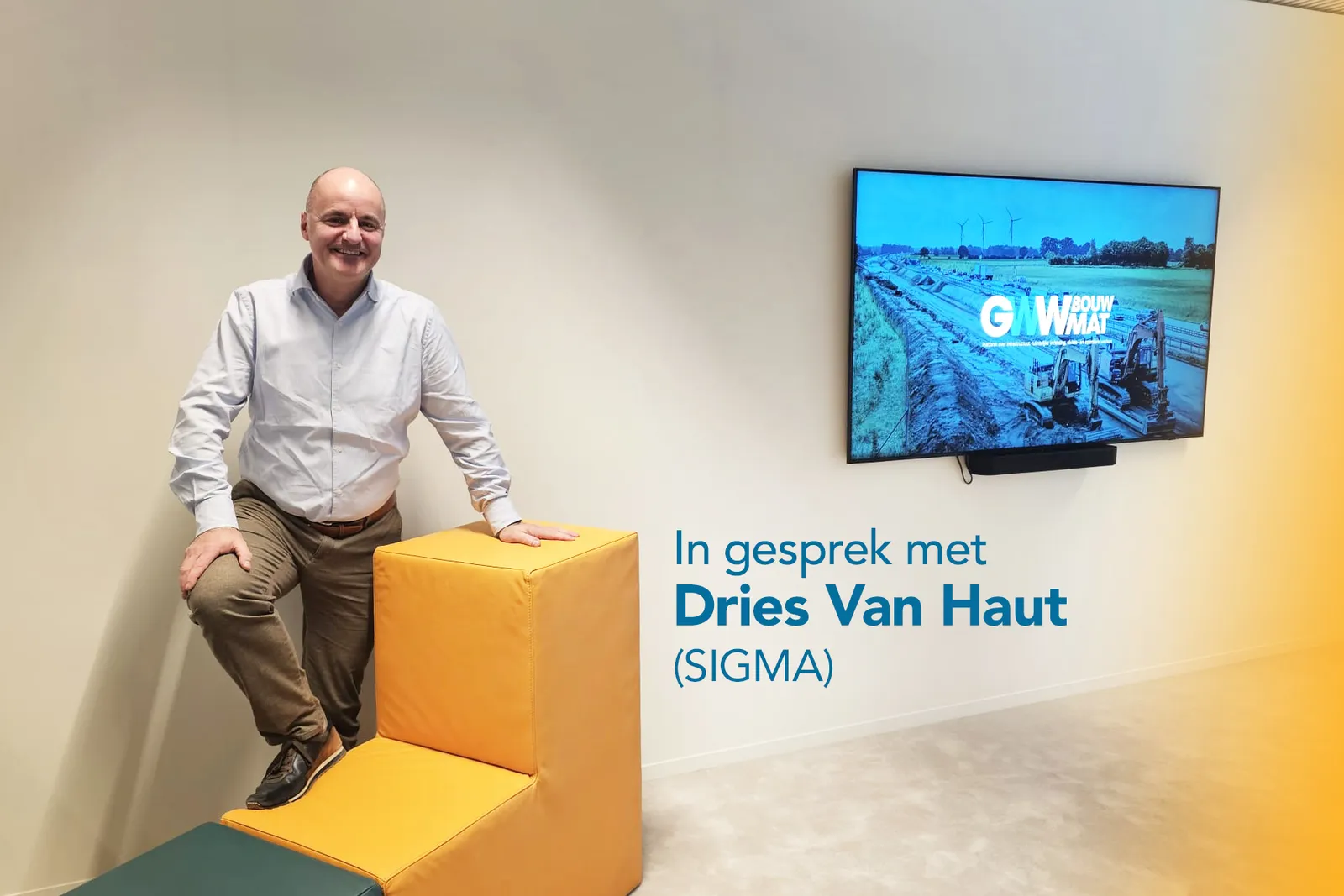
How is our sector evolving, and how are we preparing today for tomorrow? In this podcast, we talk to key figures from the sector who not only explain current developments but also dare to look ahead. People at the heart of the industry who help shape technology, regulation, safety and professionalisation. Our guest today is none other than Dries Van Haut, Chair of SIGMA, the Belgian trade association for importers, distributors and manufacturers of construction and earthmoving equipment, civil engineering machinery, materials handling equipment and industrial vehicles.
Together with Dries, we take an in-depth look at the sector. Where does it stand today, against a backdrop of economic uncertainty, tighter regulation and growing labour shortages? What technological and sustainability trends are emerging towards 2026 and beyond? And what role can and should a federation such as SIGMA play?
Question about this story? Ask your question
Full transcript
Alle hoofdstukken (45)
- Introduction to the podcast
- Guest's response
- Introducing SIGMA
- How SIGMA operates
- Personal motivation as Chair
- Commitment and collaboration
- Economic report and market figures
- Explaining the falling figures
- Temporary or structural?
- Putting things into perspective
- Geopolitical uncertainty
- Impact on businesses
- The war for talent
- Shortage of technical staff
- Technology and transition as a response to labour shortages
- The state of automation and telemetry
- Challenges around operating range
- The high cost of electric machines
- SIGMA's role in subsidies
- Sharing knowledge and external communications
- Predictive maintenance
- Using data and telemetry
- Acceleration through more data
- The rise of AI
- AI as a necessity
- Reflecting on technological developments
- Shift towards aftersales
- Changing market dynamics
- Growth of SIGMACERT
- Explaining SIGMACERT
- Objective inspections and growth
- The quick-fire round begins
- Electric or hydrogen
- Machinery Regulation
- Uptime as a KPI
- Belgium as a pioneer or a follower
- Looking ahead to 2026
- A cautious recovery
- Key trends towards 2026
- SIGMA’s role in the future
- Working with other federations
- A message for policymakers
- Administrative simplification
- Closing quote
- Closing the podcast
Introduction, SIGMA and the economic climate
Speaker: Dries Van Haut (Chair of SIGMA)
Host: Kris Vandekerckhove
Introduction to the podcast
Kris Vandekerckhove Welcome to the Bouwmat Podcast, the platform for professionals in the construction and materials sector. Kris Vandekerckhove: How is our sector evolving, and how are we preparing today for tomorrow? In this podcast, we talk to key figures from the sector who not only explain current developments but also dare to look ahead.
Kris Vandekerckhove People at the heart of the industry who help shape technology, regulation, safety and professionalisation. Our guest today is none other than Dries Van Haut, Chair of SIGMA, the Belgian trade association for importers, distributors and manufacturers of construction and earthmoving equipment, civil engineering machinery, materials handling equipment and industrial vehicles.
Kris Vandekerckhove SIGMA plays a crucial role in the sector: representing it to government and policymakers, safeguarding safety and quality through initiatives including SIGMACERT, and serving as a knowledge centre for regulation, certification and technological innovation.
Kris Vandekerckhove Today, together with Dries, we take an in-depth look at the sector. Where does it stand today, against a backdrop of economic uncertainty, tighter regulation and growing labour shortages? What technological and sustainability trends are emerging towards 2026 and beyond? And what role can and should a federation such as SIGMA play?
Kris Vandekerckhove A long introduction, but welcome, Dries.
Guest's response
Dries Van Haut I have to say, it's a great honour to be the first guest on the podcast. Thank you for that.
Introducing SIGMA
Kris Vandekerckhove The honour is all ours, Dries. For anyone who isn't familiar with SIGMA, which seems very unlikely, but just in case, is there anything you'd like to add?
Read the full transcriptCollapse transcriptnog 42 hoofdstukken
How SIGMA operates
Dries Van Haut You've already covered it very comprehensively. We are indeed a federation of forklift and construction machinery importers, and in that sense a traditional trade association. We do the things most trade associations do.
Dries Van Haut We provide information on technical, legal and social matters. We also represent our members' interests. For example, we are currently involved in social negotiations with the social partners over the collective labour agreement.
Dries Van Haut And, of course, it's also a place where we get to know our colleagues and network.
Personal motivation as Chair
Kris Vandekerckhove You've been Chair of SIGMA for years and were recently re-elected. What personally motivated you to take on this role?
Commitment and collaboration
Dries Van Haut It's probably just in my nature. I've always been someone who readily takes on commitments and responsibilities in various associations.
Dries Van Haut When you see small and large companies often struggling with the same issues and problems, it seems a bit silly to tackle them all separately. It makes much more sense to work together.
Economic report and market figures
Kris Vandekerckhove So, in short, you're a sociable person. You say it, and I won't argue. SIGMA publishes an economic report twice a year, and we've seen some striking declines. Are there any signs of improvement?
Explaining the falling figures
Dries Van Haut First of all, there are several reasons for those declines. We've come through a period in which one record after another was broken. In 2021, 2022 and 2023, growth seemed limitless.
Dries Van Haut So it's only natural that, at some point, things turn and the figures fall. The general economic situation means that people aren't investing on a large scale at the moment.
Dries Van Haut We are also seeing new players enter the market, meaning the pie is shared among more people and the figures are therefore lower. Not all these new players are members of our association.
Dries Van Haut A fourth factor is the geopolitical situation, which is creating a great deal of uncertainty and caution.
Temporary or structural?
Kris Vandekerckhove Do you see this as a temporary correction or a structural shift?
Putting things into perspective
Dries Van Haut Some factors are temporary, such as the fact that we're coming out of a record period and the current economic situation. But the arrival of new players is more of a structural change.
Geopolitical uncertainty
Kris Vandekerckhove You often talk about geopolitical turbulence. How tangible is its impact on your sector?
Impact on businesses
Dries Van Haut Businesses are being more cautious. People don't really know what's coming or how the economic situation will develop.
Dries Van Haut Things such as import tariffs and international tensions have a direct impact on our products. Our customers' customers are also being more cautious.
Dries Van Haut There is unease and caution throughout the value chain, so people are marking time.
The war for talent
Kris Vandekerckhove On top of that, there's the war for talent. Is the shortage still as acute, and where is it most pronounced?
Shortage of technical staff
Dries Van Haut It's getting worse, and we don't expect it to improve. The problem is particularly serious when it comes to technical staff.
Dries Van Haut It's hard to find both mechanics and office staff who handle technical matters. Customers themselves have fewer technical staff, so they rely on us more.
Dries Van Haut That only makes the problem worse. Younger people also have a different attitude to work-life balance and work fewer hours than the older generation.
Technology, electrification, AI and aftersales
Technology and transition as a response to labour shortages
Kris Vandekerckhove Yes, we're seeing that here too. That brings us neatly to the next part of the podcast: technology and transition, which could perhaps help ease the war for talent to some extent.
Kris Vandekerckhove We're right in the middle of what is almost a revolution, a period of technological transition. Where do you see the biggest breakthrough? Will it be electrification, automation or telemetry?
The state of automation and telemetry
Dries Van Haut Automation and telemetry are already well advanced in our industry. It's hard to think of any larger machine that doesn't have telemetry.
Dries Van Haut But the biggest shift is certainly coming in construction machinery. Not forklifts, but construction machinery. At the moment, the focus there is mainly on electrification.
Dries Van Haut We're still right at the beginning of that story. It's a topic that comes up in every investment discussion.
Challenges around operating range
Dries Van Haut The biggest challenge is getting machines that can operate for a full working day.
Dries Van Haut That's already possible with certain types of machine that don't need to move much, such as cranes. With other machines that are constantly moving, such as excavators, the challenge is still to get through a full working day on one battery charge or with a smooth battery swap.
The high cost of electric machines
Kris Vandekerckhove Quite apart from their operating range, these machines are still fairly expensive.
SIGMA's role in subsidies
Dries Van Haut Businesses need to move in this direction. The question is how SIGMA can help lower the barriers.
Dries Van Haut One thing we've achieved in the past is getting an electric construction machine or road-going site vehicle weighing at least five tonnes included on VLAIO's exhaustive technology list.
Dries Van Haut This means customers can receive 20 or 25 per cent eco-support. It helps, but the support remains limited, because an electric machine often costs 50 to 100 per cent more than a conventional diesel machine.
Sharing knowledge and external communications
Kris Vandekerckhove So you use your knowledge to help members access subsidies?
Dries Van Haut Absolutely. For example, we also took part in information days organised by M-Build and Bera, where SIGMA helped inform the sector about what is already possible and what is not. We do this both within the association and externally.
Predictive maintenance
Kris Vandekerckhove We also hear a lot about predictive maintenance. It seems to be the next step in many sectors. How far along are we with it in Belgium?
Using data and telemetry
Dries Van Haut Better information from telemetry makes preventative maintenance possible. Remote diagnostics are entirely feasible.
Dries Van Haut The major players are the ones that are already well advanced in this area. I'm not quite as familiar with it myself, but from what I hear from colleagues, there are already plenty of programmes available.
Dries Van Haut I remember an example involving Enbeeld and fuel consumption, but that data is also used for preventive maintenance. That's nothing new, really.
Acceleration through more data
Dries Van Haut Having more data available makes it easier to apply it accurately and more actively. A slight digression, sorry about that.
The rise of AI
Kris Vandekerckhove No problem. How is AI being adopted? That's obviously the next big step.
AI as a necessity
Dries Van Haut If you're not using AI yet, you're too late. Developments are moving incredibly fast.
Dries Van Haut One thing many people do, and so do we, is use AI to analyse technical problems.
Dries Van Haut A customer comes in with a problem with a machine, and AI searches the company's own data to find out how that problem was resolved last time. That way, you don't have to reinvent the wheel every time.
Reflecting on technological developments
Kris Vandekerckhove Exciting times, Dries?
Dries Van Haut Absolutely.
Shift towards aftersales
Kris Vandekerckhove We're seeing a striking shift. Sales of new machines are falling, while aftersales is growing. What does that tell us about the market?
Changing market dynamics
Dries Van Haut Our economic reports show that the balance is shifting. That doesn't necessarily mean sales of new machines are falling, but aftersales is becoming more important.
Dries Van Haut Customers have fewer technical staff and rely on us more. That's one factor.
Dries Van Haut It's also typical of a period when people invest less and keep their machines for longer.
Dries Van Haut As a result, machines are used for two years longer than planned, which brings additional costs. Aftersales is becoming more important, but I don’t see any dramatic change in the short term.
Growth of SIGMACERT
Kris Vandekerckhove SIGMACERT is growing year on year. What explains the rising demand for uniformity and safety? Is this being driven by the government or by you?
Explaining SIGMACERT
Dries Van Haut SIGMACERT is mainly used for forklifts, because there was no structured inspection system for them in the market. We have tried to address that with a structured approach.
Dries Van Haut This is less of an issue with construction machinery, as it is often used as lifting equipment and is already subject to the standard quarterly inspection.
Dries Van Haut One advantage with forklifts is that the person carrying out the maintenance also performs the inspection at the same time. That avoids two or three separate visits.
Objective inspections and growth
Dries Van Haut This is guaranteed through inspection systems and spot checks, ensuring that everything is done objectively.
Dries Van Haut Growth within SIGMACERT is steady and normal. Older machines have to be inspected again and new ones are added. This gives us annual growth, without any spectacular breakthrough.
Quick-fire round, outlook and closing
The quick-fire round begins
Kris Vandekerckhove Right, as the penultimate part of this podcast, we’re moving on to the quick-fire round, Dries. Here we go.
Dries Van Haut Fire away.
Kris Vandekerckhove Five very short questions, and we’re expecting short answers too.
Dries Van Haut Go right ahead.
Electric or hydrogen
Other speaker: Electric or hydrogen?
Dries Van Haut It depends on the type of machine and, above all, its power output. Electric power will definitely take off for lower power outputs, and it is already doing so.
Dries Van Haut For the really high power outputs, I’m convinced hydrogen will be necessary, simply because battery solutions are nowhere near on the horizon. A number of players are already working on hydrogen-powered machines, by the way.
Machinery Regulation
Kris Vandekerckhove Machinery Regulation, a blessing or a burden?
Dries Van Haut Definitely a blessing. The European Machinery Regulation creates a level playing field, where everyone starts out on an equal footing.
Dries Van Haut It ensures fair competition, and we at SIGMA help ensure that only machinery compliant with CE regulations is placed on the market.
Uptime as a KPI
Kris Vandekerckhove Uptime seems to be increasingly seen as the key KPI.
Dries Van Haut Can I give a very short answer? Yes.
Kris Vandekerckhove All right.
Belgium as a pioneer or a follower
Dries Van Haut Is Belgium a pioneer or a follower? I think we are followers in most cases. Take electrification, for example: the Netherlands is clearly a pioneer.
Dries Van Haut That said, Belgium is ahead of neighbouring countries such as Germany and France in a number of areas. Electrification is one example.
Dries Van Haut The CO2 Performance Ladder is also being discussed here, with discounts linked to tenders. It was planned for early 2025 and has already been postponed several times, but it is very much under discussion.
Dries Van Haut That issue is much less prominent in Germany and France.
Looking ahead to 2026
Kris Vandekerckhove Last question of the quick-fire round. Will 2026 be a bumper year or a year in between?
Dries Van Haut I’m afraid it will be a year in between. We’ve had a couple of bumper years, so that’s not so surprising.
A cautious recovery
Kris Vandekerckhove If it’s a year in between, can we talk about a cautious recovery in 2026?
Dries Van Haut We at SIGMA have always thought the figures would start to rise around September–October.
Dries Van Haut We also look at the National Bank’s business confidence indicator and have recently seen it flatten slightly.
Dries Van Haut Let’s hope that’s temporary and that there will be a recovery after the winter, in January or February. We’re not expecting a spectacular rise, but we are expecting a recovery.
Key trends towards 2026
Kris Vandekerckhove What do you think are the three biggest trends that will shape the sector towards 2026 and beyond?
Dries Van Haut First and foremost, electrification, which will continue to gain ground. I also think there will be technical and technological developments that help it take off.
Dries Van Haut Another important factor is AI. Our IT supplier once said that six months in AI is an eternity.
Dries Van Haut The third point I’d highlight is the geopolitical situation. If the war in Ukraine were to be resolved, the whole picture would look very different.
SIGMA’s role in the future
Kris Vandekerckhove What role do you see for SIGMA in the future?
Dries Van Haut We’re constantly trying to adapt to remain interesting and relevant. It’s a familiar pattern that when things are going less well, people have a greater need for a federation.
Dries Van Haut During the Covid period, we suddenly saw much greater demand for reliable information and advocacy.
Dries Van Haut Today, information is easier to find via Google or AI, so we are putting more emphasis on advocacy, networking and the personal touch.
Working with other federations
Kris Vandekerckhove The personal touch must never be missing.
Dries Van Haut It may also be worth mentioning that we are working more closely with two other federations.
Dries Van Haut On the one hand, Fedagrim, the federation of importers and distributors of agricultural machinery, with which we have a clear overlap.
Dries Van Haut On the other, Bera, from the rental sector. The three federations organise a New Year event together.
A message for policymakers
Kris Vandekerckhove One final question. If you could give policymakers one message, what would it be?
Dries Van Haut Make sure that at least two outdated laws or regulations are scrapped for every new one introduced.
Dries Van Haut Businesses are swamped with administration, which makes everything unnecessarily expensive.
Dries Van Haut Today, we have to put far more staff into back-office and administrative work. There is still a long way to go.
Administrative simplification
Kris Vandekerckhove So, administrative simplification.
Dries Van Haut Absolutely.
Closing quote
Kris Vandekerckhove You like to finish with a quote.
Dries Van Haut I’ll use my favourite quote from Winston Churchill: “Success is the ability to go from one failure to another without losing enthusiasm.”
Closing the podcast
Kris Vandekerckhove We feel the same way here at Louwers Mediagroep. Fantastic. Dries, it’s been a great conversation, and as the first podcast for GWW, you’ve set the bar high for our next guests. Thank you.
Dries Van Haut Thank you. I was pleased to be the first to appear here on behalf of SIGMA.
Kris Vandekerckhove Thank you, Dries.
Dries Van Haut Thank you.
Keep following this
Get an email when a new story is published. No account needed.
- SubjectGeneral







