









Partnership brings Vanadium Redox Flow technology to industry
Text Jan De Nul / Kris Vandekerckhove –Image Jan De Nul
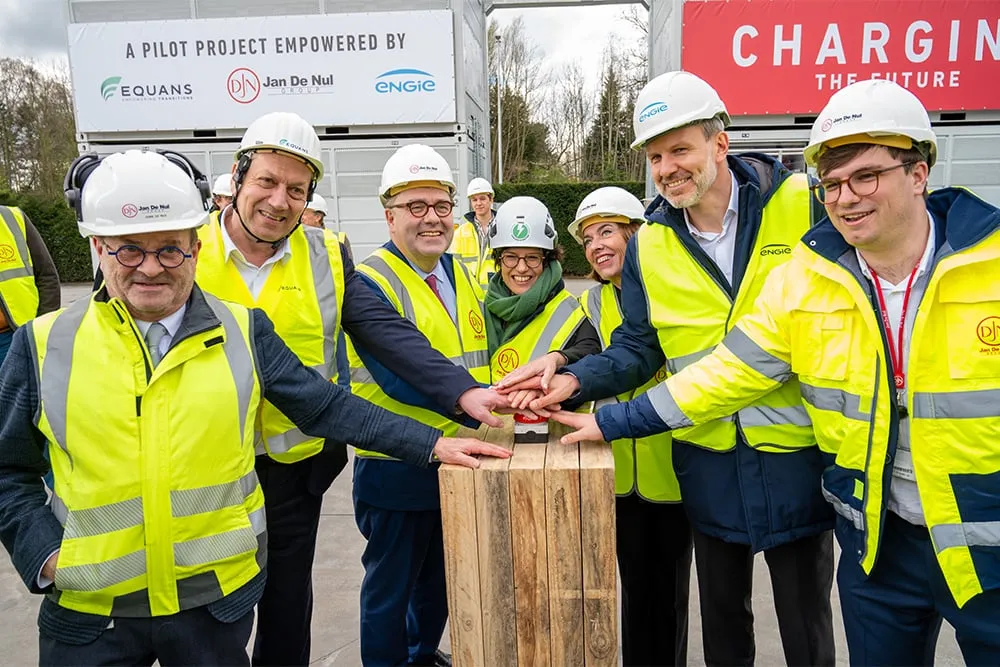
Joining forces for a battery energy storage system
When a number of ‘captains of industry’ join forces, you know something is happening. Expectations were therefore high as the partnership driving the transition to a carbon-free economy was put to work at the official press presentation at Jan De Nul in Aalst.
Jan De Nul Group, ENGIE Belgium, Equans BeLux and Invinity have recently launched a pilot project to explore the use of Vanadium Redox Flow batteries on an industrial scale. This battery type, relatively unknown to the general public, offers a safe and sustainable alternative to conventional lithium-ion batteries. The companies will investigate how these batteries can improve electricity management in an industrial setting and help bring about the transition to a carbon-free economy. The project was officially inaugurated in the presence of Minister of Energy Tinne Van der Straeten.
The potential of Redox Flow batteries
In 2019, research centre ENGIE Laborelec successfully carried out laboratory tests with a Redox Flow battery. It is now testing the control and maintenance of this technology on an industrial scale for the first time. ENGIE, Equans and Jan De Nul formed a partnership to install the Redox Flow battery on an industrial scale. Equans installed a Vanadium Redox Flow battery, manufactured by Invinity Energy Systems and with a capacity of 800 kWh, at Jan De Nul’s site in Hofstade (near Aalst), alongside its 578 kW solar installation. The installation consists of four 20 ft containers, stacked two high, and is managed by ENGIE’s smart Energy Management System (EMS), which controls the battery to optimise the installation’s self-consumption.
Frederik Van Praet, BESS (Battery Energy Storage Systems) Project, Jan De Nul, spoke first: “Jan De Nul is continuing its own energy transition and is fully committed to innovation. This project marks another step towards more sustainable operations. This Vanadium Flow battery will enable us to better balance energy supply and demand at this site. It will allow us to assess and learn how widely this type of technology can be used at our sites and in our operations in Belgium and around the world. Jan De Nul has always aspired to play a pioneering role in the energy transition.”
Empowering cities and industries
Equans designs, installs and delivers tailor-made solutions that optimise installations, systems and technical processes and make them easier to use. In doing so, the company helps its customers with their industrial, digital and energy transitions. It supports cities, industries and buildings in the fields of HVAC (heating, ventilation and air conditioning), cooling and fire safety, facilities management, digital and IT, electrical engineering, mechanical engineering and robotics. Equans is the market leader in France, Switzerland, Belgium, the Netherlands and the United Kingdom.
“We were responsible for the conceptual study, the tendering process and the integration of the various modules, and will maintain the battery system during the four-year test period. We see Redox Flow battery technology as a sustainable, robust and forward-looking solution, and are therefore particularly proud to contribute to this first industrial-scale test”, said Mark Dirckx, CEO of Equans BeLux.
Industrial test of a battery energy storage system
Vanadium Redox Flow batteries are innovative batteries that are now sufficiently developed technically and commercially to play an important role in the energy transition. They can be used instead of, or alongside, lithium-ion batteries, for example for local renewable energy generation at industrial sites or in centralised installations. Unlike lithium-ion batteries, Redox Flow batteries have a lifespan of at least 25 years, retain their capacity with little degradation and naturally provide storage for several hours. They are also safer, as there is no risk of uncontrolled combustion (thermal runaway), making them suitable for warmer climates, and they are easier to recycle at the end of their lifespan.
“As pioneers of the energy transition, we look beyond familiar lithium-ion batteries and are willing to choose innovation. There are currently few examples in Europe of large-scale projects using Vanadium Redox Flow batteries. This pilot project puts Belgium on the map as a pioneer in innovation in the energy sector. We want to become a major player in energy storage, with the ambition of developing 10 GW of storage capacity worldwide by 2030”, concludes Vincent Verbeke, CEO of ENGIE Belgium.
Een zakelijke vraag aan EQUANS? Get in touch
Companies in this story

Keep following this
Get an email when a new story is published. No account needed.
- SubjectGeneral
- CompanyEQUANS







