









Ostend | Wave Energy Converter
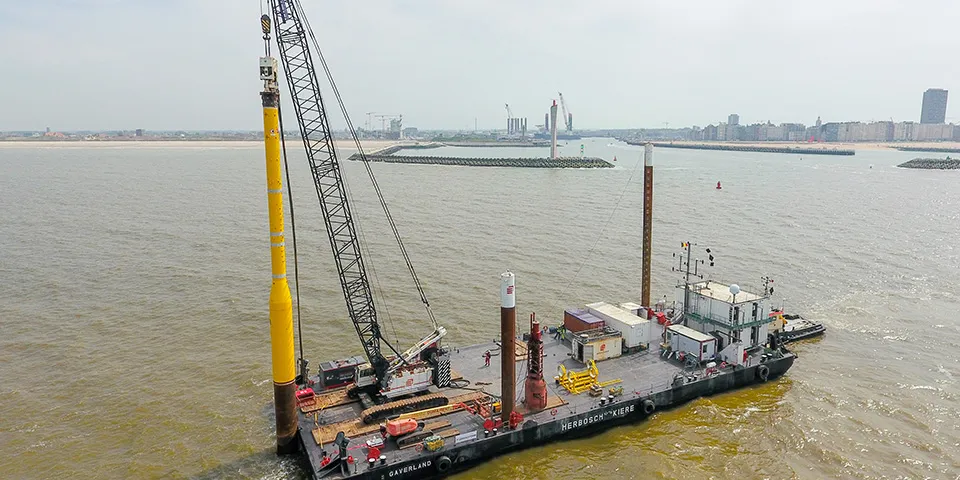
After years of intensive laboratory research and field testing, NEMOS GmbH, developer of a wave energy converter for generating blue energy, is building a prototype installation (at half scale) in the North Sea. The installation is planned approximately 500 m from the eastern harbour breakwater of the Port of Ostend, with Herbosch-Kiere responsible for the unusual foundation, piling and installation works.
North Sea setting for pilot project to generate blue energy
The installation comprises several components, including a 37 m-long, 50-tonne tubular pile that will serve as the structure’s foundation. “Access to the upper structure is provided by a set of ladders, with the section at the tidal level additionally protected so that small workboats can come alongside,” says Geert Stellamans, project engineer at Herbosch-Kiere. “The upper structure houses the controls, machinery and measuring equipment, all inside a cabin. NEMOS delivered all these components to the quay in Ostend. After Herbosch-Kiere’s work is complete, NEMOS will carry out a number of additional tasks to make the system fully operational.
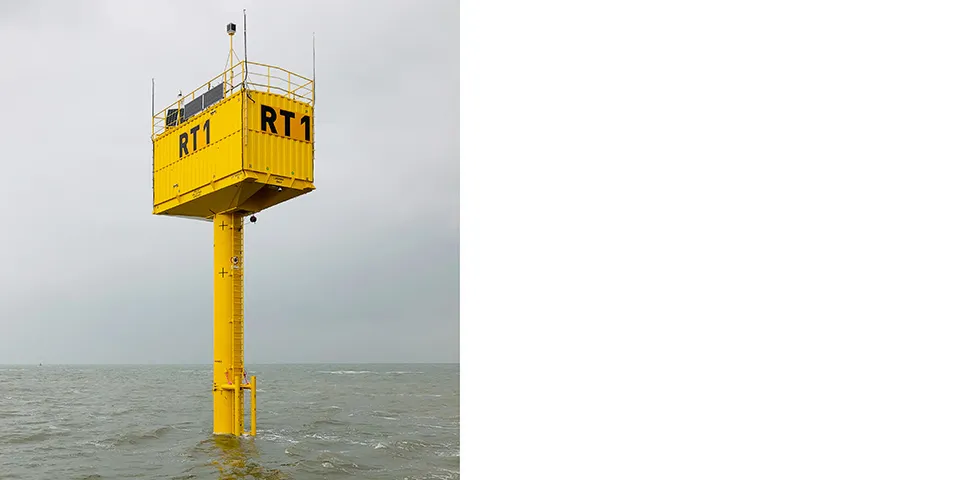
After years of intensive laboratory research, NEMOS GmbH, developer of a wave energy converter for generating blue energy, is building a prototype installation.
Vertical tubular pile
Herbosch-Kiere’s contract comprised a number of elements. Geert Stellamans explains: “First, the foundation had to be installed. The tubular pile, which was lying horizontally on the quay in Ostend, was lifted into a vertical position and then driven into the seabed at the site. A secondary crane was positioned on the quay for the operation. A 300-tonne telescopic crane lifted the pile from the quay and held it vertically alongside it. A cable crane aboard a pontoon took over the tubular pile and transported it to the piling zone. A heavy-duty vibratory hammer was used for the piling work. Once the pile was in place, all the ladder sections could be installed, followed by the cabin at the top of the tubular pile.”
Weather was an important factor in the overall installation plan, particularly wave height and the associated wind direction. “There are a number of clear restrictions when carrying out installation work on this scale,” explains Geert Stellamans. “Wind speed must not exceed 3-4 Bft, and significant wave height (Hs) is limited to 45 cm. The work was ultimately scheduled for the last week of April. However, the weather was against us and the installation had to be postponed several times, with work finally completed by the end of May.”
Challenge
The combined weight of the pile and vibratory hammer is approximately 70 tonnes. Geert Stellamans says: “With a dynamic coefficient of 1.3, the total calculated weight quickly reaches 90 tonnes. Combined with a length of 37 m, this was an important factor to take into account. A dedicated installation and lifting plan was therefore drawn up to identify all the risks. Carrying out this work was quite a challenge for Herbosch-Kiere.
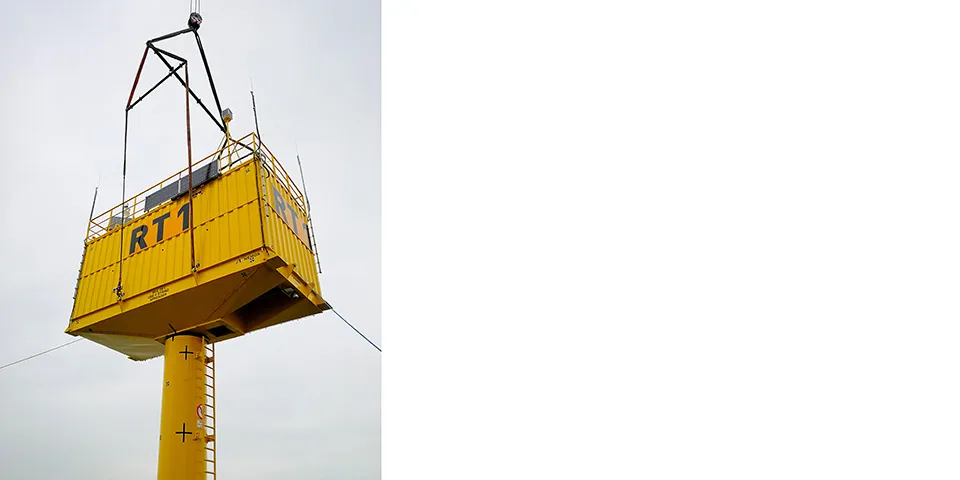
Installing the cabin.
To prevent damage to the head of the tubular pile during piling, a transition piece was bolted to its top. A total of 52 HT bolts were needed to transfer the force from the vibratory hammer to the tubular pile. “To ensure the smoothest possible force transfer, the vibratory hammer was fitted with 4 clamps instead of the standard 2,” says Geert Stellamans. “A driveability report indicated that a type 200M vibratory hammer would be suitable. However, this model was unavailable when the work was carried out. A 250M could have done the job, but this model is only available with 2 clamps. In the end, a 4-clamp 110M was used. This meant that drivability to the full depth could not be guaranteed 100%, so a back-up plan was needed. A DEMAG 62 diesel hammer was added to the work set to drive the tubular pile deeper if necessary. In the end, the tubular pile was driven to the specified depth using the vibratory hammer. Fortunately, Herbosch-Kiere has a very extensive equipment fleet and the support services to match, allowing it to respond quickly.”
Blue energy
Herbosch-Kiere’s work is now complete. Over the coming months, NEMOS will carry out a number of additional tasks to make the system operational. This will include installing a large float, along with various systems that convert the float’s movement into electricity.
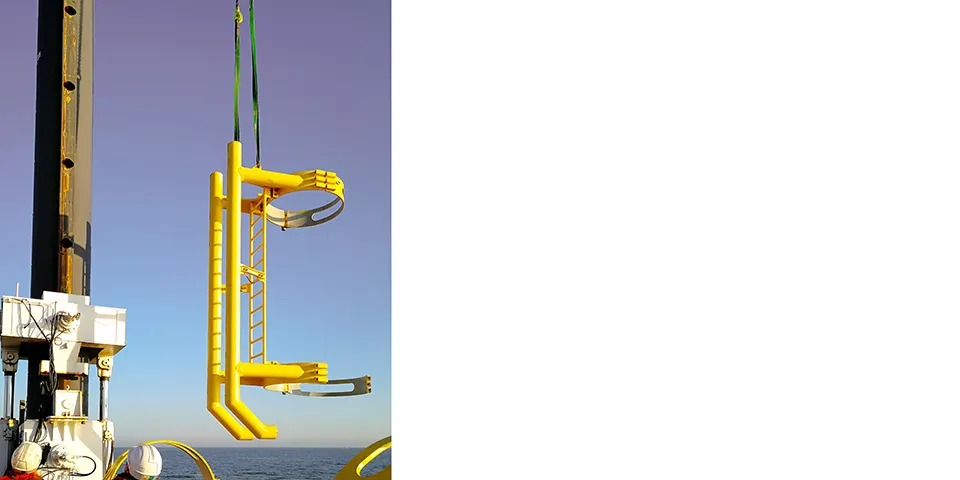
Installation of the lower ladder section.
Geert Stellamans says: “Once completed, the entire structure will be handed over to POM West-Vlaanderen, which will make the platform available after the summer to companies and knowledge institutions wishing to test or demonstrate new blue energy products. The aim is to use this test platform in real-life sea conditions to launch innovation projects across a range of marine and maritime sectors, focusing on wave, wind and tidal energy and the broader blue economy. Potential tests include generating wave energy, as NEMOS will be doing, corrosion research, cable handling and drone technology…
Herbosch-Kiere is proud to have taken part in this pilot project. We would like to thank the NEMOS team for their collaboration. We would also like to thank BMM, POM, Haven Oostende, MRCC and VIVES Dronelab for the excellent aerial photos, and for helping to ensure the project ran smoothly,” concludes Geert Stellamans.
Een zakelijke vraag aan Herbosch-Kiere? Get in touch
Companies in this story
Keep following this
Get an email when a new story is published. No account needed.
- SubjectGeneral
- CompanyHerbosch-Kiere







