









New Flemish government should continue to press ahead with investment plans
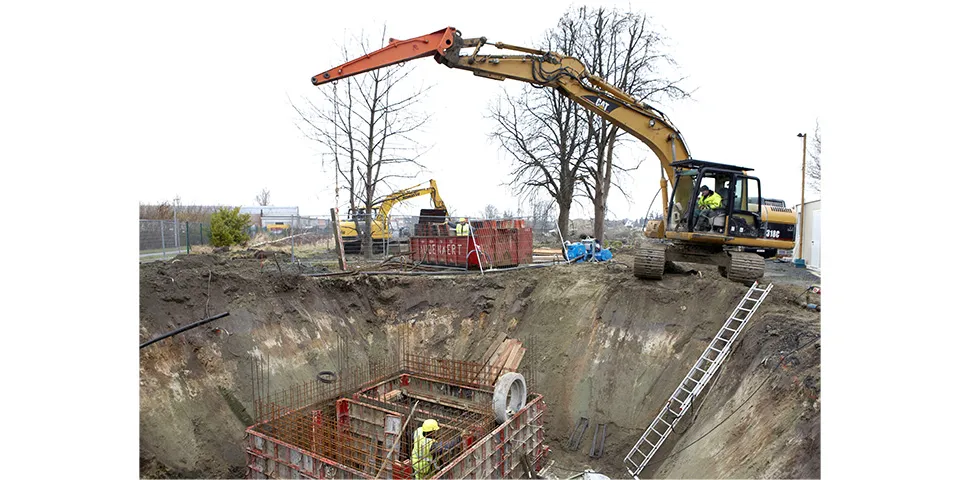
At the Flemish Construction Consultation Committee (VBOC) in March 2019, the Flemish government discussed its investment plans for 2019 with the construction sector. Both core investments and investment contributions are set to increase.
between different types of investment. Core investments have a direct, one-to-one impact on the construction sector. Alongside these are investment contributions, which are often only one part of a total investment. There are also loans and equity investments.
Around €4 billion
Compared with 2018, core investments in 2019 are up by €217 million to €2.688 billion, while investment subsidies have risen by €211 million to €1.374 billion. Together, that amounts to around €4 billion. Of core investments, 60% goes to mobility and public works (MOW), 31% to education and training, and 6% to the environment. The increase at MOW is due to work on the Oosterweel connection, additional funding for the Werkvennootschap for roadworks, and a €33 million increase in credits for the Waterweg. At the same time, investment subsidies at MOW are also rising. The funding comes, among other sources, from the kilometre charge. At the Department of the Environment, investment subsidies are increasing thanks to funding for the demolition and reconstruction grant (€15 million), resources from the Renewal Fund (€7.5 million) and resources from the Climate Fund (€7.8 million).
The Flemish Confederation of Construction is calling for an investment target of 5% of Flemish GDP in the longer term. According to the Bourgeois government, the building blocks for such a target are in place, but its precise definition is a matter for the new government.
Water
The Bourgeois government has acknowledged that meeting the 2027 deadline under the European Water Framework Directive will be difficult, despite investment that could reach €9 billion. Following on from Aquafin's 2020 optimisation programme, the government has allocated €230 million to 140 new projects. €100 million will go towards new treatment capacity, mainly expanding existing plants, or connecting homes in rural areas to existing plants. With the remaining €130 million, Aquafin will support municipalities.
2019 subsidy programme
Under the 2019 subsidy programme, €290 million will be spent on 184 municipal sewerage projects. Around €190 million of the actual sewerage costs will be subsidised at a rate of 75%. This amounts to a subsidy of €140 million. Almost 100 of the projects involve additional sewerage infrastructure.
Question about this story? Ask your question
Keep following this
Get an email when a new story is published. No account needed.
- SubjectGeneral







