









Measures to prevent alkali-silica reaction
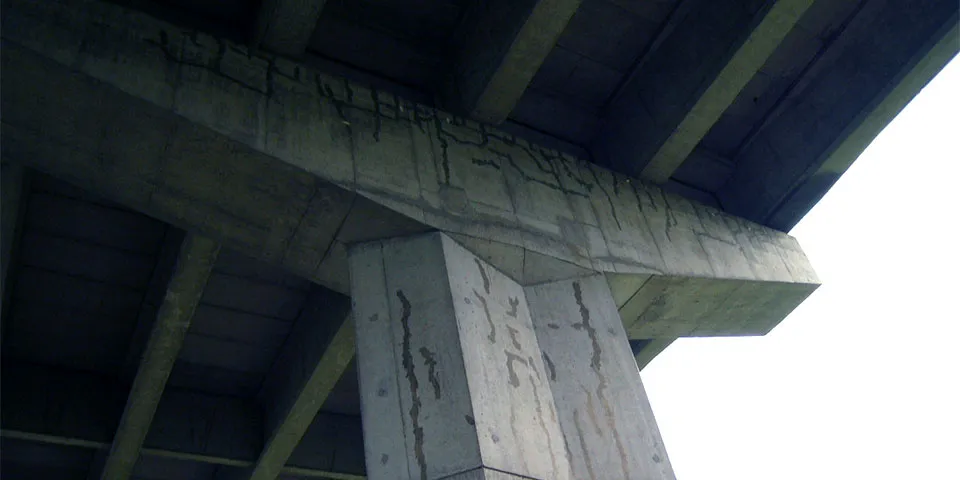
Although alkali-silica reactions (ASR) occur only rarely, this form of concrete damage can have far-reaching consequences. A new version of the Belgian standard NBN B 15-001 was published in 2018. It sets out a number of preventive measures that concrete producers can take.
Until a few years ago, ordering low-alkali cement (LA) was practically the only preventive measure commonly used to avoid the risk of an alkali-silica reaction. Since 2018, however, the NBN B 15-001 standard has provided concrete producers with several effective preventive measures. Although the measures are set out in an informative annex to the standard, they apply within the framework of BENOR certification for concrete. The measures must be implemented by the concrete producer. They must be selected according to the prevention level and exposure category specified in the concrete specification.
Prevention level (PREV)
The prevention level (PREV) classifies structural elements according to the potential economic and social impact of an alkali-silica reaction. Structural concrete elements for which the consequences of an alkali-silica reaction are largely unacceptable fall into class PREV2. Classes PREV1 and PREV3, in turn, are intended for concrete elements for which the consequences of an alkali-silica reaction are, respectively, acceptable and unacceptable. The prevention level must be stated in the information provided with the concrete specification. If the specifier does not provide this information, the concrete producer must assume the default prevention level, namely PREV2.
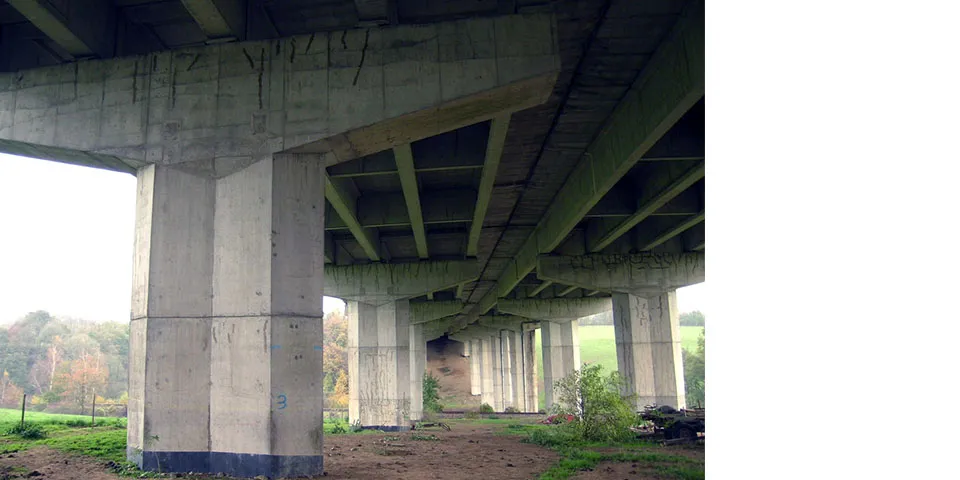
Since 2018, the NBN B 15-001 standard has provided concrete producers with several effective preventive measures.
Exposure category (AR)
The environment to which the concrete is exposed determines whether an alkali-silica reaction occurs and how it progresses. This factor is linked to the exposure category (AR). These categories can be linked to the exposure classes, which refer to the environment to which the concrete will be exposed (‘Concrete specification in accordance with standards NBN EN 206 and NBN B 15-001’ on the website of the Normen-Antenne Beton-mortel-granulaten).
Preventive measures
Several measures can be distinguished: using non-reactive aggregates, using low-alkali cement (LA), limiting the alkali content of the concrete and/or carrying out a swelling test to confirm the resistance of the concrete mix to alkali-silica reaction. The measure to be selected depends on the prevention level (PREV) and exposure category (AR). For example, using low-alkali cement (LA) will not provide sufficient protection for a civil engineering structure. We would also point out that preventive measures must now always be taken for external walls, such as using LA cement or limiting the alkali content.
For more information: WTCB-Dossiers 2019/4.1, available at www.wtcb.be.
Question about this story? Ask your question
Keep following this
Get an email when a new story is published. No account needed.
- ThemeMaterials with a lower environmental impact
- SubjectGeneral







