Plastic ground protection mats bend, but do not break
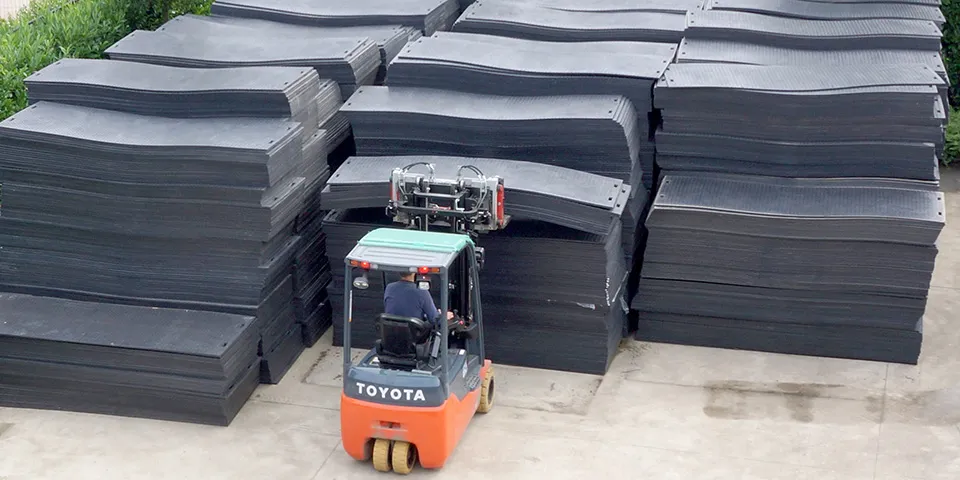
Conventional steel ground protection mats, used on many construction sites, are a familiar sight. But there is also a plastic alternative on the market. Popular in the Netherlands, this product has so far remained somewhat under the radar in Belgium. Induplates, a subsidiary of Indupack and a supplier of plastic ground protection mats, wants to change that. “Ease of use, purchase price, long service life and environmental benefits are the main advantages of plastic ground protection mats,” says managing director Vincent Van Baelen.
Indupack was founded in the early 2000s as a wholesaler of plastic pallets. Today, the company has two further divisions: Induplates and Induline. “Indupack still focuses on plastic pallets, while Induplates and Induline specialise in plastic ground protection mats and eco-friendly recycled products such as plastic fence posts, respectively,” explains Vincent Van Baelen, who describes how Induplates came about. “In the past, pallet buyers regularly asked us whether we could also supply plastic sheets to place between pallet loads. That is how we started selling PE sheets, and moving into ground protection mats was then only a relatively small step.”
Initially, the mats were part of Indupack’s product range, but in 2012 the managing director decided the time was right to give the product its own division, Induplates. Vincent Van Baelen says: “The mats grew in popularity and sales kept rising. We also want to offer customers a clear structure, so they know where our specialisms lie. Those specialisms are simple plastic products. That is the common thread running through the three product groups. Last financial year, Induplates recorded sales of just under €4 million worth of mats across Europe, both directly to end users and through distributors. That amounts to around 55,000 mats, with Germany as our largest market. On average, we keep around 15,000-20,000 mats in stock.”

Induplates’ plastic ground protection mats are made from shredded plastic bags.
Advantages
What advantages do plastic ground protection mats offer over their steel counterparts? “Plastic mats are considerably cheaper,” says Vincent Van Baelen, highlighting a key advantage. “They are also a relatively small investment for businesses. I’m thinking especially of smaller construction companies, contractors, bricklayers, landscapers and others. By buying plastic mats, they no longer depend on the larger hire companies. The mats are also much lighter, which makes them easier to use. There is no need for a crane, and they can be laid by hand. Businesses can therefore take care of temporary surfacing for their site roads themselves. It is an investment that pays for itself relatively quickly.”
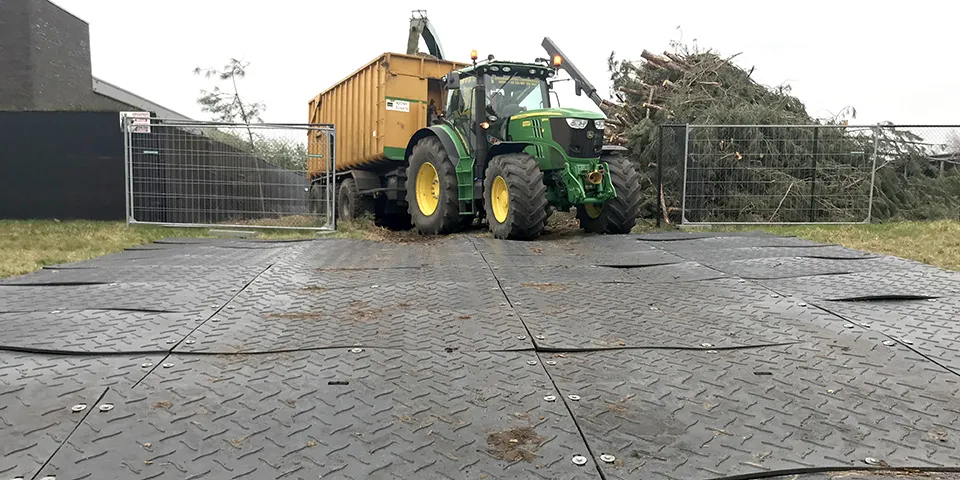
The mats are flexible and follow the contours of the ground without compromising stability.
The environment
Plastic ground protection mats also score highly in terms of sustainability. Vincent Van Baelen says: “The plastics sector often has a poor image when it comes to the environment, but our mats are made from 100 per cent recycled plastic, helping to create a better environment. The raw material is LDPE, or, put simply, shredded old plastic bags. The mats are made from this material. In that respect, we offer a highly environmentally friendly product. What is more, the mats have a virtually unlimited service life. But if they are damaged, or you want to replace them after around ten years, the old mats are shredded, washed and reused to make a new product.”
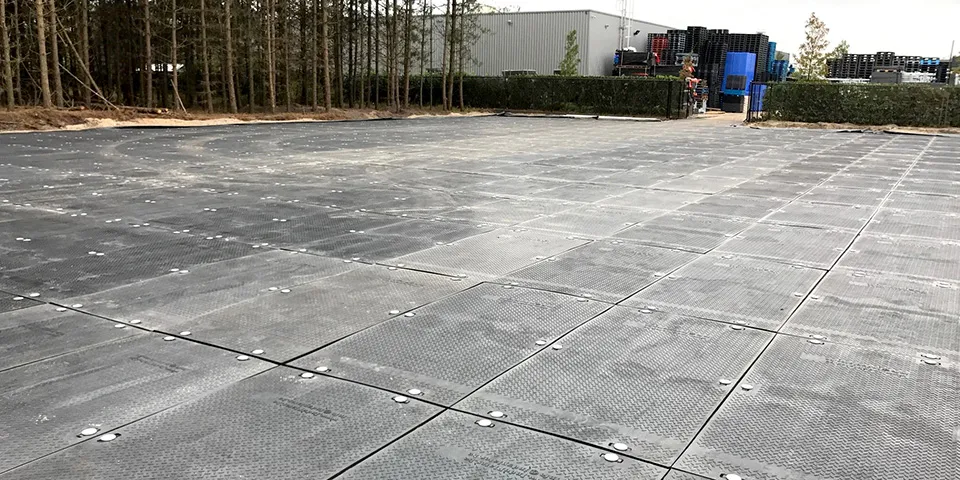
Thanks to couplers developed in-house, the mats cannot slide apart.
For every construction site
Vincent Van Baelen says plastic ground protection mats are just as strong as their steel counterparts. “The mats are flexible and follow the contours of the ground without compromising stability. Steel mats can bend under heavy loads on uneven ground. That is an extreme case, but it does happen. Plastic mats do not have that problem. We have also developed our own couplers, which allow all the mats to be connected to one another and prevent them from sliding apart.”
At bauma in Munich, Induplates showcased its full range. “We have ten models, differing in dimensions and thickness, and therefore also in weight and load-bearing capacity. The choice depends entirely on the intended application. Heavy construction firms, for example in roadbuilding, generally buy the 20 mm-thick mats with the highest load-bearing capacity. A landscaper working alone and needing to drive a bobcat across a pristine lawn, on the other hand, is more likely to need lightweight, easy-to-handle mats. Heavier mats also tend to stay in place for longer and can be moved or cleared away by a few people,” concludes Vincent Van Baelen.
Question about this story? Ask your question
Keep following this
Get an email when a new story is published. No account needed.
- ThemeMaterials with a lower environmental impact
- SubjectMachines & equipment