Natural stone paving increasingly popular in public spaces

On 4 April 2019, the Belgian Road Research Centre (OCW), in collaboration with FEBENAT, the Benelux Federation of Natural Stone Wholesalers, held a workshop on natural stone paving at Huis van de Bouw in Zwijnaarde. Topics included the use of natural stone in urban public-space projects, the properties of different types of natural stone and the legal aspects of public procurement.
Since 1952, OCW has served all partners in the Belgian road construction sector as an impartial research centre, guided by the principle of sustainable development through innovation. OCW’s remit is to promote technical progress in road construction through research, development and knowledge transfer. In keeping with this philosophy, the research centre organised a workshop on natural stone paving in early April. A French-language edition had also been held in September 2018. Natural stone paving is increasingly being chosen for public-space renovation and redevelopment projects, but the route to a finished result is often fraught with obstacles.
Legal aspects
To achieve a result in which aesthetics and comfort go hand in hand, it is important to avoid these obstacles. The workshop therefore gave all the parties involved a clear understanding of the latest developments and the associated legal, economic, technical and practical aspects. Annelies Verlinden, Country Co-Managing Partner at DLA Piper, explained the legal aspects of public procurement for road paving. “Price remains the traditional criterion in public procurement, but it often says little about quality,” she said. “A contract can also be awarded partly on the basis of other criteria, such as quality, environmental and/or social considerations.”
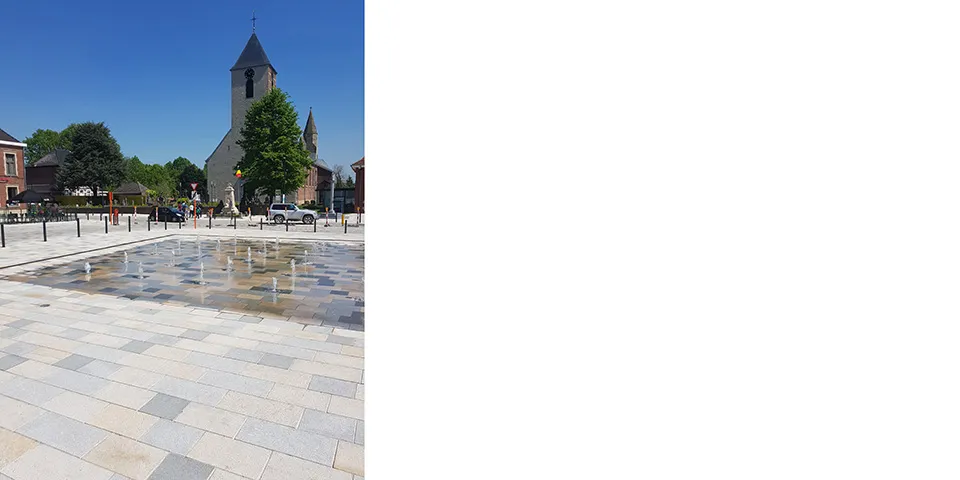
The choice of different sizes, colours and textures makes natural stone particularly attractive.
Natural stone paving guide
Examples of criteria that can favour natural stone in public procurement include requiring an eco-label, requiring technical approval with certification, and using basic or primary materials. Good practice in the design, construction, maintenance and repair of durable, safe and attractive natural stone paving is essential for use in public spaces. “That is why an OCW working group put together a guide to natural stone paving,” says Sylvie Smets of OCW. “It took ten years to write, but we needed that time because a lot has changed.”
The natural stone paving guide is a technical reference document for everyone involved in a natural stone public-realm project, including designers, architects, contractors, public- and private-sector road managers, and materials suppliers. It is a useful reference for material selection, project design and dimensioning, as well as the construction and maintenance of natural stone roads. Sylvie Smets says: “Natural stone has been used for paving for centuries. In recent decades it has faced strong competition from other paving materials, but today we are seeing natural stone regain popularity. However, we are noticing a loss of expertise in traditional techniques, and knowledge of materials and design is sometimes inadequate. One indication is the many requests for technical assistance. This guide is therefore a very useful resource.”

In recent decades, natural stone has faced strong competition from other paving materials, but today its popularity is growing again.
Many qualities
As a natural, unique, durable and timeless material, natural stone is well suited to public spaces. “It is also a very sustainable material because it is not fired and can be recycled,” says Kristof Callebaut, Doctor of Geology at Brachot-Hermant Group. “It also adds aesthetic value to a project. Its use goes back centuries: the Romans were already using Carrara marble. The choice of different sizes, colours and textures also makes natural stone attractive. In Belgium, Porfier van Quenast, Grès du Condroz and Belgian Blue Limestone are among the best-known types, but today we also see imports from countries such as Ireland (Kilkenny Lime-stone), Portugal, China and India. Surface finish is an important consideration when using natural stone in public spaces. It affects the stone’s slip resistance, appearance and susceptibility to soiling. For areas used by pedestrians, be sure to choose a finish with adequate slip resistance.”
Question about this story? Ask your question
Keep following this
Get an email when a new story is published. No account needed.
- ThemeFuture-proofing roads and railways
- SubjectMachines & equipment