Handrail lighting offers comfort and safety for vulnerable road users
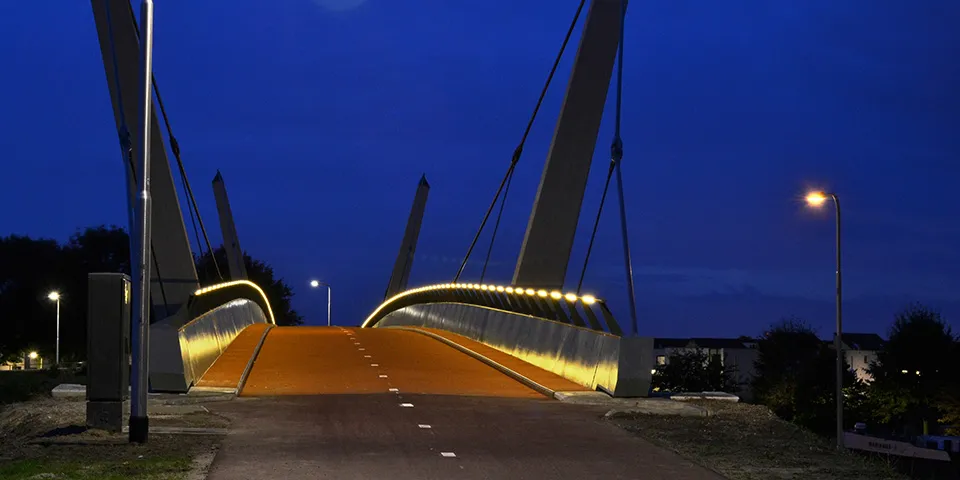
Designers of cycle and pedestrian bridges are increasingly choosing to integrate lighting into the handrails rather than the poles. But how do you create safe handrail lighting? “This is a relatively recent application on cycle and pedestrian bridges, so clear standards and specifications are not yet available,” says Piet Devriese of LEDtechnic, a specialist in linear LED lighting systems, including handrail lighting.
To determine the lighting level on the bridge deck, reference is generally made to the S(4) or P(4) standard for pedestrian or cycle environments. “In practice, however, these standards have proved inadequate for handrail lighting on bridges,” says Piet Devriese. “They were originally written with luminaires mounted on poles in mind, whereas the low mounting position of handrail lighting creates a completely different situation. In many cases, handrail lighting is also the bridge’s only lighting, usually in dark surroundings with very little or no ambient light.”
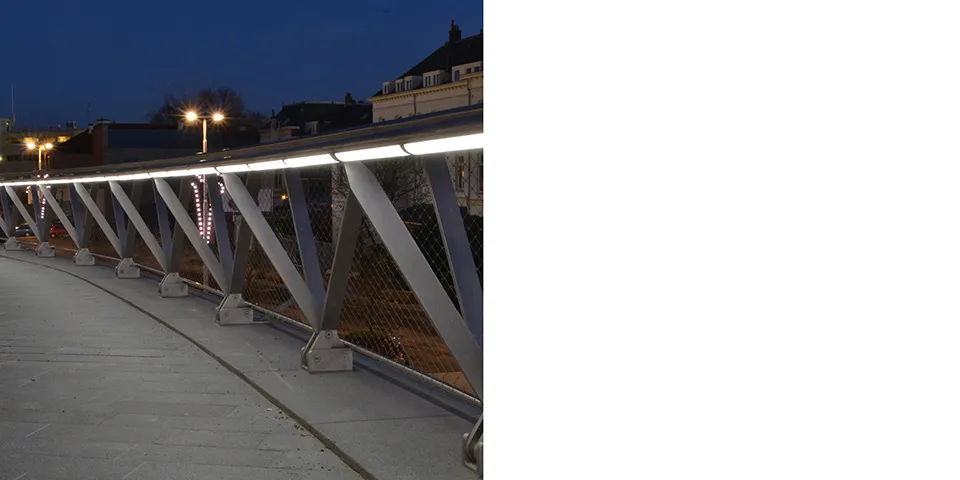
Facial recognition is maximised by providing consistent lighting across the bridge, directed as horizontally as possible.
Facial recognition
Experience has taught LEDtechnic that the light levels specified in these standards are high enough and can be achieved very easily by using point lighting with wide spacing (> 4m). Piet Devriese says: “But this arrangement is not ideal, particularly when it comes to facial recognition. On a cycle and pedestrian bridge, the focus should be on the comfort and safety of people using it. Facial recognition is crucial in this respect. It is maximised by providing consistent lighting across the bridge, directed as horizontally as possible.”
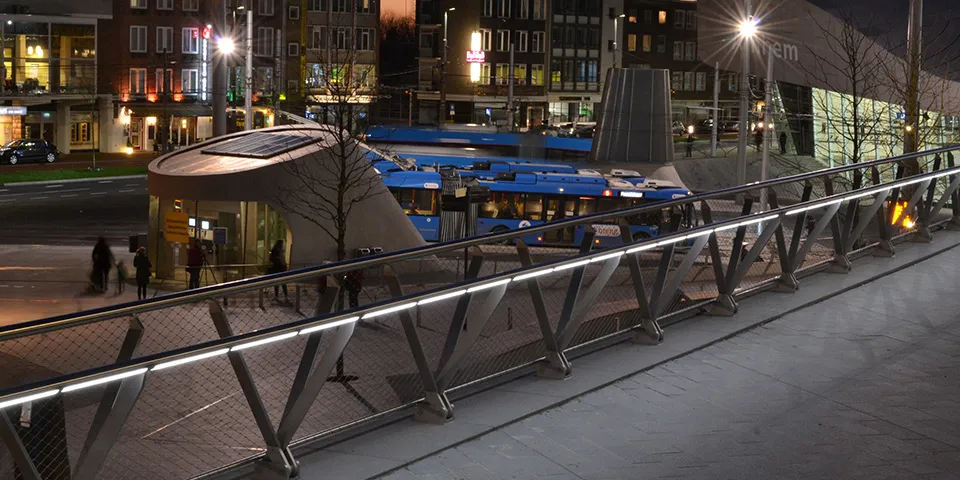
The station in Arnhem was fitted with an LEDrail in a gently curved design.
Consistent, diffuse and horizontal
When handrail lighting is installed horizontally, comfort must also be given careful consideration, and passers-by must not be dazzled. “Experience shows that, with a consistent, diffuse luminaire of this kind, a light output of around 60 lumens/m is the maximum for comfortable use on the bridge,” says Piet Devriese. “For safety and facial recognition, the target semi-cylindrical illuminance is 3 lux, with a minimum of at least 2 lux. This applies not only at a height of 1,5m, but also at 1,8m.”
“The safest and most comfortable handrail lighting for cycle and pedestrian bridges is not only consistent and diffuse, but also uses a wide beam angle and lighting directed as horizontally as possible to achieve the semi-cylindrical illuminance values. This should be combined with the average illuminance on the bridge deck,” concludes Piet Devriese.
Question about this story? Ask your question
Keep following this
Get an email when a new story is published. No account needed.
- ThemeExtending the life of bridges and tunnels
- SubjectMachines & equipment