FRP bridges continue to grow in popularity
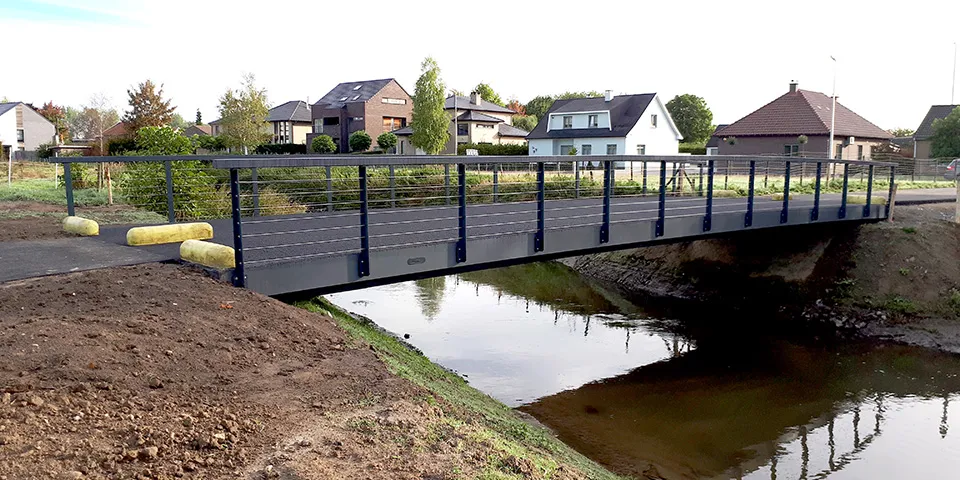
Fibre-reinforced polymer (FRP) is increasingly being chosen over more traditional concrete or steel for pedestrian and cycle bridges in public spaces. CGK Group, originally specialised in manufacturing and supplying chemical storage materials, joined the FRP trend a few years ago. “Our FRP bridges are manufactured using a vacuum technology developed by FiberCore and are supplied as a single piece, without a single nut or bolt, provided the length, width and span allow it,” says Jan Swyngedouw, project manager at CGK Group.
The Baljuwbrug in Galmaarden (14 x 2 m), the Brug Moerdreef in Malle (7 x 2.5 m), the Golfbrug in Hasselt (12 x 2.5 m), the cycle highway between Puurs and Bornem (16 x 4 m), and the Canadabruggen in Brugge (42 x 4 m) are just a few examples of FRP cycle and pedestrian bridges that CGK Group has helped deliver in recent years. Thanks to benefits such as being maintenance-free, durable, environmentally friendly, ultra-lightweight, very strong, safe and non-combustible, as well as offering good value for money, FRP bridges are growing in popularity in public spaces. FRP is a suitable alternative to conventional steel or concrete truss bridges, with no bonded joints and no screw or bolt connections.
“The bridge is manufactured as a single piece and is easy to install thanks to its low weight,” says Jan Swyngedouw. “CGK Group is also known as a manufacturer of plastic tanks. For our FRP landings, handrails, platforms and other products for industrial applications, we start with FRP profiles, which we cut and machine before using bolted joints to build FRP structures. Larger bridges and road bridges in public spaces have different load and construction requirements. That is why, for the past year and a half, we have also been working with the Dutch company FiberCore®, a specialist and market leader in bridges, lock gates and bridge decks made from ultra-strong composites for the infrastructure sector. There are already around 1,000 FiberCore® bridges in the Netherlands.”
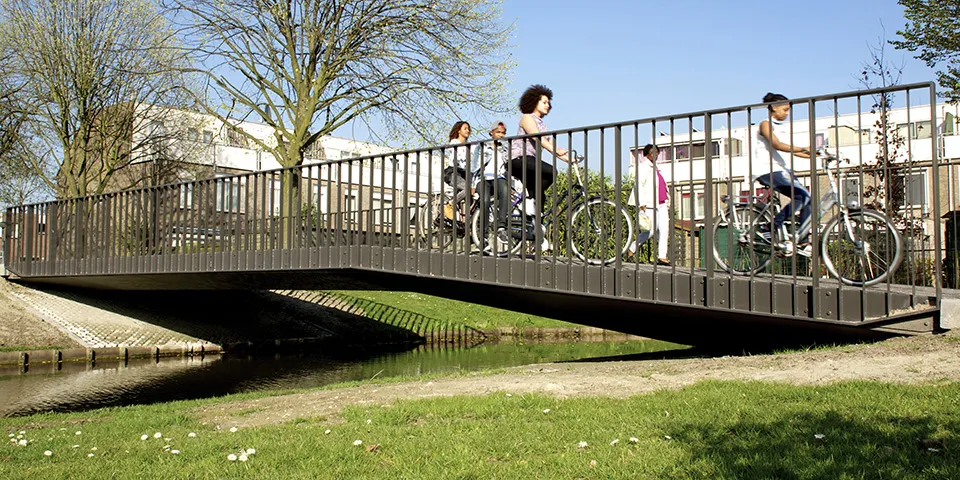
Fibre-reinforced polymer (FRP) is increasingly being chosen for pedestrian and cycle bridges in public spaces.
Longest composite cycle bridge
The globally patented InfraCore® technology is used in road bridges, bridge decks and lock gates. With this technology, large white mats of coarsely woven glass fibres are used as reinforcement in a mould, which is then placed under vacuum. The glass fabric is subsequently injected with resin. Once cured, it forms an exceptionally strong, flat panel capable of carrying heavy loads. In spring 2019, CGK Group and FiberCore® delivered a 42 m-long cycle and pedestrian bridge in Brugge, commissioned by De Vlaamse Waterweg and West Construct/Besix. The existing wooden bridges next to the Canadabrug were badly damaged and were replaced with new composite ones.
Pilot project
It is the first FRP cycle bridge of this size in Flanders and, at the same time, the longest single-piece composite cycle bridge in the world. The Concrete and Steel Expertise Department of the Department of Mobility and Public Works, KU Leuven, Ghent campus, and WTCB/SECO supported the project and carried out additional tests. The composite bridges in Brugge are a pilot project with great potential for the rest of Flanders. They have a service life of more than 100 years and are also flexible and quick to install.
Jan Swyngedouw: “The support of the Flemish government is a very good thing. The government fully recognises the benefits of FRP for bridges, which also opens the door to further research. In time, larger FRP road bridges are certainly not inconceivable. Quite the contrary. Hybrid bridges combining steel and FRP have already been installed successfully, for example. One such example is the extension of an existing railway bridge in Deinze with a pedestrian and cycle bridge.”
C-Bridge
CGK Group’s leading role in FRP is demonstrated by its involvement in C-Bridge, a roadmap for the design, regulation and construction of composite bridges in Flanders. C-Bridge is an initiative of Universiteit Gent and the Scientific and Technical Centre for the Construction Industry (WTCB), supported by the Flemish Agency for Innovation and Entrepreneurship (VLAIO) and numerous companies, including CGK Group.
Question about this story? Ask your question
Keep following this
Get an email when a new story is published. No account needed.
- ThemeExtending the life of bridges and tunnels
- SubjectMachines & equipment