









Largest onshore wind farm to be built in Zeebrugge
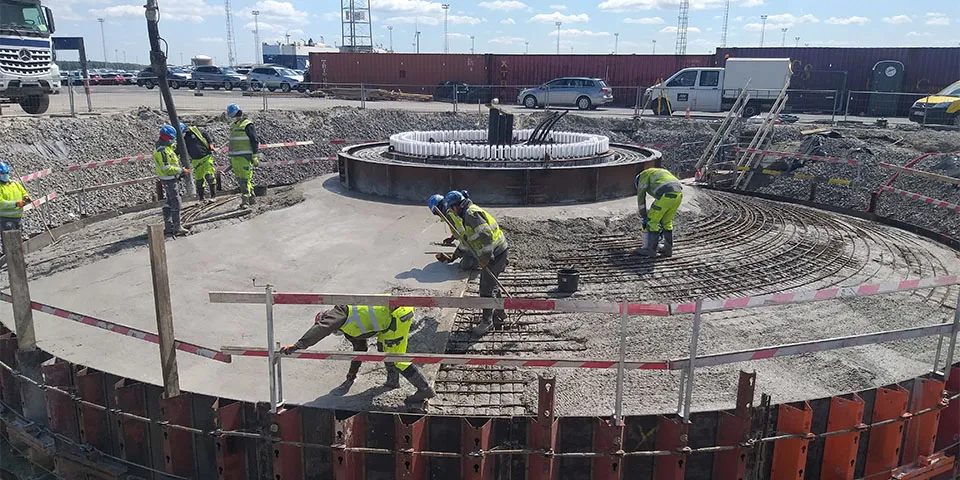
The port of Zeebrugge is to get the largest onshore wind farm on a single site in Flanders. The eleven wind turbines are being built for ICO Windpark, a partnership between International Car Operations (ICO), the port authority and ENGIE. Willemen Infra was responsible for building the wind turbine foundations and also constructed several working platforms for the cranes. “This was the first time we had worked on a wind farm project on this scale,” says project manager Wim Decorte.
The wind farm will have a capacity of 44 MW. From the second half of 2020, this green energy will be used by ICO itself, as well as by berthed ships, buildings and households in the surrounding area. The electricity will also be used to charge the 100,000 electric cars that arrive at the port by ship each year. ENGIE is providing the country’s largest electric vehicle charging hub at the wind farm, with 308 charging points. “We were commissioned to build the foundations for the wind turbines,” explains Wim Decorte, project manager for Willemen Infra. “We also built the working platforms needed to position the cranes that will erect the turbines.”
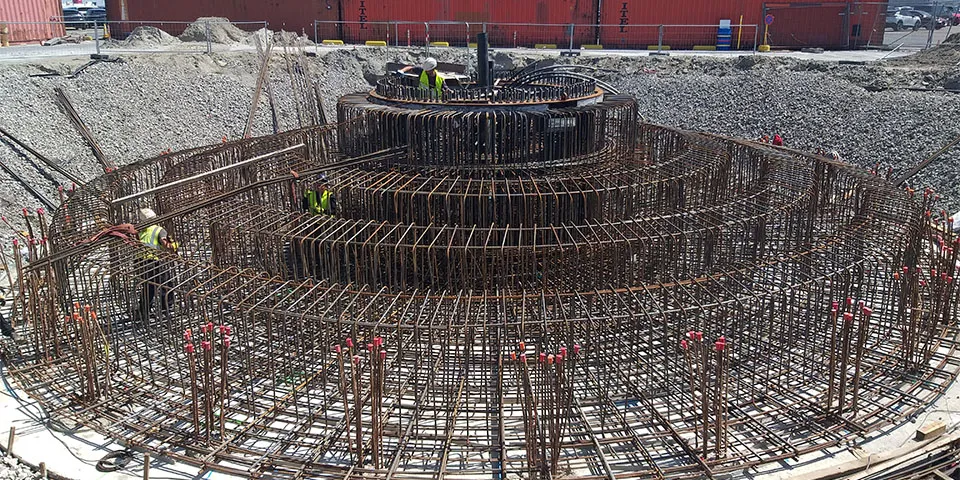
500 m³ of concrete per foundation
“Building the foundations involved installing the piles, dewatering and excavating the construction pit, and installing the ducting and the concrete working slab,” he explains. “The piles were cut off at cut-off level. The anchor cage and reinforcement were then installed, along with the earthing system, which was subsequently extended beyond the formwork. The lower section required formwork with a diameter of 17.5 m, while the upper section has a diameter of 6 m. Once the formwork was in place, we began pouring the concrete: 500 m³ per foundation, poured in a single day. A concrete pump was used to pump the concrete into the formwork. After striking the formwork, we extended the earthing system into the ground, backfilled the construction pit and finished the surface with stabilised crushed stone and asphalt.”
Go for Zero
The eleventh and final foundation was concreted on 4 June. The working platforms, in preparation for the actual erection of the wind turbines, were completed in May. According to Decorte, the coronavirus crisis had only a limited negative impact on the planned schedule. He also describes the exceptionally wet winter as an unforeseen challenge. “We are naturally proud of that. It was also the first time we had worked on a wind farm project on this scale. Successfully building the foundations for eleven wind turbines in a row, on the world’s largest car park, is very satisfying for the whole team. We also devoted a lot of time to safety. Under the banner Go for Zero, we aim for zero accidents on site, and of course our intention is to keep it that way until the work is complete. (This interview was conducted before 4 June, ed.) Given the size of the site, that would be quite an achievement too.”
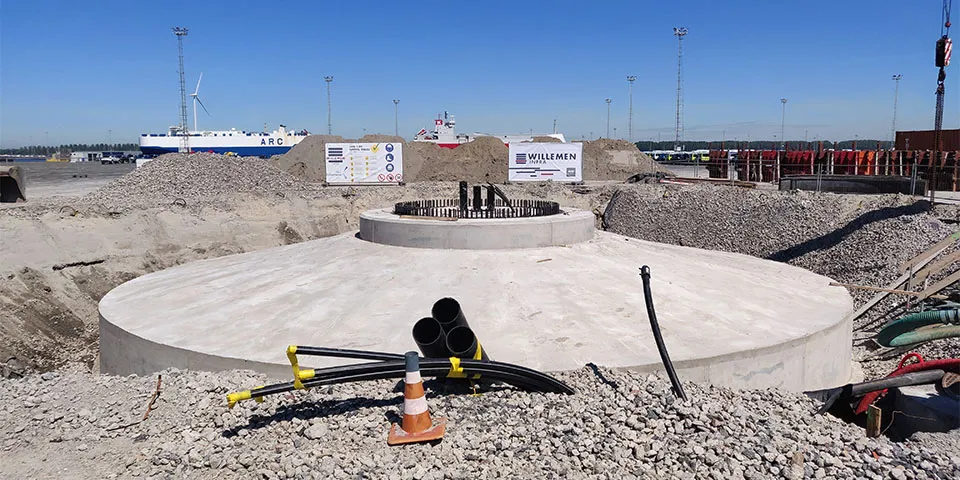
After the foundation piles had been cut off at cut-off level, the anchor cage and reinforcement were installed.
A fruitful partnership
Decorte has nothing but praise for the collaboration between the various parties. “It went exceptionally smoothly. We have been working with ICO and Port of Zeebrugge for some time, and we have nothing but good things to say about our collaboration with ENGIE and RESOL, which provided advice on safety, the environment, energy and quality. Since our experience is mainly in building bridges and tunnels, rather than wind turbines, we shared knowledge and experience in both directions. That continued even when COVID-19 emerged. The experience has inspired us to get involved in building wind farms more often in future.”
Question about this story? Ask your question
Keep following this
Get an email when a new story is published. No account needed.
- SubjectGeneral







