









Just two days of railway disruption to build tunnel using steel sheet piles
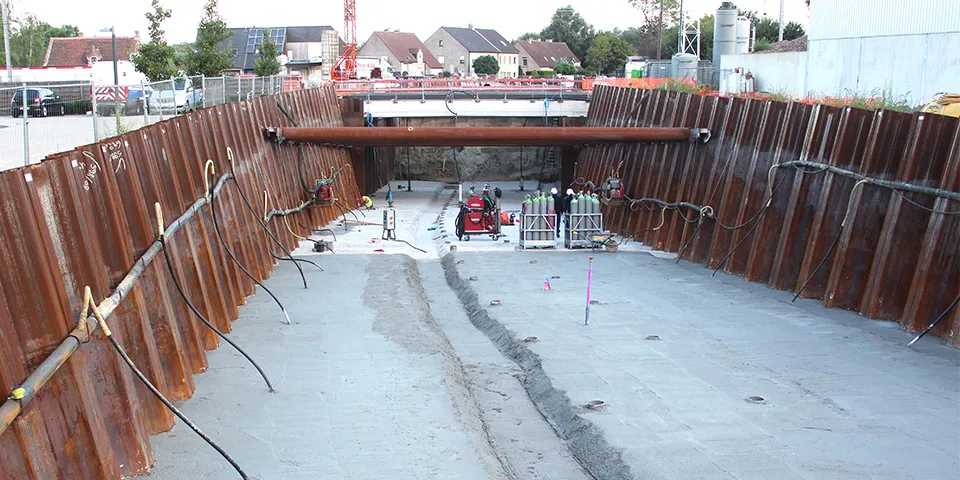
The busy Ghent-Antwerp railway line (L59) runs right through Lokeren. In the north-east of the city, the level crossing at the Oude Heerweg had been very unsafe for some time, with numerous accidents as a result. To provide a safe alternative and divert freight traffic away from the centre, rail infrastructure manager Infrabel decided, in consultation with the city council, to replace the level crossing with a tunnel between the nearby Uitbreidingslaan and Klipsenstraat.
The tunnel runs beneath four tracks, a service road and a cycle path. Two tracks (Nos. 1 and 2) carry through trains, while the other two (3 and 4) are shunting tracks. The tunnel will be accessible to lorries and cars and will also have a raised cycle path.
A narrow window
Through train services could be suspended for just two days, over the weekend of 5 and 6 May 2018, to build the tunnel. To complete the work within this narrow window, designer Tuc Rail opted for a solution using steel sheet piles. The concrete tunnel roofs are supported by 46 vertically installed AZ25-800 sheet piles, 12.4 to 12.6 m long. The tunnel entrances consist of 165 exposed AZ18-800 sections installed at a 5:1 slope, ranging in length from 5.6 to 12.4 m. A further 18 AZ18-800 sections, 3.4 m long, were needed to construct a sump beneath the tunnel floor to drain rainwater. The vertical sheet piles are connected to the sloping sheet piles using four special transition piles.
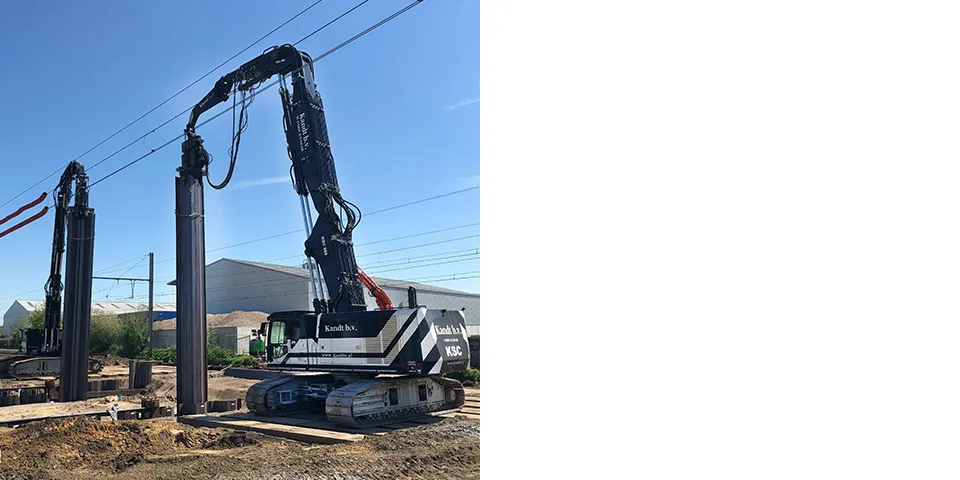
Driving the tunnel sheet piles with two 70-tonne hydraulic piling rigs.
The concrete trough deck for tracks 1, 2 and 3 was prefabricated alongside the tracks. 14 AZ25-800 sheet piles were driven between the trough deck and track 2. At 2.00 am on Saturday 5 May, rail traffic was suspended and tracks 1 and 2 were removed. 18 AZ25-800 sheet piles, 2 transition piles and 4 sloping AZ18-800 sheet piles were driven into the ground. The following day, the 400-tonne trough deck for the 3 tracks was slid over the sheet piles. After the deck had been connected to the sheet piles, tracks 1 and 2 were reinstated. Both tracks were back in service on Monday morning, 7 May.
The AZ18-800 sheet piles for the tunnel ramps were then installed at an angle of 11° and with a bend radius of 400m. The AZ25-800 piles were subsequently installed alongside track 4, the service road and the cycle path. The sheet piles for the tunnel and its entrances were driven using two 70-tonne hydraulic piling rigs, each fitted with a PVE 24VM vibro hammer.
Excavation
Once the sheet piles for the tunnel entrances had been installed, excavation could begin beneath the prefabricated trough decks. Meanwhile, the trough decks for track 4, the service road and the cycle path were cast in situ. After excavation, the interlocks on the AZ18-800 sections were welded to create a completely watertight wall. Using ArcelorMittal’s extra-wide AZ18-800 series helped to minimise the amount of welding required. After the tunnel base slab was cast, a concrete lining wall was cast against the AZ25-800 sheet piles.
The tight schedule and limited space on site meant all the sheet piles, 390 tonnes in total, were delivered by ArcelorMittal just in time. Main contractor Besix nv started work in November 2017. The tunnel opened on 22 May 2019, and the entire project was completed in early July, two months ahead of the original schedule.
Question about this story? Ask your question
Wie aan Tunnel Infrabel Lokeren werkte
- spoorwegbeheerderInfrabelIn this story
- designerTuc RailIn this story
- damplankenArcelorMittalIn this story
- Main contractorBesix nvIn this story

Keep following this
Get an email when a new story is published. No account needed.
- ProjectTunnel Infrabel Lokeren
- ThemeExtending the life of bridges and tunnels
- SubjectGeneral
- CompanyInfrabel
- CompanyTuc Rail
- CompanyArcelorMittal
- CompanyBesix nv







