









Jan De Nul Group 2019: Solid performance underpins a broad base of support
Diversified activities contribute to solid financial performance
As in previous years, 2019 remained a challenging year for the international dredging business. Market conditions showed no substantial recovery in public or private investment. The offshore segment, however, saw a sharp increase in activity. The offshore renewable energy market continues to grow rapidly. Nor is this market confined to Europe: Jan De Nul Group is also building wind farms in Taiwan and soon in the United States. The group’s civil engineering activities are holding up well, supported by a strong property market and several major infrastructure projects. The environmental division, Jan De Nul Group’s smallest business, continues to perform steadily.
Jan De Nul Group once again exceeded annual turnover of 2 billion euros in 2019. EBITDA amounted to 342 million euros, or 16.84% of turnover, putting the company among the sector’s top performers. Jan De Nul Group continues to stand out for its exceptionally strong balance sheet, with equity of more than 2.9 billion euros, giving it a solvency ratio of no less than 68%. The group also has a substantial liquidity position, with a net cash surplus of 465 million euros.
Jan De Nul Group continues to uphold its reputation as a major investor, ending 2019 with a total value of more than 700 million euros in ongoing investments in newbuild vessels. Following the arrival of the offshore jack-up installation vessels Vole au vent and Taillevent in 2015 and 2018 respectively, Jan De Nul Group ordered a third next generation installation vessel in 2019, the Voltaire. This vessel will be able to install wind turbines up to 270 metres tall, a unique capability in the market. At the end of 2019, Les Alizés, a crane vessel for floating installation, was added to the fleet. Les Alizés is equipped with a main crane with a lifting capacity of 5,000 tonnes and an equally impressive lifting height. Both vessels will enter service in 2022. Once delivered, Voltaire will immediately start work on the Dogger Bank offshore wind farm in the United Kingdom. The order for both vessels confirms Jan De Nul’s confidence in the future of this market.
Jan De Nul Group therefore continues to pursue a steady course, combining a sound financial position with targeted investment. This is paying off, with an order book of 3.4 billion euros at the end of 2019.
ACTIVITIES IN 2019
The maritime dredging and offshore sector remained the cornerstone of Jan De Nul’s activities in 2019, accounting for 77% of the group’s total turnover.
In 2019, Jan De Nul Group worked on major coastal protection projects, including in Benin, where it was responsible for the design and construction of an underwater breakwater to protect against coastal erosion. Jan De Nul Group also carried out port dredging works. In India, it helped deepen and widen the access channel to Jawaharlal Nehru Port in Mumbai. In Mauritania, Jan De Nul dredged to deepen and widen Nouadhibou, a major iron ore export port. In Argentina, the port of Quequén was deepened to -15 metres. In Vietnam, Jan De Nul Group dredged for the port facilities of Long Son Petrochemicals Complex on Long Son Island, and in Qatar for the extension of the access channel to Old Doha Port.
The offshore division was once again involved in the construction of several offshore wind farm projects in Europe and beyond. In Belgium, Jan De Nul Group delivered Northwester 2, and in Germany, Trianel Windpark. Outside Europe, specifically in Taiwan, Jan De Nul Group built two offshore wind farm projects: Changhua and Formosa 1 Phase 2. Jan De Nul Group also carried out the cable installation works for the Northwester 2 and Formosa 1 Phase 2 contracts. In 2019, Jan De Nul Group secured the Formosa 2 project. Construction of this offshore wind farm, with a total capacity of 376 MW and 47 Siemens turbines rated at 8 MW each, will start in 2020. Installation of offshore wind turbines in the United States is in full preparation and will be carried out in 2020.
The offshore division also provided general offshore services, including construction of a landfall in Italy and Albania for a subsea trans-Adriatic pipeline, as well as trenching and rock installation works for a pipeline for the BP Tangguh Expansion Project in Indonesia. In Hainan, China, Jan De Nul Group carried out rock installation works to protect a power cable between the mainland and Hainan Island. Jan De Nul Group carried out the same works in Korea to protect a power cable between the islands of Jeju and Jindo.
Accounting for 20% of total turnover, civil engineering activities remain a stable and consistent part of Jan De Nul Group. Its wide-ranging civil engineering and maintenance projects include residential buildings, school infrastructure, healthcare facilities, road infrastructure, viaducts, quay walls and locks. In Belgium, Jan De Nul Group worked on the renovation of the Leopold II Tunnel in Brussels. In the Netherlands, the Beatrixsluis in Nieuwegein was successfully completed, while in Luxembourg City Jan De Nul Group renovated and widened the historic Pont Passerelle.
Envisan, the environmental division of Jan De Nul Group, focuses on environmental technology solutions. Activity remains stable at 3% of total turnover. To support these environmental activities, the group owns and operates six treatment and valorisation centres in Belgium and France. As in previous years, the environmental division works closely with the maritime and civil engineering divisions, and in particular with the group’s project developer, PSR Brownfield Developers, which specialises in the redevelopment of brownfield sites.
HIGH SOLVENCY AND NO NET DEBT
Jan De Nul Group maintained its high solvency position in the 2019 financial year, with a ratio of 68%. Equity rose from 2,859 million euros in 2018 to 2,941 million euros in 2019, thanks to a consistent policy of retaining all profits.
Jan De Nul Group has been debt-free on a net basis since 2014. This is quite unique given the group’s strong investment DNA. Its net cash position increased further in 2019, reaching 465 million euros (376 million euros in 2018). This solid balance sheet is a major asset for Jan De Nul Group in the face of economic volatility, future investment and competitive pressures.
GEOGRAPHICAL TURNOVER BREAKDOWN
Although the world is its market, Jan De Nul Group maintains a strong presence in Europe: 45% of turnover in 2019 was generated on the European continent. However, the group’s activity grew fastest in Asia and the Middle East. This region’s share of turnover rose from 18% in 2018 to 27% in 2019. The increase was mainly due to the construction of three major offshore wind farms in Taiwan. Jan De Nul Group was also active in the Americas (17%), Africa (7%) and Australia (4%) in 2019.
ORDER BOOK GROWS TO 3.4 BILLION EUROS
Customers continue to value the breadth of Jan De Nul Group’s expertise. This was reflected in the order book holding steady, and even rising slightly, from 3.3 billion euros at the end of 2018 to 3.4 billion euros at the end of 2019. Jan De Nul Group’s order book includes the following major projects:
- In Ecuador, Jan De Nul Group signed the concession in 2018 for the deepening and maintenance of the 95 km-long channel to the port of Guayaquil. Jan De Nul Group completed the capital dredging works in 2019, after which the maintenance and operating period for the next 24 years began.
- At the port of Takoradi, Ghana, Jan De Nul Group is responsible for a further port expansion on behalf of Ibistek. In Benin, Jan De Nul is constructing an underwater dyke and strengthening beaches through sand nourishment to protect the coast from erosion. In early 2020, Jan De Nul Group completed maintenance dredging at the port of Maputo, Mozambique, on behalf of Maputo Port Development Company. Jan De Nul Group will also remain active in Mozambique in 2020, carrying out dredging works at Palma for the development of an LNG terminal.
- The offshore division also has a geographically diverse order book. In Denmark, Jan De Nul Group won the contract to transport and install offshore wind turbines at the Kriegers Flak offshore wind farm. Jan De Nul Group also signed its first offshore wind contract in France, where it will be responsible for transporting and installing 80 offshore wind turbines at the Saint-Nazaire offshore wind farm. The offshore installation vessel Vole au vent is currently heading to the United States for the Virginia Coastal wind farm.
In April 2020, Jan De Nul Group and its partner signed contracts to supply and install high-voltage cables connecting the Dutch offshore wind farms Hollandse Kust Noord and Hollandse Kust West Alpha to the onshore electricity grid. Offshore installation works will take place in 2022-2023.
- In Taiwan, Jan De Nul Group successfully completed construction of the Formosa 1 Phase 2 offshore wind farm, with a capacity of 120 MW, in 2019. Jan De Nul Group is now hard at work on its second wind farm there: Changhua Offshore Wind Farm, with a capacity of 109 MW. Jan De Nul Group is responsible for the design, fabrication and installation of the foundations, the installation of the wind turbines, and the supply and installation of the cables. Installation works will take place in 2020, followed by a 5-year maintenance period.
Jan De Nul Group’s third offshore wind farm in Taiwan, Formosa 2 Offshore Wind Farm, will comprise 47 Siemens turbines rated at 8 MW each, with a total capacity of 376 MW. Jan De Nul Group is acting as EPCI contractor, responsible for the design, supply and installation of jacket foundations and subsea cables. Construction will start in 2020 and the wind farm will be operational by the end of 2021.
Formosa 2 wind farm is located 3.8 to 9.5 km off the coast and 40 nautical miles from the port of Taichung, in Miaoli County (north-west Taiwan). Formosa 1 Phase 2 wind farm was built by Jan De Nul Group in 2019 and lies next to Formosa 2. Changhua wind farm is further south.
In planning Formosa 2, Jan De Nul Group will be able to draw on its experience with these neighbouring offshore wind projects, as well as its European experience with offshore wind projects in Belgium, England, Sweden, Denmark, Finland and Germany. - In Belgium, work began in 2019 on the largest hospital in the country, the Grand Hôpital in Charleroi. The 145,000 m² hospital complex is being built on a 17-hectare site and will have a total of 900 beds. It is scheduled to open in 2024. In 2019, Jan De Nul was also awarded the Constitution contract as part of a consortium. The project includes construction of the Toots Thielemans and Lemonnier, metro stations, as well as 575 metres of underground tunnels. Preparatory work is under way, with construction due to start in the second half of 2020.
- Together with its partners, the environmental division launched the largest remediation project ever undertaken in the Port of Antwerp in 2019: Fort Filips. This heavily contaminated ruin will be encapsulated with an impermeable wall and cover layer. A raised flood defence will provide better protection against flooding for the port area.
A MAJOR INVESTMENT PROGRAMME WITH SUSTAINABILITY IN MIND
Jan De Nul Group is maintaining its current investment programme to keep its fleet modern. The programme spans the group’s various segments and aims to maintain or expand market share, with an emphasis on climate-friendly technology.
The focus is on replacement investment in small and medium-sized dredgers, and expansion investment in vessels for the offshore wind sector.
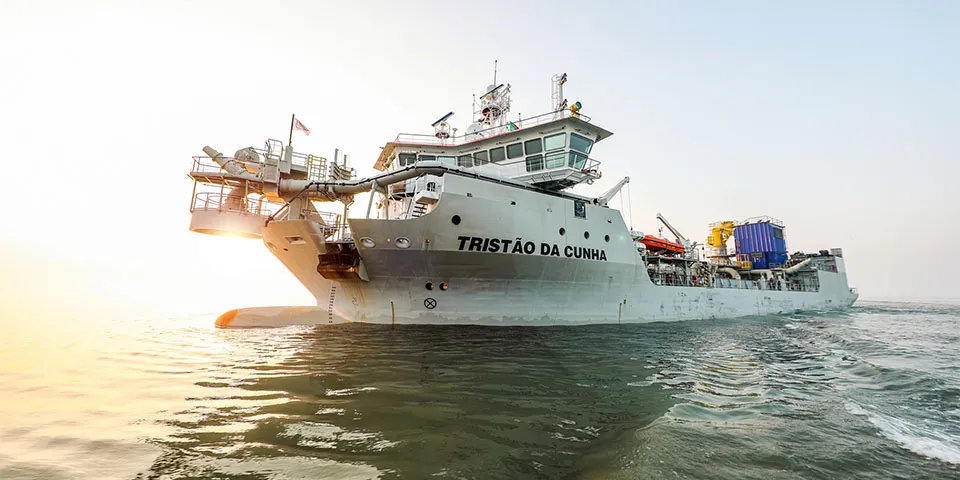
- In March and April 2019, Keppel Shipyard in Nantong, China, delivered the three 3,500 m³ trailing suction hopper dredgers Afonso de Albuquerque, Diogo Cão and Tristão da Cunha. The vessels are currently operating in South America, Europe and the Far East.
- In 2019, Keppel Offshore & Marine shipyard in Singapore delivered the 6,000 m³ trailing suction hopper dredger Sanderus. Its sister vessel Ortelius is due to follow in mid-2020.
- In December 2019, Jan De Nul launched the 18,000 m³ trailing suction hopper dredger Galileo Galilei at the COSCO shipyard in Dalian, China. The vessel is scheduled for delivery in 2020.
- In October 2019, Jan De Nul Group acquired the vessel Willem van Rubroeck in Croatia, having submitted the highest bid at a public auction. This cutter suction dredger had been ordered by Jan De Nul Group from the Uljanik shipyard several years earlier. The shipyard was declared bankrupt in 2019. Ownership of the unfinished vessel was ultimately transferred to Jan De Nul Group in February 2020. The vessel was moved to the Remontowa shipyard in Poland in April 2020, where completion work will continue. It is expected to enter service in 2021.
- In April 2019, Jan De Nul Group ordered a large offshore jack-up installation vessel, Voltaire, from COSCO Shipping Heavy Industry shipyard in China. This jack-up vessel will be equipped with a main crane with a lifting capacity of more than 3,000 tonnes and will be able to operate in water depths of more than 80 metres. The vessel will be capable of installing the new generation of very large offshore wind turbines. Construction is currently still in the engineering phase. Actual construction is due to start in May 2020. The vessel is expected to be delivered in 2022.
- At the end of 2019, Jan De Nul also ordered a large crane vessel, Les Alizés. The vessel will be built by China Merchants Industry Holding Co. Ltd. at its shipyard in Haimen. Les Alizés will have a crane with a lifting capacity of 5,000 tonnes, a carrying capacity of 61,000 tonnes and a deck area of 9,300 m². The vessel will enable Jan De Nul Group to install large, heavy foundations for wind turbines in deep water. Delivery is scheduled for 2022.
Les Alizés and Voltaire are complementary vessels. This investment responds to the global trend in the offshore wind energy sector towards installing ever larger wind turbines. The latest generation of turbines can be more than 270 metres high, with blades up to 120 metres long, and mounted on foundations weighing up to 2,500 tonnes.
Like the new trailing suction hopper dredgers, Voltaire and Les Alizés will be equipped with an ingenious, in-house-developed filtration system to eliminate harmful substances from exhaust gases. This exhaust gas filtration technology meets the strict European EURO STAGE V emissions requirements for land and inland waterways.
This will make both vessels the first seagoing installation vessels in the world with extremely low emissions (Ultra-Low Emission vessel, or ULEv). Both vessels will also receive a Cleanship NDO7 label and a Green Passport EU label. The first label confirms that the vessel monitors and minimises its wastewater and all other waste. The second means that all materials and hazardous substances are identified during the construction phase to facilitate the vessel’s subsequent recycling. Both certificates are issued by an independent specialist body.
GREEN FINANCING
Les Alizés and Voltaire will work primarily in the renewable energy sector and are equipped with an advanced emissions treatment system. These investments therefore qualify for a green loan.
To finance both investments, Jan De Nul Group signed a green loan agreement on 5 July 2019 with a consortium of five banks led by KBC Bank (the consortium comprises KBC Bank, BNP Paribas Fortis, ING Luxembourg, Rabobank and Belfius Bank).
This is Jan De Nul Group’s first green syndicated loan.
The green loan was structured in accordance with the ‘Green Loan Principles’ drawn up by the Loan Market Association (the industry association representing banks, lawyers and other financial parties). Its aim is to promote investment in green projects by providing banks and companies with guidelines on the characteristics of a green loan.
In addition to this green loan of 300 million euros, a long-term revolving credit facility of 250 million euros was also established with the same banking consortium.
COVID-19
At the time of publication, the world is facing the consequences of COVID-19. The effects of this pandemic are not reflected in the 2019 financial results. Jan De Nul Group is doing everything possible to ensure the safety and health of its employees worldwide, optimise its cost structure and maintain its excellent working capital position. As mentioned above, a committed Green Term Loan was arranged in 2019 to finance major vessel investments in the coming years. In addition, Jan De Nul Group has an excellent balance sheet profile and an order book of 3.4 billion euros.
Question about this story? Ask your question
Keep following this
Get an email when a new story is published. No account needed.
- SubjectGeneral







