









Innovative, fast and ultra-precise track construction
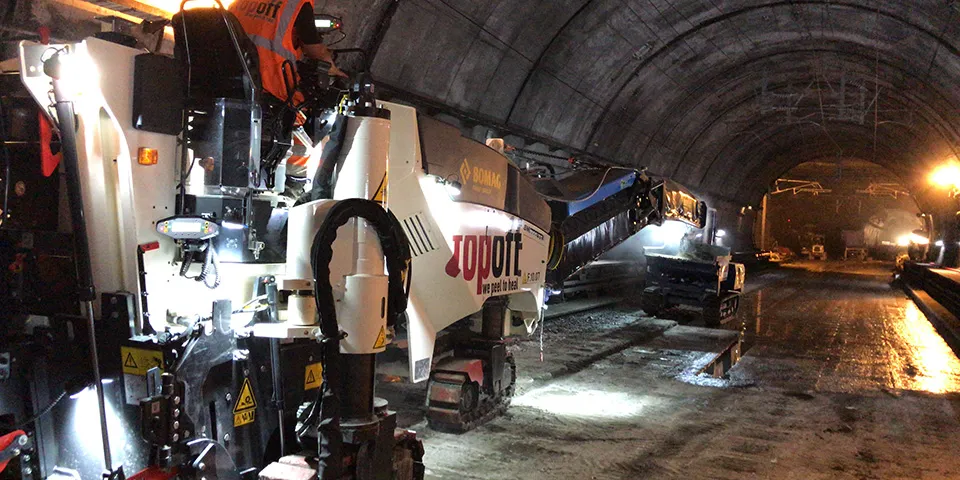
For track renovation and construction, Innotrax, a subsidiary of milling specialist TopOff, developed its own sophisticated, patented technique. “With our technique, we can lay up to 400 m of track a day, to millimetre accuracy,” says managing director John Vastmans, who is reaching out to Belgium’s major railway contractors.
Innotrax was launched around four years ago. John Vastmans, who is also managing director of TopOff, explains: “Innotrax grew out of the idea that fine milling concrete could create a very flat surface. As a specialist subcontractor, TopOff achieves excellent results with 3D milling, and I had been looking towards the rail sector for some time. We began exploring the possibilities and eventually settled on a process in which we construct a concrete slab track with an oversize layer, then 3D plane-mill it with a fine milling machine. That remains the basis of the technique today, and we patented it straight away.”
3D from start to finish
While a traditional railway contractor still removes ballast with an excavator, Innotrax uses a fully 3D approach. “We can also 3D mill out ballast,” explains John Vastmans. “We can even mill contaminated and uncontaminated ballast separately. We then plane-mill the subgrade, allowing us to quickly install our self-developed formwork with integrated dowels. Because the subgrade is so flat, there is no need for filling anywhere, which greatly reduces the number of operations. To hold the formwork together, we have developed a structure with built-in dowels. These are then adjusted and scanned. Once we are sure that all the dowels are correctly positioned, we fill the formwork with concrete, leaving an oversize layer of 5 to 10 mm. After a curing period of ten days, the oversize layer is milled off. The surface is then cleaned, and the track can be installed without any additional packing.”
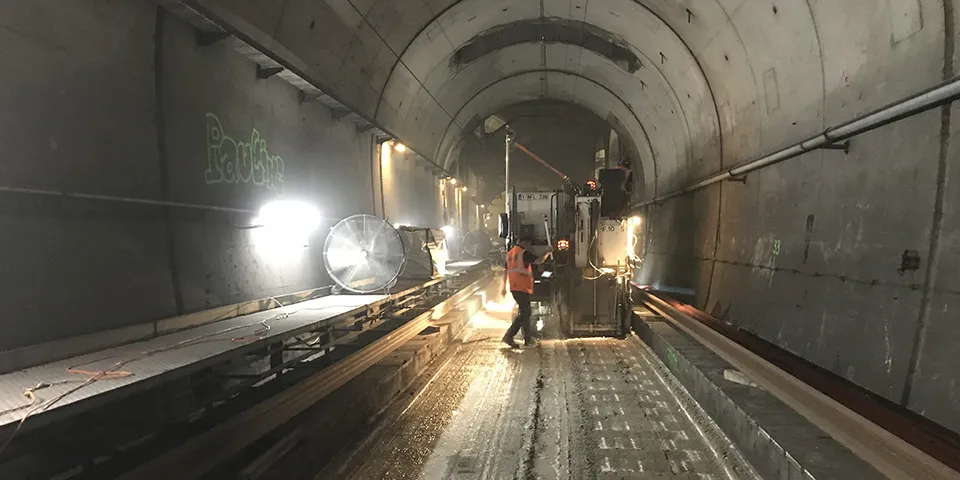
Innotrax developed a process in which a concrete slab track is laid with an oversize layer, then 3D plane-milled using a fine milling machine.
Saving time and costs
Innotrax’s efficient technique saves a great deal of time and therefore cuts costs. John Vastmans explains: “A French company had already developed a system for vibrating the rail fastening plates into fresh concrete. You can push the plates in accurately and precisely, but fresh concrete is a living material and can still shift by up to 5 mm as it cures. The company in question then developed a way of compensating for this deviation, but at the cost of a slower installation rate. With our installation method, we can lay up to 400 m a day. That is 3 to 4 times faster than the traditional approach. And we work to millimetre accuracy. That was a condition I set myself: I would not enter the rail market if I could not meet its strict tolerances.”
Despite the many advantages of this innovative technique, the major domestic railway contractors have yet to embrace the system fully. “Innotrax has not made the progress I had envisaged over the past four years. The rail sector tends to stick to its traditional construction methods, and it is not easy for an innovative technique to gain traction. By contrast, railway infrastructure manager Infrabel is very focused on innovation and digitalisation. A few years ago, Innotrax was given the opportunity to work on the Overboelare tunnel in Geraardsbergen. The project was a success. We did not use a single packing plate on the 400 m section.”
Paris Metro
Other notable projects for Innotrax include work on the Kirchberg Tunnel in Kautenbach, Luxembourg, and the Paris Metro. “Innotrax was the only foreign company among the five candidates for the Paris project, yet we won the contract. That is quite something. The client trusted us and was intrigued by our immediate offer to 3D mill. The project enters its second phase in 2020, and there is a good chance that Innotrax will be involved again. The rail market is international, and I have complete confidence in our technique. There is also a lot of discussion, for example, about spraying railway tracks. Many herbicides are still used for this purpose. In time, that will no longer be allowed, and Innotrax’s easy-to-maintain construction method will offer an excellent alternative,” concludes John Vastmans.
Question about this story? Ask your question
Keep following this
Get an email when a new story is published. No account needed.
- SubjectGeneral







