









Impressive welding for self-erecting crane mast
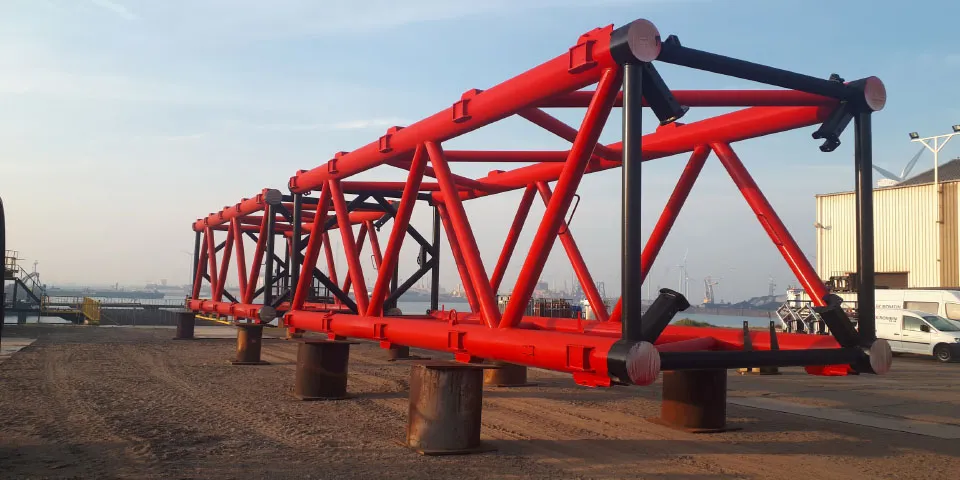
By fabricating the main mast for Mammoet’s new Focus 30 crane, steel construction specialist Hillebrand, part of ASK Romein, is showcasing its expertise in heavy steel structures.
The Focus 30, with a capacity of 1,000 tonnes, is a pedestal crane whose gigantic main mast can be erected vertically. “This project is an excellent reference for us,” says Frank Buijk, project manager fabrication & operations at Hillebrand.
Text | Niels Rouvrois Photography | ASK Romein
The Focus 30 is designed for work in locations with limited manoeuvring space, such as refineries and urban areas. What makes the crane unique is that it erects itself vertically, to a maximum height of 150 m. Its operating footprint is just 26 x 26 m, without compromising stability or strength. Only a small crane is needed to lift the sections into place during assembly. This means it can be assembled in a space of just 40 x 26 m. “Traditionally, masts of this size are assembled with the mast lying horizontally on the ground,” says Frank Buijk. “The drawback is that this requires a great deal of space, which is often unavailable at refineries. The crane would then lie across various types of pipelines, which would have to be shut down, making the process time-consuming and costly. The Focus 30 is assembled vertically, and at a radius (working radius) of 30 m, it still has a lifting capacity of 1,000 tonnes. That is quite substantial.”
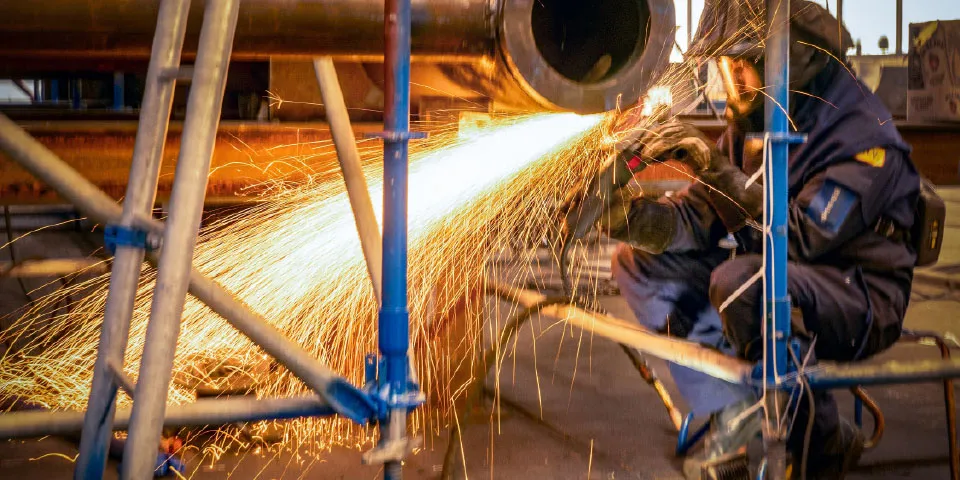
Mammoet’s input included some complex welding details.
A rewarding challenge
Mammoet awarded the crane construction contract to four companies, with Hillebrand tasked with building the main mast. Hillebrand has the expertise needed to build large, complex steel structures such as bridges, as well as structures for factories and stadiums. The company also has an impressive track record in structures for the offshore industry. Although Hillebrand had previously built various crane components, fabricating the 80 m-long main mast, comprising eight sections, proved a rewarding challenge. Frank Buijk says: “Mammoet designed the mast, but Hillebrand took full responsibility for developing the specific welding procedures needed to weld it while guaranteeing its strength. Mammoet’s input included some complex welding details, which required us to find an intelligent and practical way to implement those requirements. We did an excellent job.”
Delicate welding work
At Mammoet’s request, Hillebrand’s work was approved and certified by Lloyd’s Register. Frank Buijk says: “During fabrication, we achieved a repair rate of less than 0.2%. This project demonstrates Hillebrand’s outstanding skills in delicate welding work on S690 high-strength steel. In this case, Mammout supplied the design, but Hillebrand also has the know-how to contribute during the design process. Customers often come to us with a basic idea and a number of requirements. Our engineers then work with the project team to turn that information into a high-quality design.”
The crane is currently undergoing testing at the Mammoet site in Westdorp. “Everything is being tested, from automatic erection to load testing and the built-in safety systems. The tests are going extremely well. The crane is expected to be shipped to the United States in November. This is a great project, and one we can be very proud of,” concludes Frank Buijk.
Question about this story? Ask your question
Keep following this
Get an email when a new story is published. No account needed.
- SubjectGeneral







