









Impact of Vlarema 9 on construction and demolition waste
Text Valérie CouplezImage iStock
It has taken some doing, but on 7 July the Flemish Government amended the Flemish Regulations on the sustainable management of material cycles and waste. This brings Vlarema 9 into force. The amendment decree is still awaiting advice from the GBA and the Council of State. One of the new policy priorities is a framework for the selective collection of waste on site and the subsequent sorting of various construction and demolition waste fractions. In this feature, we outline the main changes, insofar as they have been fleshed out in concrete terms, and hear from a company about the practical implications.
The Flemish Climate Plan 2021-2030 states that by 2030, 50% of recyclable waste in household residual waste and comparable commercial waste must be kept out of the residual waste stream. On 5 November 2021, the Flemish Government approved a vision paper setting out additional climate measures. These raise the ambitions of the Flemish Climate Plan. The target has been increased, with the aim of effectively recycling 75% of the recyclable material still remaining in residual waste. Better source separation or thorough sorting after collection are important measures for achieving these targets. For commercial waste in general, clearer rules are being introduced on the conditions for the joint collection of certain dry, non-hazardous recyclable fractions (paper and cardboard, wood, metal, rigid plastics and films) for subsequent sorting. However, refining this article in turn created legal uncertainty for the construction and demolition waste stream.
Separate collection of construction and demolition waste
A new subsection clarifies which construction and demolition waste fractions must be collected separately on site, and which can still be recovered through subsequent sorting and are suitable for recycling. With this proposal, Flanders aims to close the construction materials loop as effectively as possible. Collection on site and any subsequent sorting must therefore be geared towards reuse or material recycling. Given its specific composition and origin (construction and demolition sites), construction and demolition waste must first be collected and presented separately from other waste (household contents, commercial residual waste, etc.). Before demolition or renovation work begins, contractors must collect separately all waste that is not construction and demolition waste and remove it separately from the construction and demolition waste.
More fractions to be sorted on site
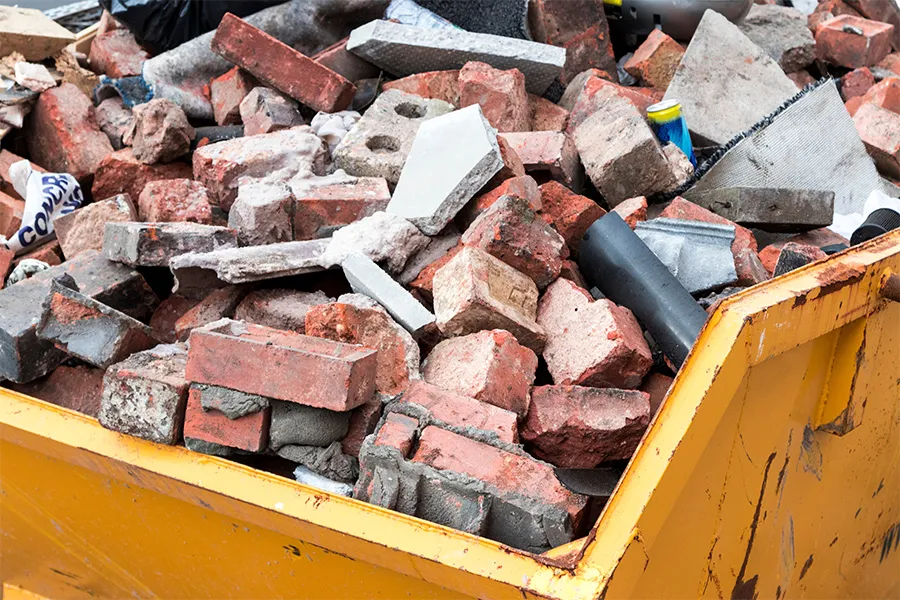
Flemish policy prioritises sorting and selective collection at source, as this produces the cleanest fractions and enables the highest-quality recycling. Accordingly, the list of waste streams requiring selective collection in Article 4.3.2 is being extended only to include fractions typical of construction and demolition sites. In addition to glass, metal, rigid plastics and wood, already listed in Article 4.3.2, the following typical construction and demolition waste fractions can also be recycled and returned to the materials cycle: inert rubble comprising concrete rubble, masonry rubble or mixed rubble, cellular concrete, glass wool, rock wool, plasterboard and gypsum blocks, bituminous roofing or sealing materials. In some cases, separate collection on site is not required. This applies to sites where separate collection at source is not possible or desirable due to limited space, or for technical or safety reasons. In these cases, all dry, non-hazardous construction and demolition waste fractions may be collected together in the same container, provided that the mixed construction and demolition waste is subsequently treated as set out in new subsection 5.2.16.
Proportionate charging for commercial waste
Also relevant to the demolition and crushing sector, and by extension to all businesses, is the requirement that the costs of commercial residual waste be charged proportionately. In other words, the cost charged must reflect the weight of the residual waste collected. This incentivises waste producers to present less commercial residual waste for collection. Weight-based charging is a highly effective measure with proven results among households. Since businesses are generally even more responsive to price changes than consumers, an even greater impact is expected here. The plan SEA for the draft Local Materials Plan also points this out. According to the SEA, more than half of the expected reduction in commercial residual waste resulting from the plan's measures is attributable to the specific measure of weight-based charging. So, in the end, sorting will pay off. ■
Question about this story? Ask your question
Keep following this
Get an email when a new story is published. No account needed.
- SubjectGeneral







