









How heatwave-resilient are Brussels and other cities?
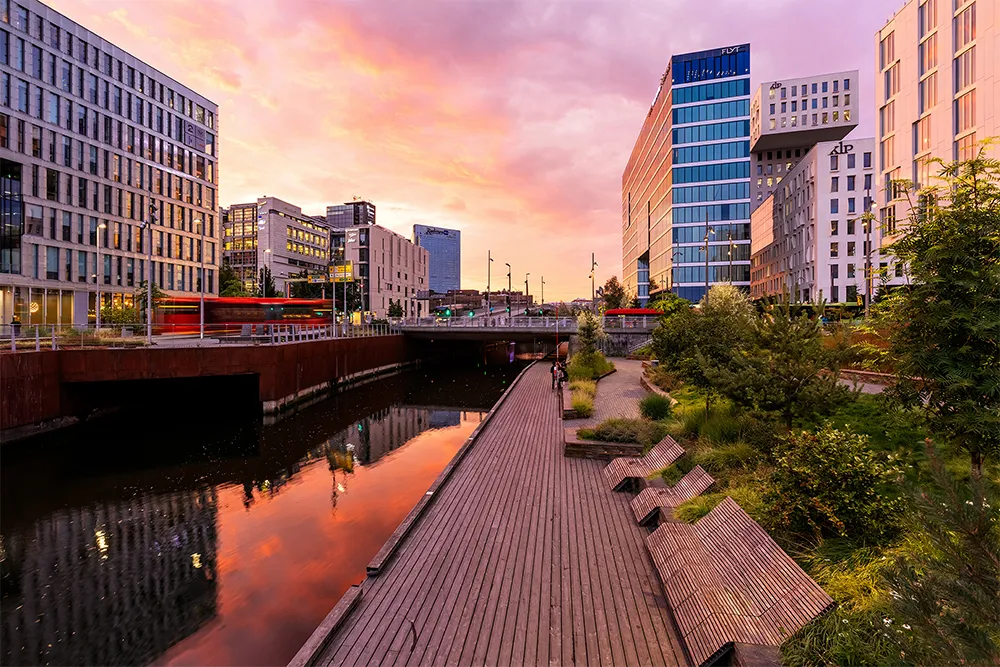
As the fastest-warming continent, Europe is facing rising temperatures and heat-related mortality as a result of climate change. Sweco’s analysis of 24 European cities highlights the urgent need for heatwave mitigation and resilience. Digital innovation, nature-based solutions and green-blue infrastructure, as well as the design of high-performance buildings, form the basis of such heat action plans.
Temperatures in Europe are rising twice as fast as the global average, and heat-related mortality has increased by around 30% over the past 20 years. Sweco’s new report examines 24 European cities using the climate risk dashboard of the European research project PROVIDE. The findings reveal a significant shortfall in cities’ climate plans when it comes to heat-related concerns.
More than 70% of Europeans currently live in cities, a figure expected to rise to 84% by 2050 as urbanisation continues. Climate change and the “Urban Heat Island effect” (UHI) mean urban areas are now experiencing increasingly higher temperatures than rural areas. Sweco’s report shows that some European cities are taking steps in the right direction to tackle heat, but significant gaps remain to be addressed.

Séverine Hermand
Climate resilience expert and co-author of the report
“European cities need to focus more on protecting vulnerable groups by improving cooling in facilities such as nurseries, care homes and healthcare facilities. The EU budget has allocated €680 billion to climate-related measures for the 2021-2027 period, so funding is available. It is now time for European cities to implement new methods to help cool urban areas. This is possible, and there are several solutions.”
Brussels: a critical situation
One of the cities analysed is Brussels, where Sweco is already working on projects to tackle heat. Due to the Urban Heat Island effect (UHI), temperatures in Brussels can be up to 8°C higher than in surrounding rural areas. The number of days with moderate heat stress is expected to increase by 150% between 2020 and 2100, equivalent to nine additional days per year. Historical data show a significant increase in the frequency and duration of heatwaves, posing serious threats to public health, infrastructure and resources.
In response, Brussels has set out a major climate resilience policy focused on Nature-based solutions, infrastructure adaptation and urban planning. Nature-based solutions include creating and enhancing green spaces and biodiversity through projects such as ‘Reseau Nature’ and the Neder-Over-Heembeek Stadsbos, alongside diversifying tree planting under the ‘Air-Climate-Energy Plan’. Infrastructure adaptation is being pursued by promoting the Duurzame Bouwgids and the Materialen tool, as well as through retrofitting.
Key recommendations
- Invest in detailed data: Expand vulnerability mapping and improve monitoring and evaluation, for example through digital twins and GIS spatial mapping.
- Enable innovation and co-creation: Nature-based solutions at building and neighbourhood scale.
- Pursue transparent and collaborative governance: Invest in knowledge, data-driven heat management and joint planning for a heatwave crisis.
- Commit to a long-term vision: Authorities and policymakers must develop more efficient and modern strategies to protect vulnerable groups and ensure climate equity.
Sweco’s analysis of 24 European cities, their resilience policies and heatwave data includes in-depth case studies of six cities and shows how temperatures are expected to rise in each city between 2020 and 2100:
- Copenhagen +160% estimated increase in heatwave days
- Stockholm +150%
- Oslo +140%
- Rotterdam +130%
- Brussels +130%
- Helsinki +100%
*Sweco studied 24 cities: Brussels, Copenhagen, Helsinki, Oslo, Rotterdam, Stockholm, Amsterdam, Edinburgh, Madrid, Glasgow, Seville, London, Rome, Lisbon, Paris, Vienna, Barcelona, Geneva, Prague, Istanbul, Toulouse, Gdansk, Warsaw and Athens.
Sources: ERA5, European State of the Climate 2023/Copernicus, The Lancet Planetary Health, Provide Climate Risk Dashboard, Sweco. See the report for the full list of references.
Question about this story? Ask your question
Keep following this
Get an email when a new story is published. No account needed.
- SubjectGeneral







