









How healthy is your soil?
How healthy is your soil? That is the question OVAM wants to answer for landowners across Flanders with the Grote Grondvraag. From November, this online communication tool will show where soil may carry certain risks from past activities, increasing the likelihood of contamination. It also guides landowners through the procedures for proceeding with further investigation.
The Grote Grondvraag is part of the Flemish legislator’s ambition to investigate all 85,000 at-risk sites in Flanders by 2028, with a view to starting remediation of all of them by 2036. Almost 45,000 have already been ticked off. Through the campaign, OVAM also hopes to map the remaining plots more quickly. Our region’s rich industrial past means that Flanders has many contaminated sites. Yet healthy soil plays an important role in society. Ann Cuyckens of OVAM explains: “Soil is important not only for food security, but also for other functions, such as water storage and CO2 storage, and for supporting biodiversity. There are plenty of reasons to take good care of our soil. With the Grote Grondvraag, we want to identify all at-risk sites together and restore them to good health.”
The Grote Grondvraag (campaign image).
Not necessarily contaminated
On the website www.degrotegrondvraag.be, members of the public can find out whether information is available about the soil quality of their land. Mechelen, Nijlen and Gavere served as test areas. From November, data will be available for the municipalities that have already signed up. “An increased risk does not necessarily mean that the soil is contaminated,” Ann Cuyckens points out. “If professional activities such as a garage or dry cleaner’s were carried out there in the past, or if the land once contained a 20,000-litre fuel oil tank, it is considered an at-risk site. These activities require an environmental permit, issued by the municipalities. OVAM has this information and is now making it available to the general public. After all, owners are not always aware of the history of their site. Our first aim with this tool is to make that information clear to them.” It is also compulsory to carry out a soil investigation by 2021, 2023 or 2027, depending on the scale of the activities, on sites where historical risk activities took place.
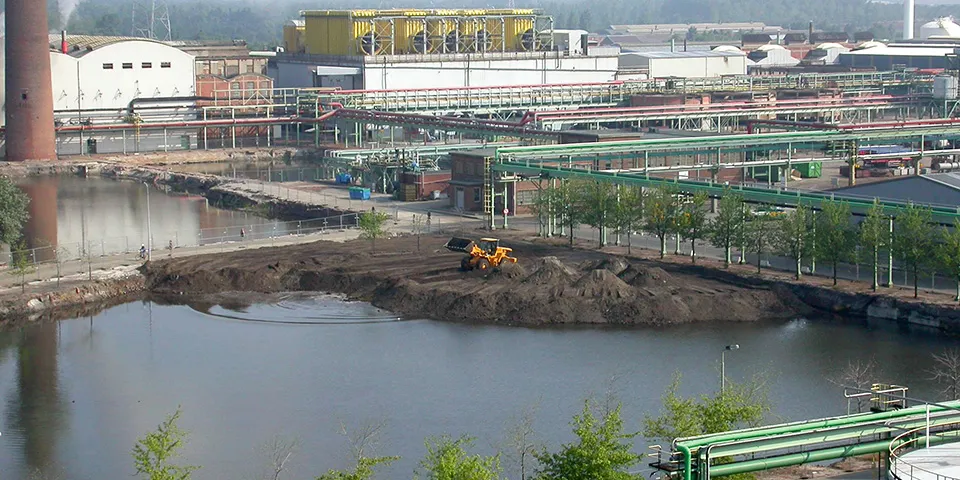
Balen Nyrstar, backfilling of plot.
Exploratory or descriptive
The process does not stop at mapping sites. The increased risk of soil contamination means that a soil investigation is required. This does not, however, mean that the soil is contaminated. An exploratory soil investigation can establish whether it is. This must be carried out by an approved soil expert. “Private individuals can apply for an exemption from the investigation requirement for historical risk activities that they did not carry out themselves,” says Ann Cuyckens. “In that case, OVAM pays for the exploratory soil investigation. Anyone using the online tool will be guided through the procedure very simply, and can apply for the exemption straight away.”
If the investigation does show that the soil is contaminated, a descriptive soil investigation will be required. This maps the contamination both vertically and horizontally. Ann Cuyckens says: “Initial results show that this is necessary in only a quarter of cases. The cost of such an investigation can be high. Companies can therefore also qualify for an exemption, provided they meet the conditions. The descriptive investigation will determine whether remediation is required. So far, this has been the case in only one in six instances.”
Een zakelijke vraag aan OVAM? Get in touch
Companies in this story

Keep following this
Get an email when a new story is published. No account needed.
- SubjectGeneral
- CompanyOVAM







