









How are conflict-free traffic lights progressing in Flanders?
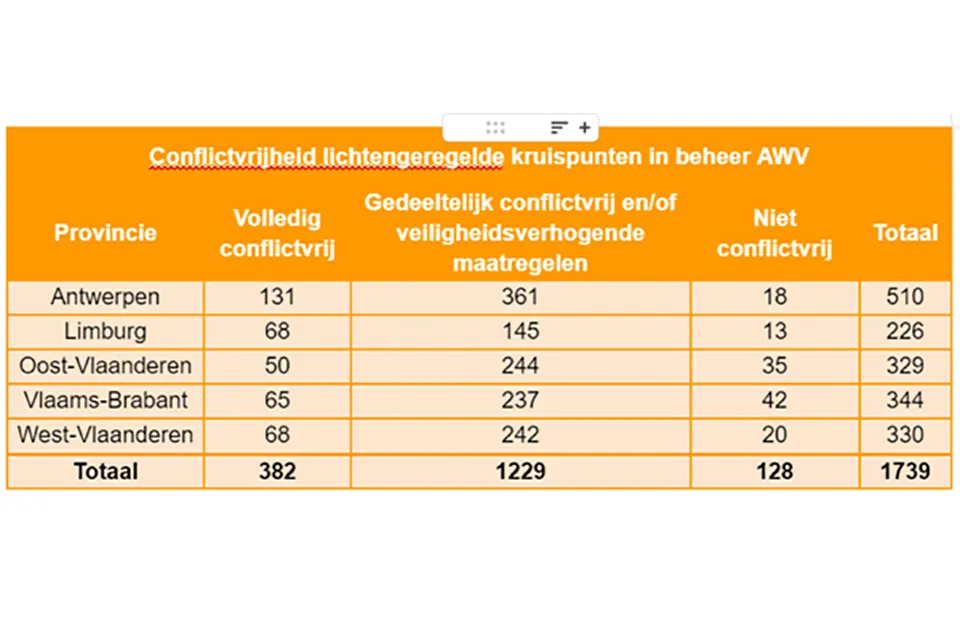
Conflicts at signal-controlled junctions are being systematically eliminated across Flanders, at an average rate of one junction every three days. Today, 93% of the 1,739 signal-controlled junctions managed by the Agency for Roads and Traffic (AWV) are fully or partly conflict-free and/or have safety-enhancing measures in place.
Conflicts removed and additional detection to reduce waiting times at 877 junctions
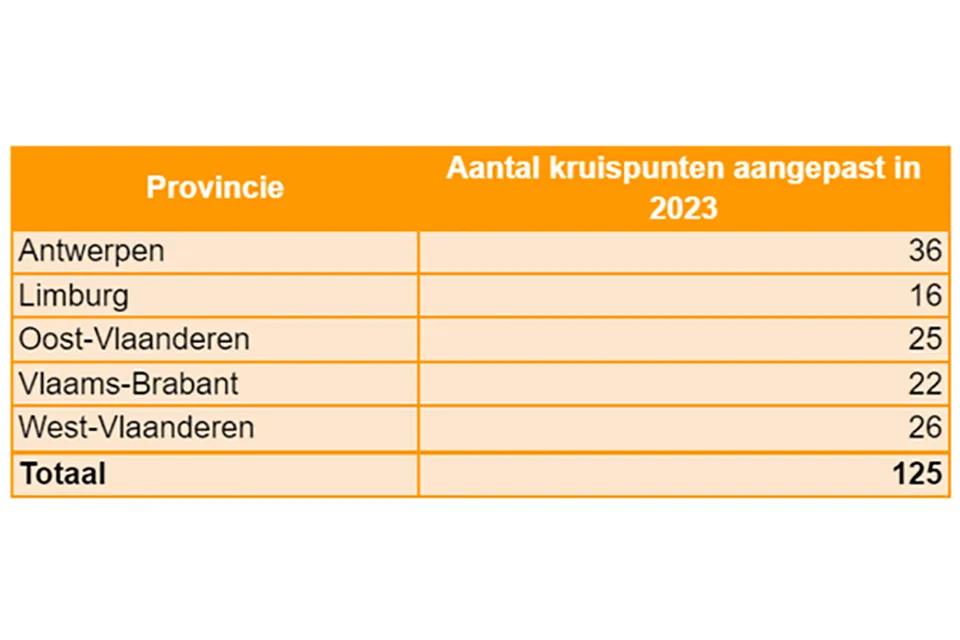
Under the Flemish Traffic Lights Action Plan, conflicts are removed at at least 125 junctions every year. AWV is therefore systematically eliminating situations in which road users cross paths, significantly improving road safety. A further 125 junctions were modified in 2023, equivalent to one every three days.
During this term of office, AWV has made a total of 519 junctions as conflict-free as possible*, bringing the total to 877 signal-controlled junctions since the action plan began. Flemish Minister for Mobility and Public Works Lydia Peeters gives the exact figures: “Today, 93% of junctions are fully or partly conflict-free and/or have safety-enhancing measures in place. In 2019, the figure was still 85%. Of all junctions, 22% are fully conflict-free; 71% are partly conflict-free or have safety-enhancing measures in place. Such measures include an advance start or ending the green signal for pedestrians and cyclists at the same time, or amber flashing lights to indicate that a conflict remains. We expect these figures to continue rising over the coming years; AWV teams are working hard to make this happen.”
Greater focus on pedestrians and cyclists
To decide which conflicts are permitted in a signal plan, AWV uses a conflict-free signal control framework. “To give even greater weight to the safety of pedestrians and cyclists, our agency revised the framework in consultation with road safety experts and cycling organisations,” says Kathy Vandenmeersschaut, Director-General of AWV. “Under the new framework, for example, more queuing is permitted for motor traffic in order to eliminate conflicts, and conflicts are no longer permitted between turning traffic and cyclists on a two-way cycle track. Where conflicts with active road users remain, we look at the infrastructure and how it can be adapted to further improve the safety of cyclists and pedestrians crossing the road.”
Professor Dirk Lauwers sees important steps in the right direction: “More and more traffic signals on the Flemish regional road network are being controlled in a way that improves road safety. A clear framework for assessing signal control, which checks step by step how the signal plan can enable vulnerable road users to cross the junction safely, provides the guidance. Last year, this framework was tightened further to give road safety the highest priority, even if this sometimes comes at the expense of traffic flow for cars. The priority now is to complete the traffic lights action plan without delay and, by evaluating any accidents that continue to occur, identify where and how further measures may be needed.”
AWV will continue its work in the coming years. Particular attention will be given to junctions being redesigned, those on school routes, those recently assessed using an MIA Quick Scan, and those on the hazardous locations list. We also want to tackle junctions that have not yet had any conflict-free measures introduced, as well as junctions where conflicts with pedestrians and cyclists remain.
Changing signal plans is no simple task
Installing a new signal plan is a precise task that requires careful preparation and an analysis of current and future traffic conditions. Contrary to what many people think, this kind of change takes time. Traffic counts are carried out at the junction, and a new signal plan is drawn up and programmed into the traffic signal controller. It is then tested in a laboratory before being commissioned on site. A new signal plan also often requires changes to the junction infrastructure, such as installing additional poles, signal heads or detection loops.
___
*Number of traffic signal junctions modified under the Traffic Lights Action Plan between 1 January 2020 and 31 December 2023
Question about this story? Ask your question
Keep following this
Get an email when a new story is published. No account needed.
- SubjectGeneral







