Grond/Weg/Waterbouw Vlaanderen is part of Louwers Mediagroep: 45+ trade platforms in the Netherlands, Flanders and Wallonia. Trade magazines, websites, newsletters, video and podcasts, since 1987.
We may not realise it, but heatwaves are among the most dangerous natural disasters of this century. Sweco is drawing attention to the issue and setting out sustainable design solutions for our cities and municipalities in its recent Urban Insight report, ‘Building resilience: being young and getting old in a hotter Europe’.
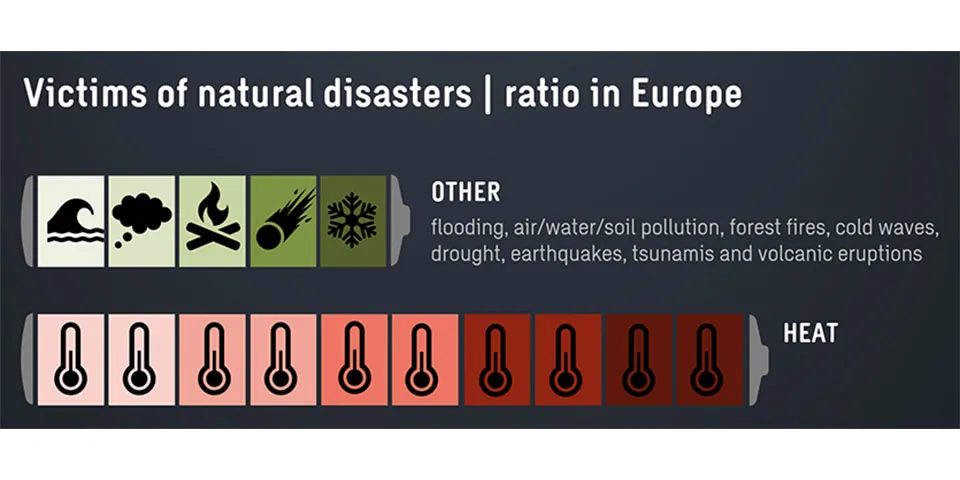
More than twice as many people die from heat in Europe each year as from all other natural disasters combined, including floods, pollution, wildfires, earthquakes, tsunamis and volcanic eruptions[1]. However, climate change means that extreme weather events of this kind will become more frequent. We need to tackle this now by taking widespread preventive action and putting a few smart measures in place!
Make the problem visible
Natural disasters such as floods, wildfires and volcanic eruptions cause immense visual damage to our living environment. But the danger of a heatwave lies elsewhere: it is invisible. Heatwaves are still felt, although the experience varies greatly from person to person. Detailed heat maps not only show the problem in concrete terms, but also demonstrate the effectiveness of spatial interventions. These can range from creating green infrastructure, such as parks and street trees, and blue infrastructure, such as swales, to choosing specific materials and colours. These measures are relevant not only at neighbourhood or city scale, but also at building scale. Examples include using well-insulating materials, green roofs and façades, and considering a building’s orientation. These interventions can help us respond to heatwaves relatively easily and improve liveability in our cities and municipalities.
Design across generations
As the Urban Insight report shows, heat mainly affects older people, young people and socio-economically disadvantaged groups. These groups are less likely to have their voices heard and therefore have less influence over the design of their living environment. It is therefore essential to actively create space for these voices in the design process. Well-designed participation programmes can play a crucial enabling role. It is important not only to involve the public early in a project, with particular attention to specific groups, but also to maintain regular dialogue with these stakeholders throughout the process. Only then can we arrive at a design that everyone feels comfortable with.
The immense cost of heat
Decisions are often made on the basis of cost-benefit analyses. This becomes more complex when the cost of health, and even of a human life, is taken into account. If we also factor in the two per cent drop in productivity for every degree above 25 °C in the working environment, the sums involved run into billions of euros[2]!
We are constantly shaping our living environment. It takes only a small step to incorporate targeted heat measures into spatial planning projects. By prioritising greening, water, shade, depaving, access to drinking water and natural ventilation in our built environment, we can actively contribute to public health. We know the remedy, so let us save lives now. We have no excuse!
Find the right company in the sectorSearch by product, area of expertise, region or project in the company directory and across all articles from Grond/Weg/Waterbouw Vlaanderen.
We use cookies to keep the site working properly. With your consent, we also use cookies for statistics and third-party banners. Read more in our privacy and cookie statement.