









Formwork systems for Viaduct van Irbich are a technical masterpiece
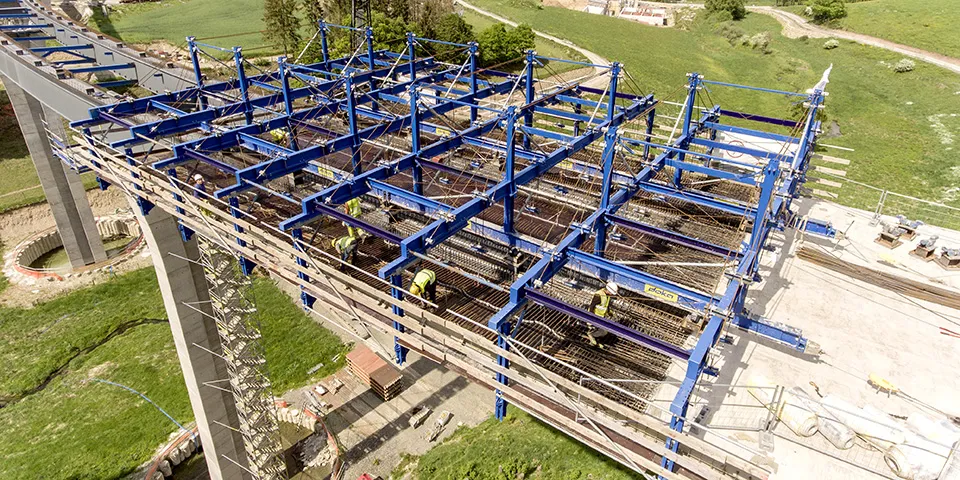
Viaduct van Irbich in Luxembourg forms part of ‘la transversale de Clervaux’, a new road connecting the N7 and the CR340/N18. The bridge comprises two abutments and six piers supporting steel girders, topped with a concrete deck. The formwork for the piers and deck is the result of ingenious, bespoke design by formwork specialist Doka.
Viaduct van Irbich is being built by Jan De Nul. The contractor called on Doka to supply the formwork systems. Doka Belgium, with offices in Ternat and Tielt, offers its clients the latest innovative formwork technology to deliver construction projects more quickly, to a higher standard or more efficiently. “Where necessary, we focus on project-specific formwork design in close collaboration with the client, to meet the requirements of the client and designers. For standard applications, our Belgian team carries out the technical formwork studies in-house. For technical masterpieces such as the deck of Viaduct van Irbich, we called on our international specialists at our Competence Center Bridges,” says Koen Lamers, Managing Director at Doka.
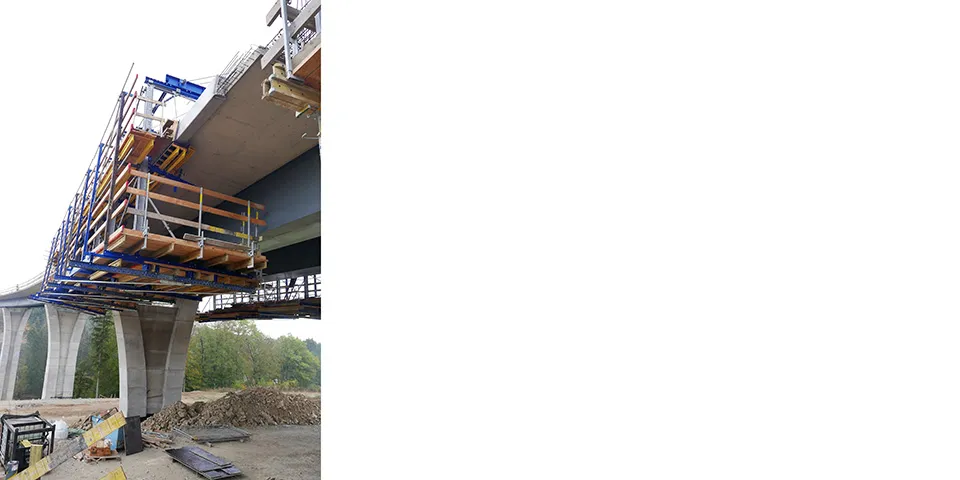
The formwork traveller can be converted into a curing platform.
Climbing formwork for the piers
Doka supports the client with the technical studies and provides initial guidance on site. For Viaduct van Irbich, the engineering department at Doka Belgium developed two bespoke formwork systems. Based on Doka’s plans, Jan De Nul pre-assembled the formwork in its workshop using Doka equipment it had already purchased, supplemented by Doka where necessary. “The piers were concreted using our climbing formwork,” explains Brecht Diependaele, Technical Manager at Doka. “Specifically, we used our Top 50 beam formwork system, a combination of beams, steel profiles and formwork panels assembled to suit the shape being constructed, with a view to reusing them throughout the entire structure, from the first stage to the last. The viaduct piers are all different heights. We therefore started at the bottom with formwork of different heights. All subsequent stages were repetitive and were concreted in 4-metre lifts. The start of the open V-shaped pier head was formed using standard climbing formwork. The 6.86-metre-high head was cast in two lifts. We were able to reuse the formwork for every pier, as the pier heads are identical.”
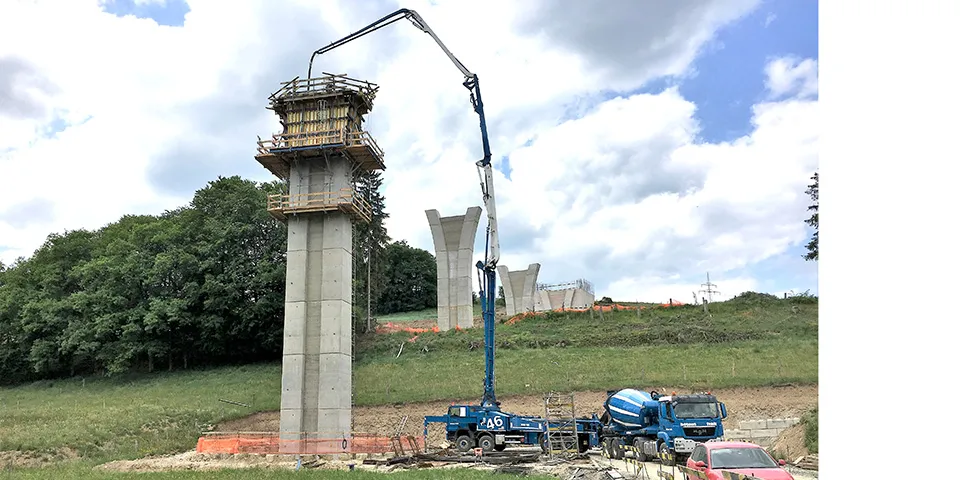
The piers were concreted using the Top 50 beam formwork system and the MF240 climbing formwork system.
Bespoke formwork traveller for the bridge deck
Whereas the climbing formwork consisted largely of standard components, the formwork traveller for the concrete deck required considerably more calculations. “The formwork was much lighter than usual,” explains Koen Lamers. “The design prepared by the engineering consultancy for the client assumed that the maximum load on the steel girders during construction could be only 167.5 kg/m2, whereas the standard systems we have available impose a load of around 300 kg/m2. We had to slim down our standard system to meet the specified criteria.”
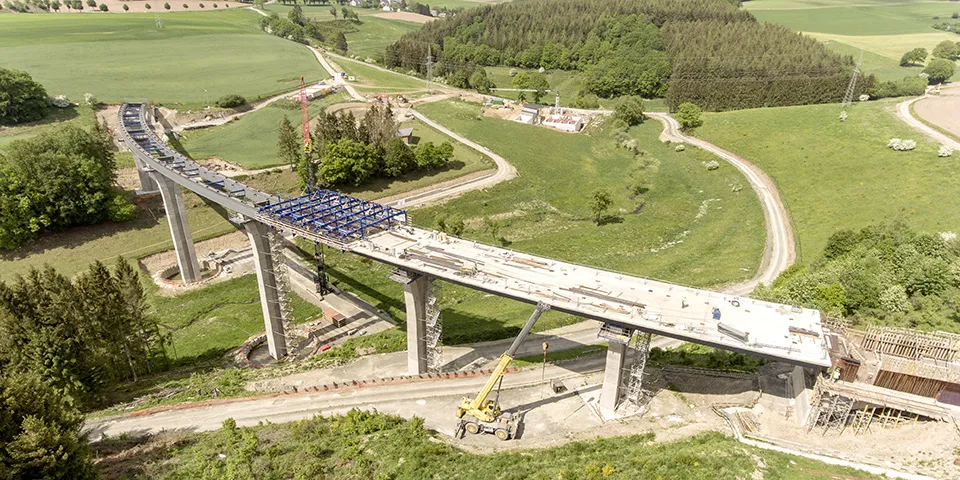
The formwork traveller is 4×6 metres long and casts 20 linear metres at a time.
Conversion into a curing platform
The main beam and rollers of the formwork traveller are standard components; everything above them was specially engineered by Doka’s engineering department in Austria. “The formwork traveller is 4×6 metres long and casts 20 linear metres at a time,” explains Brecht Diependaele. “The bridge follows a slight curve, so the formwork traveller is shorter on the inside than on the outside. The client wanted to use the formwork traveller after concreting as a curing platform for inspections and to carry out further works, such as casting the edge beam and installing the bridge deck drainage. We ensured that our formwork traveller could easily be converted into a maintenance platform.”
A Doka specialist provided on-site support when the formwork traveller was first set up at Irbich. “We did not need to return after that. That can only mean that everything was clear from the outset to the competent construction team. We were also not needed to support the conversion into a maintenance platform. This shows that our system is easy to use, performs optimally and helps improve productivity,” concludes Koen Lamers.
Question about this story? Ask your question
Keep following this
Get an email when a new story is published. No account needed.
- SubjectGeneral







