









First houseboats moor in Antwerp’s Cadix district
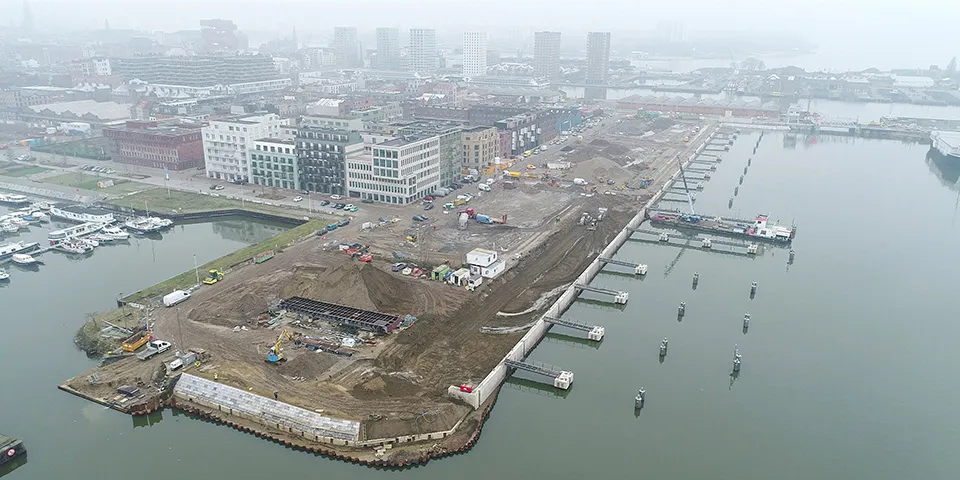
The new Cadix district on Antwerp’s Eilandje is flourishing. After the first residents moved into the apartment blocks in the north of the district, roadworks along the Houtdok have now also been completed. Last summer, around ten houseboats were allocated berths there. The project, which aims to transform the abandoned industrial zone into a sustainable residential district, is taking shape. Much of this is thanks to contractor Aertssen, which completed the public realm works quickly.
A few hundred people live here today, and that figure is expected to reach around 4,000 in a few years: the City of Antwerp is developing the Cadix district on a large scale. The project, in which Aertssen was responsible for rebuilding several roads on the site, is being carried out in several phases, with a mixed-use development as its ultimate goal. The plans include shops, schools, a childcare centre, offices, hospitality venues, a green neighbourhood square and a varied range of housing aimed at a broad target group.
Multi-year plan
Contractor Aertssen worked on several streets on the site in 2012 and 2013, and was invited back to continue the work in 2017 and 2018. Werner Verreydt, Works Manager: “In the east of the district, between Indiëstraat and Madrasstraat, there are 3 development plots for luxury apartments and social housing, among other things. Noorderpershuis is also on this side of the district. In due course, it will be restored and converted into a public-facing building, and as a heritage site it will be very important to the identity of the Cadix district. A few years ago, we completely rebuilt Indiëstraat and the streets between these development plots. Last year, we took on Madrasstraat on the other side, along with the 340-metre-long quay at the Houtdok. Houseboats have now moored at this quay.”
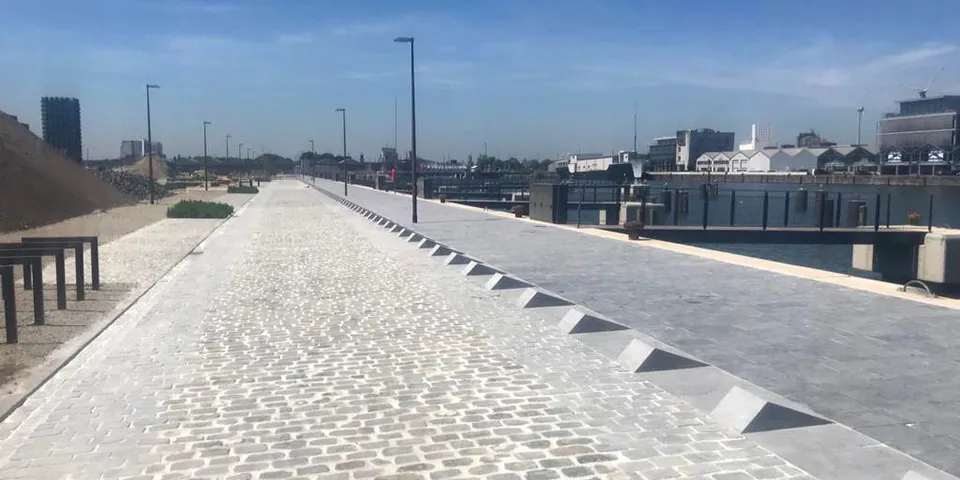
Contractor Aertssen rebuilt several streets. The quay at the Houtdok now features a combination of cobbles and blue stone tiles.
From demolition to construction
Aertssen was the only contractor involved in the complete rebuilding of the roads. Verreydt: “Our company has all the disciplines needed for projects like this, so there was no need to bring in any other partners. We were brought in to demolish the existing surfacing, carry out remediation works where necessary, renew the existing sewers, install new utility services throughout the project and, finally, complete all the road construction above ground, including the foundations and kerbs. We also excavated and removed 11,000 m³ of soil. That is precisely why we are so proud of this project: this is the kind of work we do really well, because it draws on our different divisions and allows us to respond quickly.”
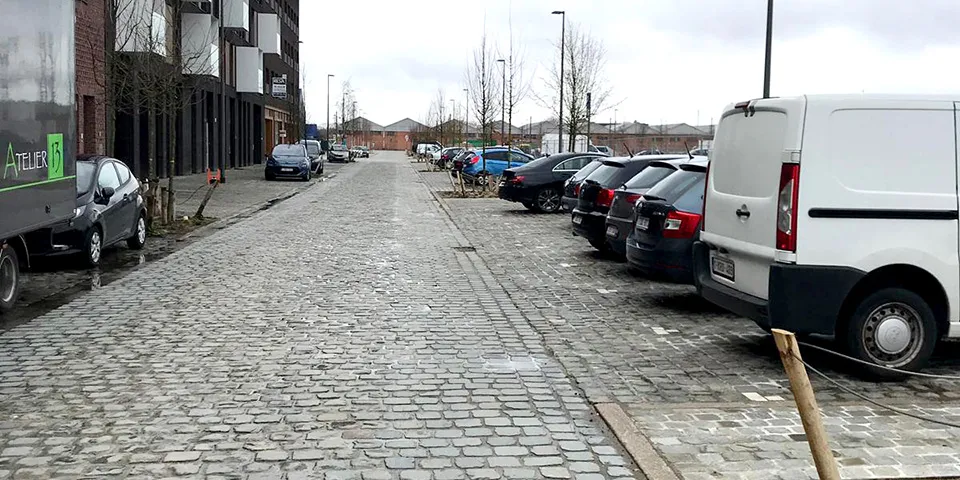
No fewer than 6,500 m² of cobbles were laid in this part of the project.
6,500 m² of cobbles
The streets in the east of the Cadix district are largely surfaced with cobbles, which, according to Verreydt, lend the quay at the Houtdok extra charm: “For this project, we needed 6,500 m² of cobbles and 2,000 m² of flat paving stones. Alongside the cobbled road at the Houtdok, we laid a walking and cycling path in blue stone tiles. It makes an attractive combination. Finally, while we wait for the apartment buildings to be constructed, we also installed 4,500 m² of temporary crushed-stone surfacing. That meant large quantities of different types of surfacing, but it was no problem for us. We also kept to the project schedule. We were asked to work in three phases, in line with the needs of the district. The quay had to be ready by a specified deadline so that the houseboats could moor there on time. Another part of the district had to be completed within a separate, strictly defined period, to minimise disruption to local residents and traffic. It all went very smoothly,” Verreydt concludes.
Question about this story? Ask your question
Keep following this
Get an email when a new story is published. No account needed.
- SubjectGeneral







