









Drive through a wadi? You can!
Text Niels RouvroisImage Acterra
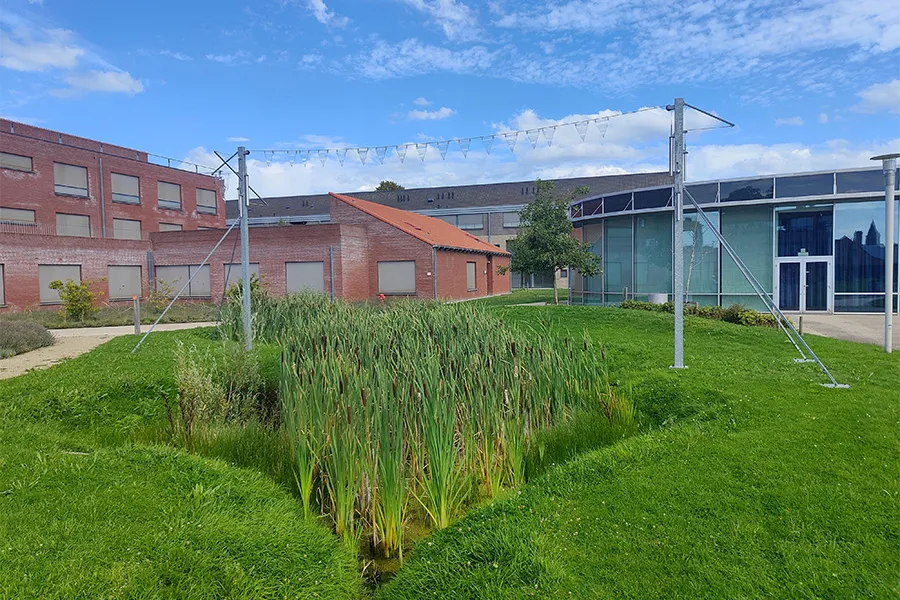
With its TerraViva® planting substrates, Acterra focuses mainly on trafficable lawns and underground growing spaces for trees in urban areas. Accelerated climate change has made wadis and permeable paving essential ways of designing public spaces. Awareness is also growing among private garden owners that they can do their bit. “By making better use of the space, you can make a wadi much more efficient”, says Bart Geerts, managing director of Acterra, which produces the TerraViva® substrates.
Over the years, Acterra’s trafficable lawn mixes have evolved from monotonous grass cover to mixed compositions featuring mainly plants that can withstand foot traffic. This matters, as the importance of reducing paved surfaces and integrating more green space continues to grow. Every measure taken by local authorities and private individuals to make public spaces, homes and gardens more climate-resilient makes a difference. WadIs (Water Drainage Infiltration) are a popular and widely used option. A wadi is a gravel- and sand-filled basin that can both store water and allow it to infiltrate.
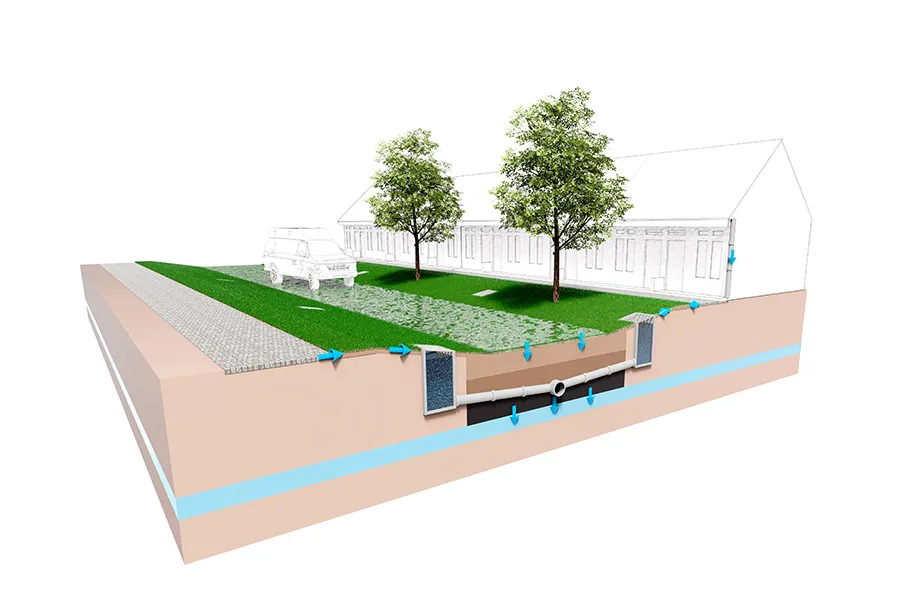
“In many cases, wadis take up valuable land in a housing development or industrial estate”, explains Bart Geerts. “Their purpose is to allow rainwater to infiltrate slowly into the ground, but they are often made extremely deep to provide enough storage, with infiltration taking place over a very small area. This makes the sides very steep, which makes maintenance difficult. After a few years, the wadi becomes overgrown, and chainsaws are needed to tidy it up again. In public spaces in particular, this makes the wadi unsafe and unsightly, giving it an increasingly negative image.”
A combined solution
“You can walk through a wadi, but it must not be subjected to heavy loads. For example, you cannot drive a car over it, because that would compact the soil and make it impermeable”, says the website www.blauwgroenvlaanderen.be. Bart Geerts says this is not entirely true: “Acterra has developed a solution that combines water infiltration with a road that can be driven on. This makes better use of the available space. By laying the evacuation road/fire access road around, for example, a business 30 cm lower than the surrounding green space, water can be stored across the entire road. Even when there is water in the wadi, vehicles can still drive through without subsidence or the risk of getting stuck. A win-win situation.”
Question about this story? Ask your question
Keep following this
Get an email when a new story is published. No account needed.
- ThemeSpace for water and green infrastructure
- SubjectGeneral







