









Construction lorries help tackle congestion

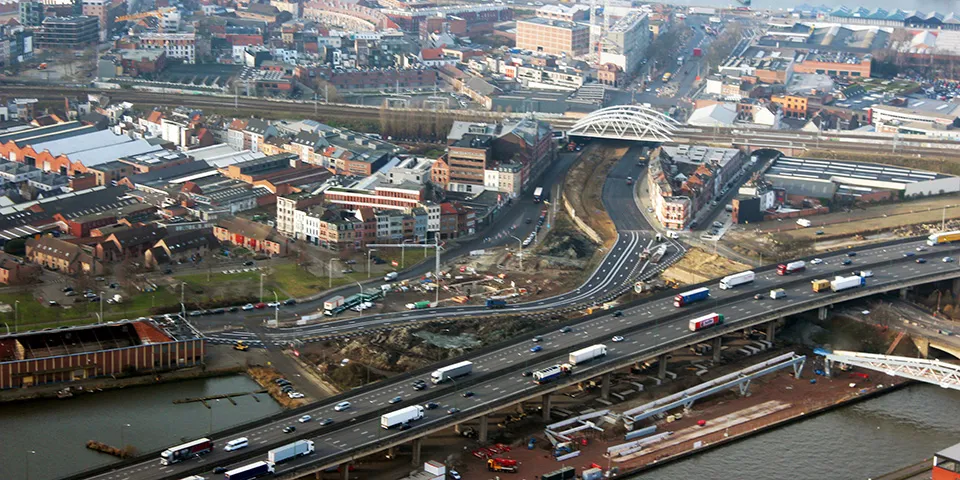
Around a third of all lorry traffic on the Antwerp Ring and through Antwerp’s streets carries construction materials. More often than not, these lorries are only partly loaded or even completely empty. “A stronger focus on recycling and the circular use of construction materials could help address this problem,” says Maarten Van Acker, Professor of Urban Planning at the University of Antwerp.
Professor Van Acker’s research is carried out by the Urban Development Research Group, a University of Antwerp research group that contributes to the development of knowledge on urban development, with a focus on the sustainable transformation of cities. Research into Antwerp’s mobility problems is one part of its work. “This project was commissioned by a unique coalition comprising the Flemish Government Architect (Team Vlaams Bouwmeester), the Department of Environment Flanders, the Public Waste Agency of Flanders (OVAM), the City of Antwerp and the Port of Antwerp,” explains Professor Van Acker. “Under the working title Metabolisme Antwerpen, stad van stromen, the city is viewed as a kind of human body, with flows coming in and going out. The aim of the research was to generate new insights at the intersection of urban planning, the circular economy and spatial planning in the Antwerp context. We focus on four challenges that are most critical for Antwerp: a regional heat network, better air quality in street canyons, a sustainable drinking water supply network and a circular flow of construction materials.”
Mobility problems on and around Antwerp’s ring road have been acute for years. Maarten Van Acker says: “A third of the traffic on the ring road is freight traffic, with a substantial share made up of construction traffic. Antwerp also faces a number of major construction challenges. Much of the building stock constructed after the Second World War will need to be renovated or demolished within the next ten years, generating a great deal of construction waste. At the same time, there are major new-build projects, such as covering the ring road and reinforcing the Scheldekaaien. These enormous projects will require huge quantities of construction materials. Both new materials and waste will therefore have to be transported over long distances to and from the sites, resulting in increasing congestion. This raised the question: is there another way to deal with construction waste?”
Small and large scale
In close collaboration with OVAM, which is committed to the circular use of construction waste, two strategies were proposed: one at city scale and one at a smaller, local level. “At city scale, we are looking for more sustainable modes of transport, such as mobility hubs in easily accessible locations, or using the covering of the Ring to bring together lorries carrying construction materials before they reach the ring road. We also need to consider how tram and metro networks in cities such as Brussels and Antwerp could be used to transport goods. And, of course, we need to make even greater use of the waterways. Construction materials are ideally suited to water transport, something De Vlaamse Waterweg is actively promoting. For example, the BONTON, a floating concrete plant, is already being used to build the Scheldekaaien. It is reportedly avoiding more than 8,000 lorry journeys.”
Professor Van Acker also sees opportunities at a smaller scale: “Why not create a construction equivalent of the farmers’ market, the increasingly popular small food markets? I’m thinking of smaller sites at neighbourhood level where people can bring their construction waste. For example, an unwanted but still usable door. This also connects with a rich tradition we discovered. When Antwerp’s ruien and underground sewer system were covered, people could bring their own waste. And Antwerp residents were able to buy sections of the Brialmontomwalling as building materials.”
The challenge
The challenge will be to work out what a circular construction system for Antwerp could look like, with a specific exploration of the possibilities for construction logistics. “There are forward-thinking companies, and various organisations are increasingly understanding the message. For example, the Brussels Bouwmmeester chose a project along the canal aimed at keeping manufacturing businesses in the city to tackle congestion. We are therefore moving towards a different kind of spatial planning, one that also makes room for manufacturing and the construction industry near cities and even within them. Things are moving, but there is still plenty of room for improvement. That is why we need to keep making the same point.”
Question about this story? Ask your question
Companies in this story
Keep following this
Get an email when a new story is published. No account needed.
- SubjectGeneral
- CompanyOVAM







