









Complex 667 m horizontal directional drilling operation for the Zeebrugge dock
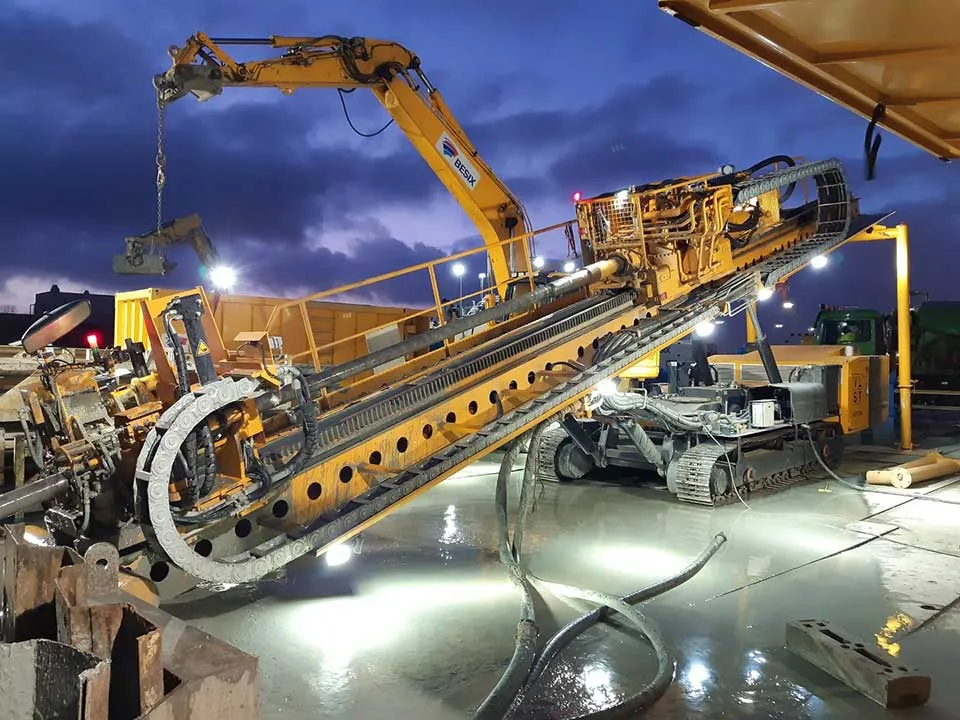
Commissioned by construction firm Artes Depret, grid operator Fluvius and drinking water company Farys, Van den Berg, part of BESIX Group, carried out a horizontal directional drilling operation beneath the Verbindingsdok in Zeebrugge.
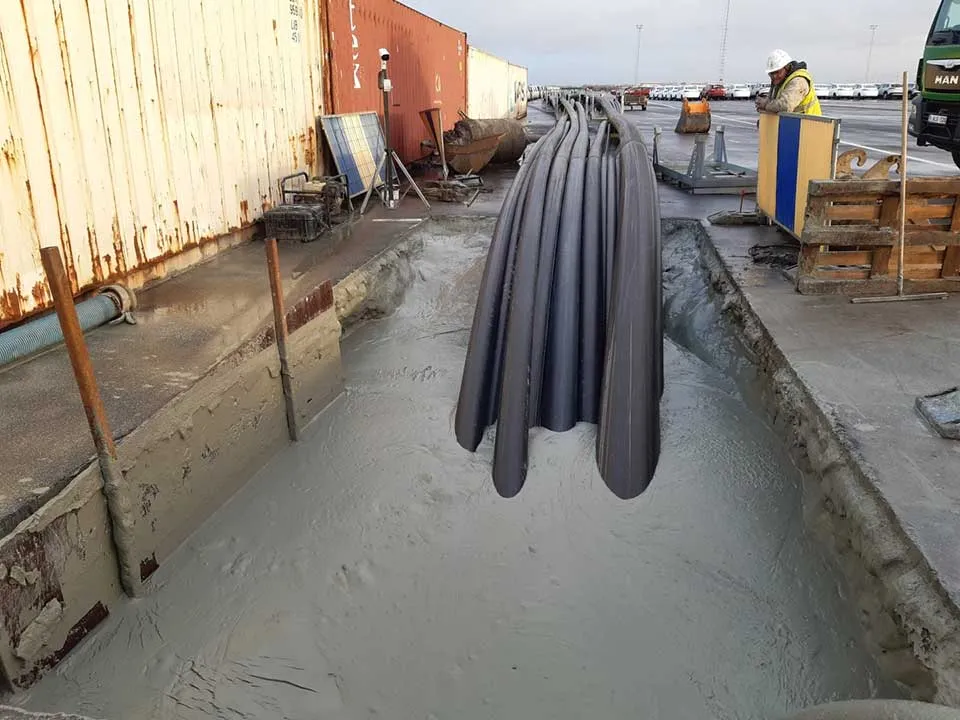
A bundle of 13 PE pipes was pulled through the bore to carry water, electricity and data. “The distance between the entry and exit pits is 667 m, and we drilled to a depth of 45.70 m. This depth is required for driving the piles that will support Europe’s largest movable bridge,” says Peter Cloet, project manager Horizontal Directional Drilling (HDD) at Van den Berg.
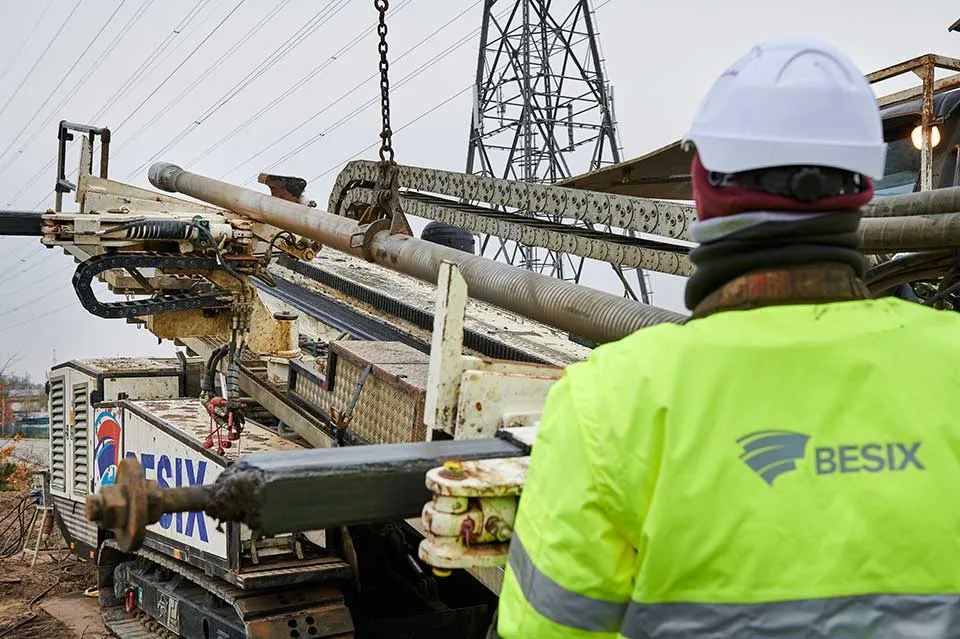
The huge bridge comprises two fixed concrete sections, together measuring 270 m, and a 130 m steel swing bridge. The swing bridge allows ships up to 55 m wide to pass, making it Europe’s largest movable bridge. Van den Berg’s specific assignment was to carry out a directional drilling operation to connect the two sides of the Verbindingsdok. The work is now almost complete. Only the water pipe remains to be installed.
“For the drilling operation, we used a PRIME 80-tonne Rig, together with its recycling and mixing unit, pumps, power generators and all the associated small tools and equipment,” says Peter Cloet. “As this is what is known as a rock bore, with hard layers of sand and shells beneath the dock, additional tooling is required during the pilot bore. A bore 47 m deep and 668 m long is not something you see every day in our country. Nor is installing a bundle of 13 pipes over such a distance commonplace in the Belgian market.”
Drilling in three stages
PE pipes with an SDR rating of 9 were selected for the project. These pipes have thicker walls than standard SDR 11 pipes. This rules out the risk of the PE pipes collapsing underground and allows the bundle to be pulled in with greater force. To complete the pull-in operation successfully, all the pipes were ballasted with water, reducing the total pulling force required.
The drilling itself was carried out in three stages. Peter Cloet: “First, a pilot bore is drilled between the entry and exit pits using an optical gyroscope. This creates a bore tunnel with a diameter of 250 mm. Since we had to pull through a bundle of 13 pipes, the diameter had to be enlarged in several stages to 1,200 mm. In the third phase, we pulled in the casing pipes, which had been welded together to the required length and laid ready at the exit pit. Laying out and welding the PE pipes, more than 8.5 km in total, was no easy task. This work had to be planned in good time so that everything was welded and ready.”
Studies and investigations
Preliminary studies and investigations were crucial to the successful completion of the project. Peter Cloet: “We worked very constructively with Artes Depret to develop both the prebuilt and the required PE pipes down to the smallest detail. When preparing the prebuilt, we took into account the minimum depth required at the banks of the Verbindingsdok, as piles had to be driven there for the new quay walls. Once the prebuilt had been finalised, the necessary calculations were carried out. These covered all kinds of factors that need to be considered before work begins, including pulling forces during the pull-in operation, drilling fluid pressures, stresses on the PE pipes and other important considerations.”
The coronavirus caused a delay to the start of work. Peter Cloet: “However, thanks to good communication between all the parties involved and the person responsible at ICO, the business park where our exit pit was located, the necessary arrangements were always made and the work was very well coordinated. It was a major undertaking, but in retrospect it went very smoothly.”
Collaboration and expertise
Thanks to highly constructive internal collaboration and the extensive expertise within the Underground Infrastructure division, which includes the HDD team, Van den Berg nv is able to plan and carry out projects of this kind down to the last detail. “That is one of our great strengths, alongside our site teams, who always give 100 %. Van den Berg has a division with more than 30 years of experience dedicated exclusively to Horizontal Directional Drilling. This specialist technique enables utility operators to cross obstacles such as canals, waterways, railways, motorways and other sensitive areas underground, avoiding major disruption and reinstatement work. Since its introduction in the 1990s, Van den Berg has been a pioneer in the European market,” concludes Peter Cloet.
Question about this story? Ask your question
Keep following this
Get an email when a new story is published. No account needed.
- SubjectGeneral







