









Bouwunie round-table discussion: horizontal directional drilling
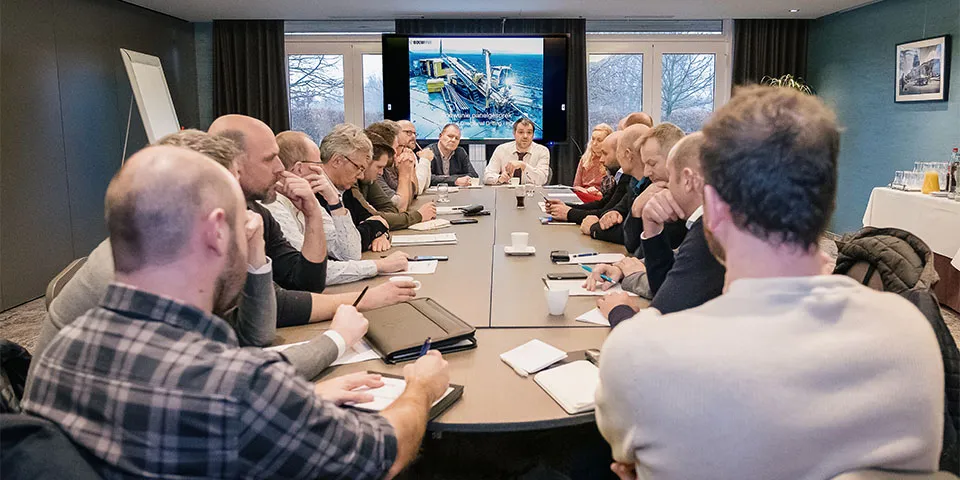
In the absence of clear guidance, the Flemish Council of Network Operators (VRN) published a comprehensive technical guideline for horizontal directional drilling in 2015. The guideline represents a significant step in the right direction, but it is certainly not the final destination. That became clear during the round-table discussion on ‘horizontal directional drilling’ organised by Bouwunie at the end of February.
“Those sitting around this table can make a difference in the world of HDD”
Horizontal directional drilling is a steerable trenchless technique for installing various types of pipes and cables. It is mainly used to cross inaccessible areas such as navigable waterways, railways and motorways. As the importance of ‘minimising disruption’ during public works continues to grow, horizontal directional drilling is being used increasingly often. The strong turnout at the round-table discussion also showed how much interest there is in the subject. Bouwunie brought together no fewer than 20 stakeholders, from clients and contractors to utility companies and umbrella organisations, for a discussion that covered both the benefits and the sticking points.

“Risks are assessed more accurately for larger studies”: Johan Vanhulle, bvba Vanhulle
VRN guideline
The discussion began with the VRN technical guideline, which has been seeking for several years to standardise, in broad terms, the complex business of directional drilling. “About ten years ago, we realised that without clear regulations we were heading for gridlock. A lot of drilling was being done, but hardly any as-built surveys. That couldn’t go on,” says Thierry Adriaensens, project manager at Aquafin.
The VRN was dealing with the same issue at the time. The two working groups, one at Aquafin and one at the VRN, joined forces and were expanded to include input from FARYS, Proximus, De Watergroep, Pidpa, Fluxys, Telenet, Elia and Fluvius, as well as contractors and manufacturers. Thierry Adriaensens explains: “After many discussions with all the parties involved, a guideline was approved by the VRN in 2015 (Aquafin, De Watergroep, Elia, Farys (TMVW), Fluvius, Fluxys, IMWV, IWVA, Orange Belgium, Pidpa, Proximus, Telenet, Water-Link (AWW), Waterbedrijf Knokke-Heist). It sets out rules for directional drilling, divided into three types (see box, ed.). Aquafin immediately incorporated the guidelines into its specifications, and they have since also been included in the new standard specification.”

“Clear rules and an obligation for temporary storage sites to accept bentonite slurry will bring prices back to normal”, Chris Wauters, Fluvius.
Vincent Decruyenaere, national secretary of Bouwunie Infrastructuurwerken, agrees and adds: “Bouwunie’s drilling contractors put in a huge amount of work to develop this guideline and provided the cable and pipeline operators with a great deal of input.”
Not always clear
Practical guidelines for directional drilling are now available, and the registration of all KLBs (Cable and Pipeline Operators) since 1 September 2009 had already marked a step forward. From 1 January 2016, KLIP (Cable and Pipeline Information Portal) has enabled people requesting plans to obtain digital plans from all KLBs through a single electronic request. But has much actually changed in the field? Yes and no. “Risks are assessed more accurately for larger studies and larger directional drilling projects,” notes Johan Vanhulle of bvba Vanhulle. “Small drilling jobs are often decided on late. I think it’s important to carry out a survey on site first in those cases. What’s more, the information returned through a KLIP request isn’t always very clear. Sometimes the plan doesn’t identify the work as directional drilling. That can lead to damage, through no fault of your own.”

“If you take a sample of bentonite slurry in its original liquid form, you’ll miss a lot of contamination”, Peter Hendrikx, RDL.
Bart Verberckmoes of Engie Fabricom agrees: “The most difficult cases are those where the plan says ‘excavated’, but the work was actually carried out by drilling. I’d rather have a plan with no data, but marked ‘directional drilling’. You can then still find out for yourself exactly where the pipes are.” But what happens to all that incorrect information? Ilse Baeck, technical engineer at Canalco and vice-chair of Bouwunie Infrastructuurwerken, calls for clear communication.
“The KLIP data must clearly state whether or not the work involves drilling. If anything is listed incorrectly, this must be fed back to the Information Flanders Agency so it can be corrected. The digital platform is certainly an improvement. It can still be tricky to navigate and clearly has some shortcomings, but it is very important to raise these with the AIV every time.”
Old versus new pipes
Even in 2020, a great deal of information about older pipes was still missing. For new pipes, the VRN guideline requires an as-built plan of the pilot bore and the installed pipe (as-built survey), with X and Y coordinates referenced to Lambert 72 and Z in TAW, for type 1 and 2 drilling. “The past is characterised by scattered Excel files,” says Chris Wauters, senior technologist contractors utilities and HDD at Fluvius. “You often had to guess the entry and exit pits and the depth. We’re now trying to turn that around, but of course you can’t erase the past. Even with new pipes and an as-built survey, you can’t be 100% certain. During subsequent works, someone might move the cables aside without it being documented. Still, it goes without saying that today we have many more resources and options. And we need to build on that.”
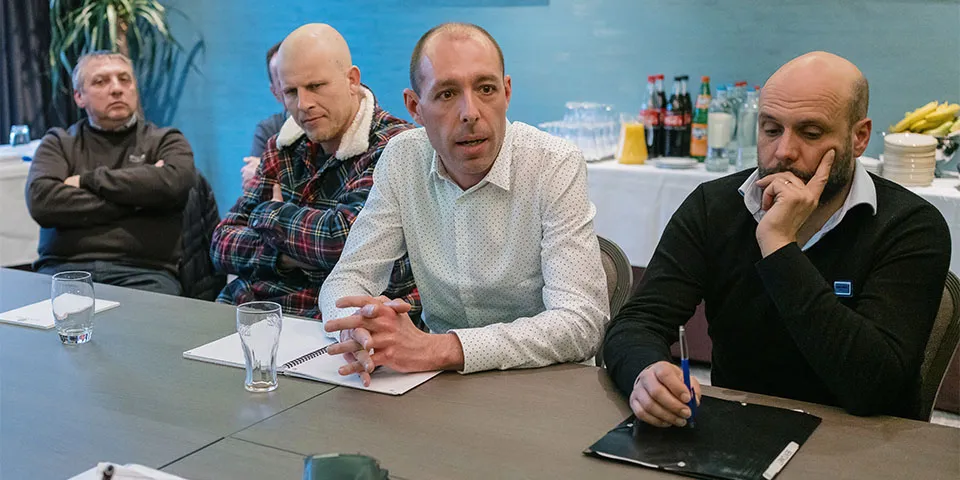
“Thanks to a fully traceable system, we know where soil materials in Flanders come from and where they go”, Timothy Geerts, Grondwijzer
Bart Permentier of Proximus agrees: “The information we used to have after drilling was much more limited. Now it’s more detailed. We’ll never be able to correct all the poor documentation from the past, but we can work towards a better future. I’m surprised that drilling is still being carried out without being documented. We should aim to have an as-built survey as standard for all drilling. And the task doesn’t necessarily have to be pushed onto the contractor. De Watergroep, for example, does it itself.”
Gas network operator Fluxys places a deliberate emphasis on the accurate position of the pipe. “After the directional bore has been completed, we carry out a further survey using specialist equipment,” says Paul Van Es, senior pipeline engineer at Fluxys. “That tells us exactly where the pipe is. We also offer contractors the opportunity to review the bore with us. We help them interpret the digital location data they provide and even come to site to mark out pipes, so as to minimise the risks as much as possible. And we do all of that free of charge.”

“BIM is already well established in the building sector, but the infrastructure sector is lagging far behind”, William Martens, FARYS.
BIM and measurement systems
William Martens, project manager at FARYS, also stresses the importance of surveying assets: “Minimising disruption is paramount today, and in city centres we’re practically never allowed to break open the road. But because the correct coordinates are missing, we sometimes have no choice but to drill beneath the carriageway, so to speak, with our eyes closed. We’re trying to address that through the new guideline, which is gradually gaining traction, including in the standard specification. For every new project, all cables, pipes and connections must be surveyed, digitally as well, and linked to coordinates. That’s the famous BIM approach.¹ It’s already well established in the building sector, but the infrastructure sector is lagging far behind.”

“It can’t be right that Belgian companies processing small volumes have to comply with the rules, while larger foreign companies aren’t inspected.” Kim Voets, Dekabo
BIM may still be some way off, but the sector is certainly not standing still when it comes to innovation. “In the past, you had two or three measurement frequencies available. Now there are packages with up to 1,000 frequencies,” says Kurt Drossin of Vermeer Benelux. “Equipment is used to scan the drilling path and detect interference signals, ultimately helping to identify the right frequency. This means you drill blind as little as possible and have as little interference as possible. The machines are certainly ready for today’s challenges.”
Kim Voets, operational director at Dekabo, agrees, but adds a caveat: “We’re seeing measurement systems become better and more advanced. But our people also need to know what they’re doing. That requires the right training, which isn’t always easy to put in place. And we still can’t see underground. So I too would like to see uniform reporting after completion. It adds a great deal of value, and we’re also seeing progress in that area.”
Bentonite slurry
The handling of bentonite slurry is a new point of concern when carrying out horizontal directional drilling. Since 1 April 2019, the use of bentonite slurry from directional drilling has been covered by the ‘soil management regulations’. Timothy Geerts, head of soil management at Grondwijzer, explains: “Thanks to a fully traceable system, we know where soil materials in Flanders come from, what their quality is, where they go and how they are used. But we’re hearing from the sector that there are problems. For example, many temporary storage sites (TOPs) are reluctant to accept bentonite slurry that has been removed from site. That’s where the problem lies at the moment. The rules aren’t always followed strictly, and bentonite slurry is used at locations without being reported or a permit being applied for. Those who do follow the rules price themselves out of the market.”
RDL, Reconversiemaatschappij Duurzaam Leefmilieu, welcomes bentonite slurry with open arms. Operational director Peter Hendrickx says: “We want to comply with the regulations, but the Soil Science Service of Belgium says: ‘We can’t prepare a technical report based on analyses carried out on drilling slurry in its original form.’ So we have to separate it into fractions. The soil material is pressed, the water is discharged, and the pressed material is then analysed as soil. This is how we produce a technical report. When it is pressed, contamination attaches itself to the finest fraction, in this case bentonite. And that means we are increasingly left with a contaminated batch. If you take a sample of bentonite slurry in its original liquid form, you’ll miss a lot of contamination. That mistake is still made quite often.”

“Those sitting around this table can make a real difference in the world of horizontal directional drilling”, Koen De Schaepmeester, DSK Piping
Call for clear regulations
The disposal of bentonite slurry after horizontal directional drilling is clearly a sensitive issue.
“What is missing above all in this matter is clear regulation,” says Bert Hegge, recycling manager at APK Group. Chris Wauters of Fluvius agrees wholeheartedly: “There are no, or hardly any, soil depots willing to accept it. Clear rules and an obligation for soil depots to accept bentonite slurry are the best solution. That would automatically lead to reasonable prices and the problem would resolve itself.” Price remains an issue, as Koen De Schaepmeester, managing director of DSK Piping, also confirms: “We usually build settling ponds into which the slurry is pumped and then left to decant. We estimate how much we will process and then look at the available storage capacity. The only alternative we currently have is to pay a lot for slurry processing.”
Unfair competition is another sticking point. “We use around 10 m³ a day at most, but then a Dutch company comes along and processes many times that amount,” stresses Kim Voets of Dekabo. “And where does that company take its bentonite slurry? I fully agree with the need for regulation, but Belgian companies processing small volumes should not be expected to comply with the rules while larger foreign companies go unchecked.”
According to William Martens of FARYS, implementation certification for contractors could help address this: “That is, provided it is included in the standard specification. If a foreign company does not have that certificate, it will no longer be able to work in Belgium. Implementation certification can also help us separate the wheat from the chaff. We have already started procedures for training, monitoring and improving implementation-related inspections. I would also like to call on everyone to get involved.”
Kurt Drossin of Vermeer also confirms that training is crucial to the bigger picture: “We have been organising training courses for some time. When we look abroad, we are lagging a long way behind in this respect. In Germany, there are even schools that issue certificates.” Timothy Geerts of Grondwijzer points out that ‘certification options’ already exist for clients: “Contractors involved in earthworks on major projects are required to submit a soil management report to the client at the end of the works. This document is issued by an accredited soil management organisation such as Grondwijzer and certifies that the soil movement regulations have been followed correctly from start to finish. It is also important for clients to include the necessary items for this in their specifications.”

“Bouwunie’s drilling contractors have put in a huge amount of work to develop this guideline and provided the cable and pipeline operators with a great deal of input.” Vincent Decruyenaere, Bouwunie
Achieving something together
Alongside the call for clear regulation on matters including the processing of bentonite slurry and post-drilling surveys for both small and large boreholes, the round-table discussion also highlighted the need for uniformity. All the stakeholders want a consistent framework within which to work. “Lots of rules are fine, but funnel them into a single, consistent way of working,” as Bart Verberckmoes of Engie put it so aptly. Ultimately, all parties are pursuing the same goal: carrying out a borehole correctly. In that respect, Bouwunie’s round-table discussion may well have been a first step towards more. “The people sitting around this table can genuinely make a difference in the world of horizontal directional drilling. I hope we will meet again soon,” concluded Koen De Schaepmeester of DSK Piping on an optimistic note.
Round-table participants: Thierry Adriaensens (Aquafin), Peter Hendrikx (RDL), William Martens (FARYS), Ilse Baeck (Canalco), Bart Permentier (Proximus), Peter Cloet and Maarten Pombreu (BESIX, Van den Berg), Paul Van Es (Fluxys), Chris Wauters (Fluvius), Bart Verberckmoes (Engie Fabricom), Tom Devriendt and Kurt Drossin (Vermeer Benelux), Kim Voets (Dekabo), Geert D’Joos (Drilling Solutions), Johan Vanhulle (Vanhulle), Koen Deschaepmeester (DSK Piping), Bert Hegge and Daniel Deblanc (APK Group), Timothy Geerts (Grondwijzer), Frank Derycke (Vanhie-Vandaele).
Moderator: Vincent Decruyenaere
(Bouwunie)
Een zakelijke vraag aan Vermeer Benelux? Get in touch
Companies in this story
Keep following this
Get an email when a new story is published. No account needed.
- SubjectGeneral
- CompanyVermeer Benelux







