









Blancefloerlaan track works on schedule for commissioning in November
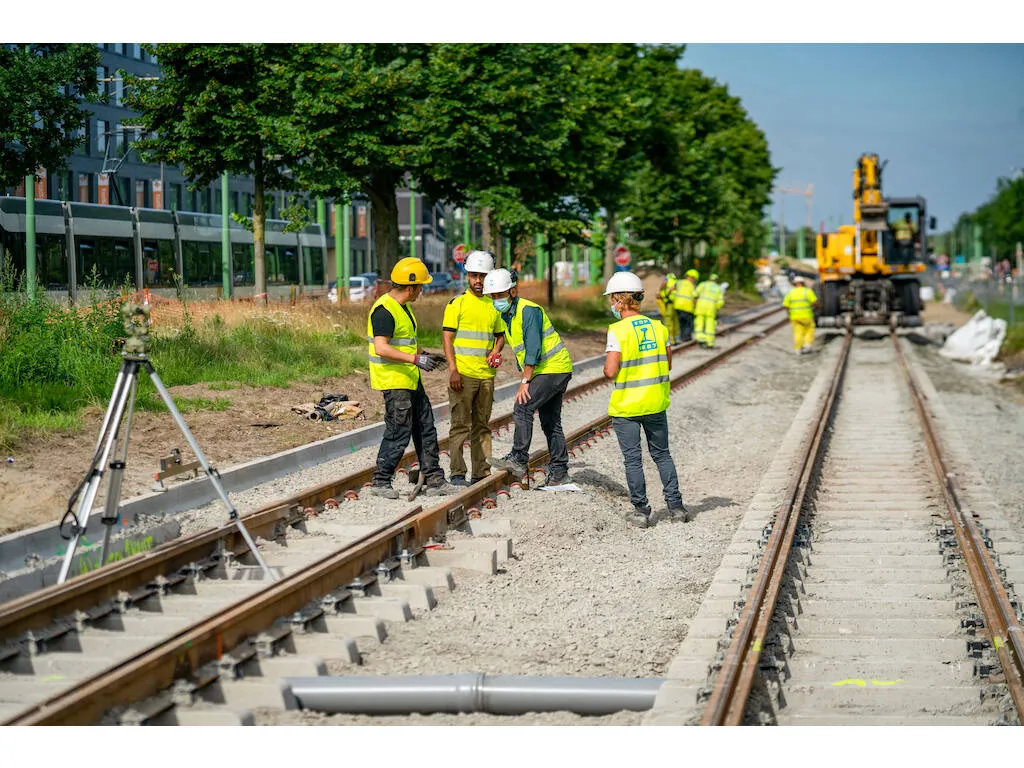
Since March, the tram tracks in the central reservation of Blancefloerlaan, between Halewijnlaan and Hugues C. Pernathlaan, have been rebuilt. A temporary joint venture between Frateur, De Pourcq, BESIX Infra, Taveirne and Franki Foundations (part of BESIX Group) is carrying out the work on the 1.2-kilometre route on behalf of De Lijn. As well as the tracks, the overhead line and the Halewijn, Sporthal and Van Cauwelaert stops are also being completely renewed. “The biggest challenge comes in November, when the new route will be commissioned and put into service over a single weekend,” say Frateur, De Pourcq and BESIX Infra in unison.
In recent years, De Lijn has faced subsidence of the tram tracks in the central reservation of Blancefloerlaan. Ground investigations showed peat layers at a certain depth, which would cause subsidence over time. It was therefore decided to rebuild the tramway on the southern side of Blancefloerlaan entirely on the northern side. This meant tram services to Linkeroever, an important artery for De Lijn in Antwerp, were not disrupted during the works. “A tender was issued using a design & build formula to find a solution for founding the deeper soil layers and prevent future subsidence,” says Jan Gillis, technical director at Frateur, De Pourcq, which submitted a comprehensive technical proposal together with BESIX Infra, Franki Foundations and Taveirne.
Pile-supported mattress
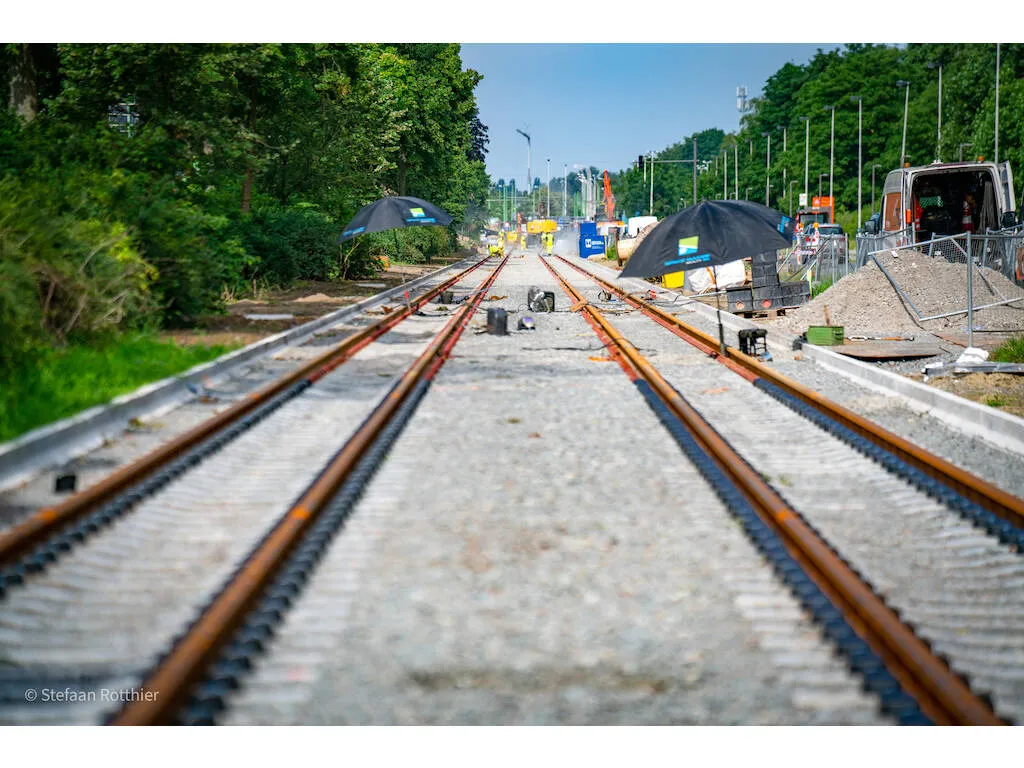
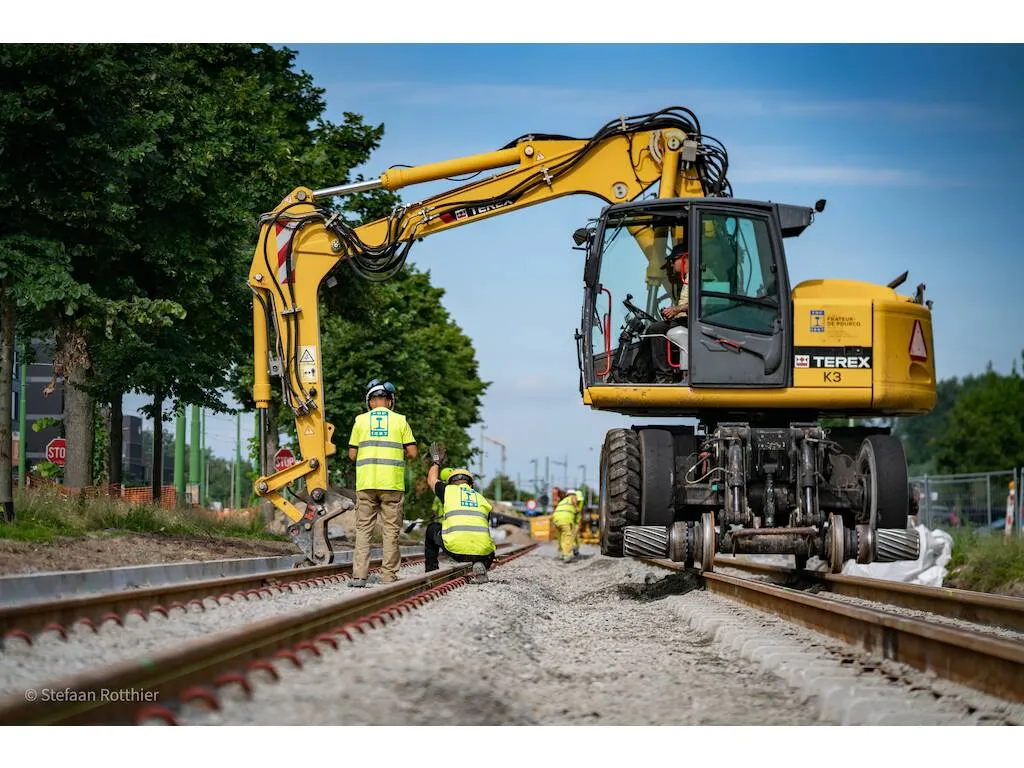
A pile-supported mattress system was chosen to ensure stability in the peat soils. Jan Gillis explains: “Normally, a conventional formation is excavated to a depth of 60 cm below ground level, with new foundation layers and tram tracks placed on top. At Blancefloerlaan, it was decided to excavate to a depth of 135 cm and then install pile foundations, carried out by Franki Foundations, depending on the location of the peat layers. ❯ These peat layers had been mapped in advance. Piles of different lengths, from 6 to 10 metres, were used for the foundations because we wanted to make sure that the poor ground layers were fully supported. A pile-supported mattress was chosen for installation on top of the pile foundations. These mattresses consist of crushed stone and three strong layers of geogrid, installed by BESIX Infra. Frateur, De Pourcq then laid the tracks, including the new cabling and overhead line …” The first track panels were installed at the end of May, almost three months after BESIX Infra began excavation. “We started on 1 March,” says Jeroen De Beleyr, project manager for roads and sewers at BESIX Infra. “Initially, the central reservation was excavated between the Halewijn junction and the park & ride area. BESIX Infra carried out all the earthworks in that area. After excavation, we laid a working platform of mixed rubble so that Franki Foundations could start installing the foundation piles in mid-March. The entire new tramway will ultimately be supported by these concrete foundation piles. There are almost 2,000 piles in total. March and April were mainly devoted to earthworks and foundation works. Once the foundation work was complete, BESIX Infra also began installing distribution slabs on the foundation to distribute the loads, followed by the mattress foundation, up to level -53 cm, where the track construction begins.”
On schedule
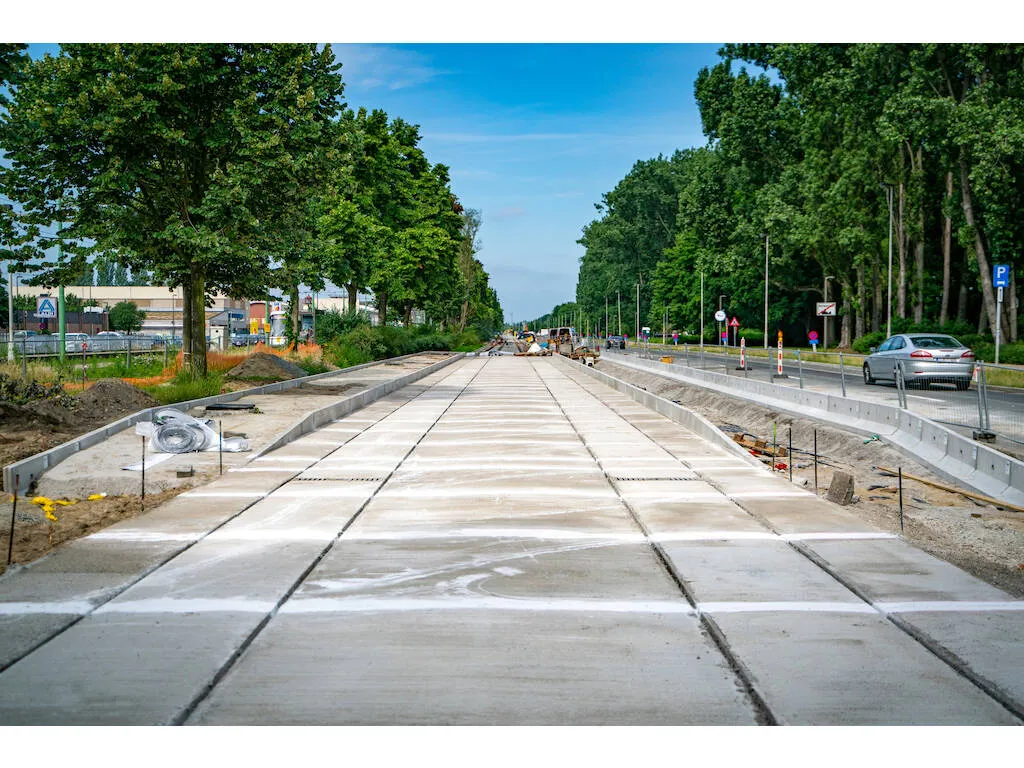
Work on the new tram tracks is currently fully on schedule. Jeroen De Beleyr says: “The foundations are complete, Frateur, De Pourcq is busy laying the tracks, we have installed the ducts and draw pits in the verges, and work is also under way on the new platform structures. In the first section of the route, where the tracks are already in place, the concrete finishing layer between the tracks was also laid before the construction holiday. The areas around the platforms will have a fully concrete surface, while the central reservation will combine concrete and grass grid.” The four partners involved, BESIX Infra, Frateur, De Pourcq, Franki Foundations and Taveirne, have worked closely together from the design stage onwards. Jan Gillis says: “Everyone is involved in the project from start to finish, and good cooperation and clear communication are essential to keeping to the schedule. The different stages follow one another quickly, so it is important that everyone sticks to the programme. Working together is very important to Frateur, De Pourcq, not only with the partners but also with all stakeholders. With major projects like this, which have an impact on the surrounding area, it is important to stay in touch with the community and give everyone involved the chance to contribute. A project like this is about much more than track works; the coordination around it is just as important.”
A well-oiled machine
The temporary joint venture’s smooth operation is, of course, down to the extensive experience each partner brings to its field. Jeroen De Beleyr says: “BESIX Infra specialises in sewerage works, often combined with roadworks. With foundation specialist Franki Foundations as part of BESIX Group, we also have all the expertise needed to deliver projects like this flawlessly. A key aspect of our work was anchoring the distribution slabs together. This had to be done to a very high standard, and quickly, to keep to the schedule. Finishing works, road concrete, ducts, draw pits … are also right up our street. With Taveirne and Frateur De Pourcq as trusted partners of De Lijn, we have a perfectly balanced team.” Jan Gillis confirms: “Frateur, De Pourcq often works with De Lijn, and in this project we are the managing party between the joint venture and De Lijn. We know where De Lijn’s priorities lie and exactly what it needs. That makes for a very positive relationship.”
A tense weekend
According to Frateur: De Pourcq and BESIX Infra, the biggest challenge is still to come: switching over to the new tracks. “Everything will be converted over a single weekend in early November, while continuing to minimise disruption to trams that are still running. In two days, the final metres of pile-supported mattresses and tracks will be installed, and the overhead line power supply will be switched over. It will certainly be an exciting weekend. According to the schedule, trams will run on the new tracks from 2 November, and all the surrounding works, such as removing the old tracks and incorporating the necessary greenery, are expected to be completed by mid-2022,” concludes Jan Gillis.
Question about this story? Ask your question
Keep following this
Get an email when a new story is published. No account needed.
- SubjectGeneral







