









900 noise measurements at façades map road traffic noise
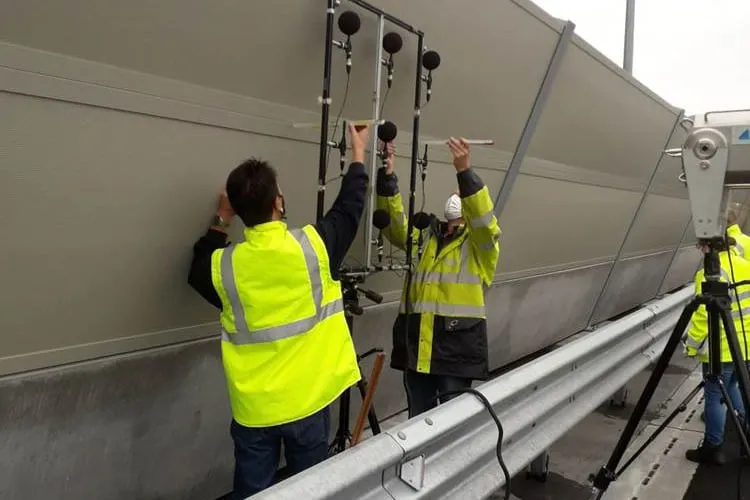
Agentschap Wegen en Verkeer (AWV) is reducing noise pollution caused by road traffic. Since 2020, around 40 kilometres of noise barriers have been renovated or built, 16 kilometres of quieter road surfacing has been laid and more than 900 acoustic measurements have been taken at façades.
Noise map makes noise pollution visible
Noise pollution is being systematically mapped. Over the past four years, AWV has carried out more than 900 acoustic measurements at façades, known as façade noise exposure measurements. The rolling noise of motorways is also measured every year. The new noise map for Flanders, recently published and drawn up in collaboration with the Departement Omgeving, shows noise levels around Flemish roads with more than 3 million vehicle passages a year.
“The noise map is used to draw up an action plan for the next five years. This shows where noise barriers, earth bunds or a different type of road surfacing could make a difference. Since 2020, AWV has renovated or built around 40 kilometres of noise barriers and laid 16 kilometres of quieter road surfacing,” says the Flemish Minister for Mobility and Public Works.
Impact of measures sometimes overestimated
Environmental factors often determine how effective a noise-reduction measure is. Air temperature is one such variable: the colder it is, the louder traffic sounds, except when snow has a sound-absorbing effect. Wind direction and the make-up of road traffic also play a part. A noise barrier, for example, works better against the sound of cars than against the low-frequency noise of lorries.
The impact of reducing speed is also often smaller than expected. When the speed limit is lowered from 120 to 90 km/h, the reduction in noise is ‘only’ around 1 dB(A). This is barely perceptible to the human ear. This is largely because lorries produce the most noise and often already travel at 90 km/h. In addition, reducing speed mainly eliminates peak noise, while the overall noise level falls by less. Speed reduction as a noise-mitigation measure is therefore most useful on roads with relatively low speeds and little lorry traffic.
Vegetation over a limited depth does not block noise either. A dense forest at least 100 metres deep is needed to achieve an additional noise reduction of around 3 to a maximum of 5 dB(A). Even so, traffic noise can sound less intrusive when it is not visible. Noise is subjective and therefore not always easy to ‘manage’.
New techniques
AWV makes an objective analysis of noise, but the subjective experience of local residents is also important. Through its collaboration with the citizen science project De Oorzaak, in which members of the public record their own experiences and attach noise sensors to their façades, AWV is also investigating how those personal experiences can enrich its objective measurements. The method is currently being tested along the N44 in Aalter.
We are also looking at new techniques to mitigate noise at the source, as it travels and at the receiver. For example, we reduce rolling noise from vehicle tyres by cutting fine grooves into the road surface using the relatively new NGCS technique, short for Next Generation Concrete Surface. There are also plans to start using diffractors, concrete structures with slots running parallel to the road surface that scatter sound waves.
Question about this story? Ask your question
Keep following this
Get an email when a new story is published. No account needed.
- SubjectGeneral







