









100th BENOR certificate for hydraulically bound mixtures awarded to JacKri
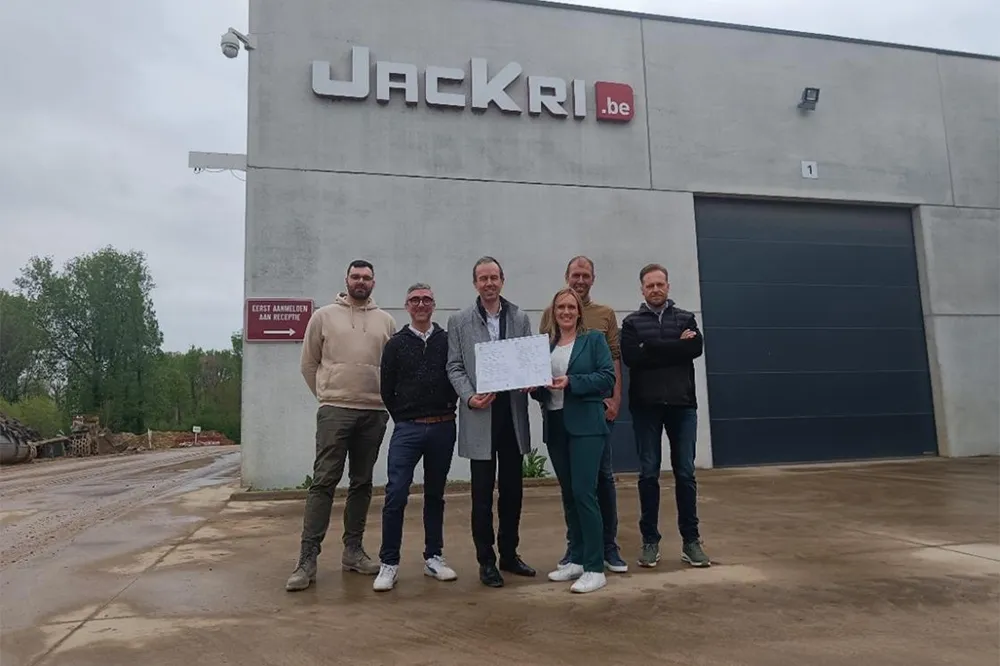
At the end of April, certification body COPRO awarded the 100th BENOR certificate for hydraulically bound mixtures to JacKri of Bilzen. This Limburg-based earthworks and landscaping contractor specialises in recycling and opened a state-of-the-art stabilised sand and concrete plant in 2022. The certificate marks an important milestone for both independent certification body COPRO and JacKri.
From 0 to 100
Since the first TRA 21 regulation was approved in 2008, COPRO has gradually expanded certification for hydraulically bound mixtures, such as 3 MPa sand-cement (stabilised sand), cement-bound crushed-stone base course IIA and lean concrete. “Since version 2.2 of SB 250 (the standard specification for road construction), published in 2010, this certification system has provided quality assurance for hydraulically bound mixtures used in road foundations. The number of certified companies has steadily increased since then,” explains Toby Verdin, Certification Manager at COPRO.
The 100th BENOR certificate was recently awarded to JacKri, a company that has specialised in earthworks since 2008 and began processing construction waste into recycled aggregates in 2016. “We opened our stabilised sand and concrete plant in May 2022. The certificate confirms the quality we deliver, and we are convinced it will give our company a boost,” says Ellen Theuwis, director of JacKri. “With 100 certified companies, high-quality hydraulically bound mixtures are available throughout Flanders. This has a significant impact on the environmental footprint of these products,” adds Toby Verdin.
With sustainability and circularity in mind
Today and in the near future, the road and infrastructure sector is committed to further reducing its environmental footprint. Around 2,700,000 tonnes of hydraulically bound mixtures are produced each year under the BENOR mark. “One advantage for the circular economy is that locally available recycled sands and aggregates are used wherever possible, instead of natural sand and aggregates delivered from quarries. This means shorter transport distances and lower CO2 emissions. Cements with a lower clinker content can also be used as a binder. This certificate is therefore part of the green story we are building with producers in the road and infrastructure sector,” says Toby Verdin.
“Our plant is right by the E313 exit, making it an ideal base, and carrying out every stage at one location, from collecting construction waste to reusing it in unbound and bound applications, contributes to sustainability and an efficient, short supply chain,” says Ellen Theuwis. COPRO has also clearly observed this trend. “In recent years, we have seen an increasing number of crushing plants looking to operate their own production plant. This enables contractors to manage the entire cycle, from demolition to reuse, in-house. The idea stems from the circular economy and the use of recycled aggregates,” confirms Toby Verdin.
Inspections as a key to growth and development
As a certification body, COPRO carries out inspections and checks to ensure the consistent quality of products used in the construction sector. “Hydraulically bound mixtures literally form the foundations, the base, of roads. Given that a chain is only as strong as its weakest link, the quality of these mixtures must be monitored systematically. Otherwise, roads can suffer from subsidence, surface damage and other problems. Our mission is therefore to organise, coordinate, harmonise and promote quality in the construction sector,” says Toby Verdin.
The cooperation between JacKri and COPRO is a good example of how external, impartial checks can help companies grow. COPRO does more than carry out inspections: certificate holders can turn to the certification body with any questions they have. “This allows us to keep growing and developing in line with the highest standards of quality and sustainability. We are very grateful for that,” says Ellen Theuwis.
New: draining lean concrete
This year, the certification body expects to issue the first technical data sheets for BENOR-certified draining lean concrete. The test methods and type testing were developed by the Belgian Road Research Centre as part of the “Be-Drain” study. This innovative permeable foundation is also defined in SB 250 and fits seamlessly into the green agenda COPRO is committed to.
COPRO continues to develop its work. The future of hydraulically bound mixtures promises a range of new challenges and initiatives. The industry is expected to focus further on developing new compositions to increase circularity, reduce CO2 emissions and respond to the need for infiltration and water storage. COPRO will support these efforts, with a focus on quality and sustainability.
Een zakelijke vraag aan Copro? Get in touch
Companies in this story
Keep following this
Get an email when a new story is published. No account needed.
- ThemeMaterials with a lower environmental impact
- SubjectGeneral
- CompanyCopro







