The many benefits of the cycle path paver
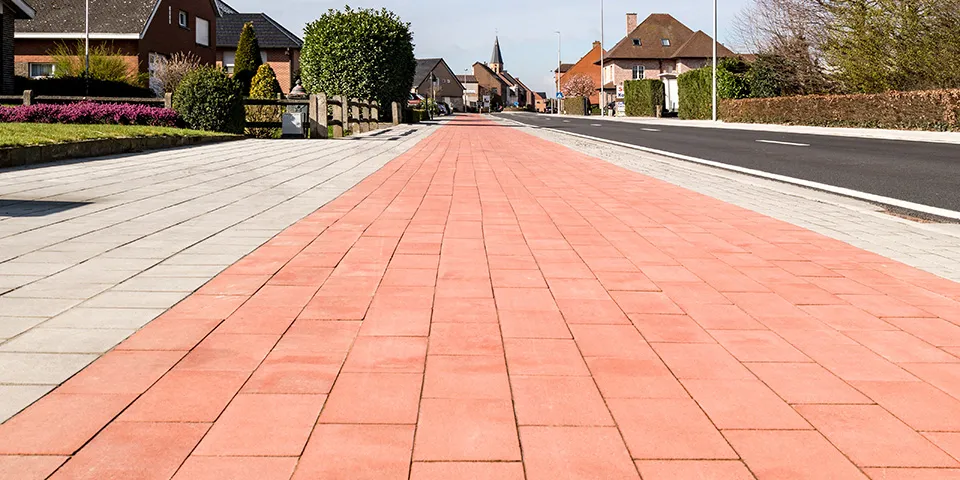
Commuting by bike is on the rise. We are also getting in the saddle more often in our free time, so clearly marked, continuous and comfortable cycle paths are more important than ever. The cycle path paver meets all these requirements and is now an excellent alternative to monolithic surfacing such as asphalt.
Cycle paths in densely built-up areas generally have to meet more stringent requirements than cycle highways or cycle paths in rural areas. However, the surface of cycle paths must remain accessible, particularly in built-up areas, where utility lines and sewer connections are often located beneath the cycle path. In 2017, members of FEBESTRAL, the association of manufacturers of concrete paving products, developed a concrete cycle path paver that can improve the quality of cycling infrastructure in cities and municipalities in many ways.
30 x 15 cm
Precast concrete producer Alkern VOR Beton was closely involved in the development process and recently supplied cycle path pavers to Rollegem-Kapelle, one of the first municipalities to use them. “The cycle path paver is a small, red concrete block measuring 30 x 15 cm and 8 or 10 cm thick,” explains Stijn Degraer, managing director of Alkern VOR Beton. “The spacers are kept to a minimum, so the blocks lie close together and you barely feel the joints when riding. The concrete elements are also laid in a half-bond pattern along the direction of travel, meaning cyclists encounter fewer joints and ride more comfortably. The flexible layout allows the cycle path to be interrupted at junctions or side roads, so it is not subjected to crossing traffic from cars and lorries. A cycle path paved with cycle path pavers therefore remains stable, level and comfortable.”
Repair work
The cycle path paver is particularly suitable for repair work because it can be removed quickly and just as easily reinstated. When properly laid, the cycle path is level again, which is not always the case after repairs to monolithic cast surfacing. The ease of laying and repairing saves time and money, while also enhancing the appearance of the path without sacrificing its safe, distinctive red colour. The cycle path paver can be laid anywhere, including in places that are difficult to access. It has a fine wear layer at least 4 mm thick, is made from high-quality sand, aggregate and grey or white cement, and is coloured throughout.
Question about this story? Ask your question
Keep following this
Get an email when a new story is published. No account needed.
- SubjectRoad construction