Reusing hot-dip galvanised gantries on roads in Flanders
Text Zinkinfo Benelux Beeld Agentschap Wegen en Verkeer
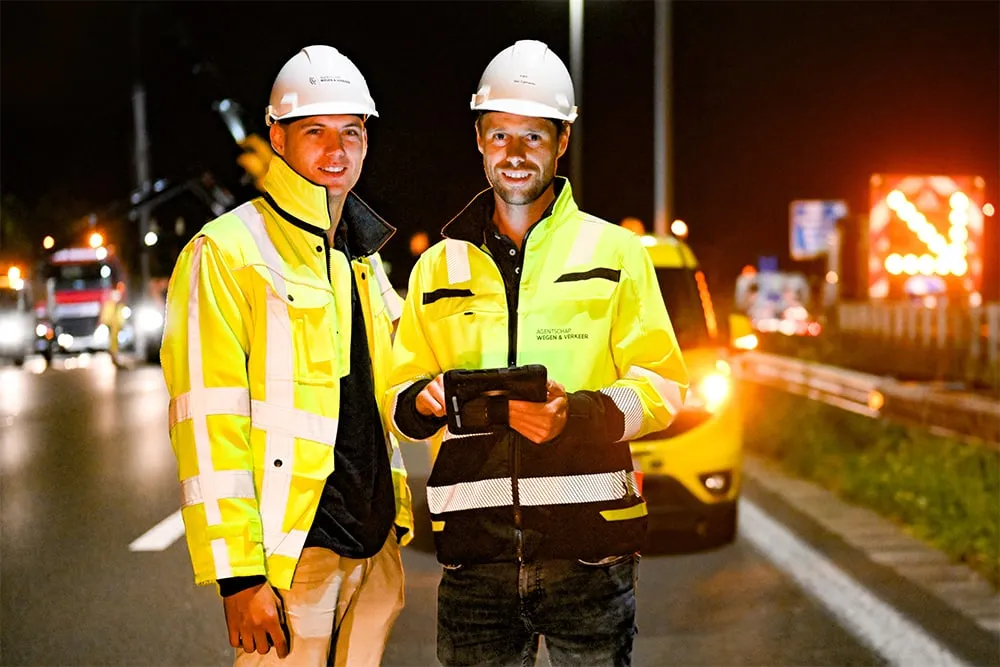
Interview with Ben Cannaerts, project engineer for traffic management and enforcement systems at Agentschap Wegen en Verkeer
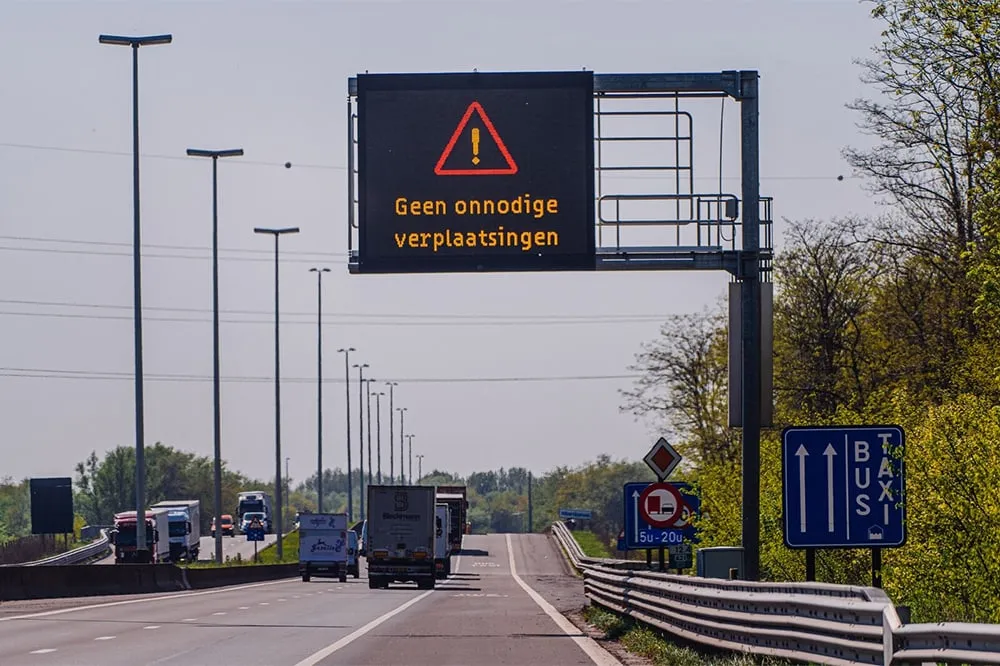
Zinkinfo has long been familiar with the advantages of hot-dip galvanising as the most durable form of corrosion protection for steel structures. When driving along the motorways in Flanders, you regularly pass beneath imposing signal gantries, which always look smart with their galvanised finish. Zinkinfo spoke to Ben Cannaerts, project engineer for traffic management and enforcement systems at Agentschap Wegen en Verkeer, about this.
Why did you choose galvanising?
Ben Cannaerts: “Our standard specifications have required our signal gantries to be galvanised for years. For us, this is an obvious choice: we do not see any equivalent alternatives. We could opt for a paint system, but in our view it does not provide the same long-lasting protection against rust. What is more, the galvanising process protects both the inside and outside of the hollow sections with a zinc coating, so there is no risk of internal corrosion. Our gantries are exposed to the elements all year round, and in winter they are also exposed to road salt. Turbulence causes constant moisture build-up beneath the gantries, against which a zinc coating offers the best possible protection.”
What service life do you specify in the contract?
“We require a service life of 50 years for the gantries, whereas our standard SB260 specification for civil engineering structures normally sets a requirement of 100 years. The oldest gantries currently seen on our motorways date from the 2000s, so they are still relatively young.”
AWV is responsible for the infrastructure of regional roads and motorways in Flanders, while Brussels and Wallonia naturally have their own road authorities. Are gantries identical throughout Belgium, or do they differ between regions?
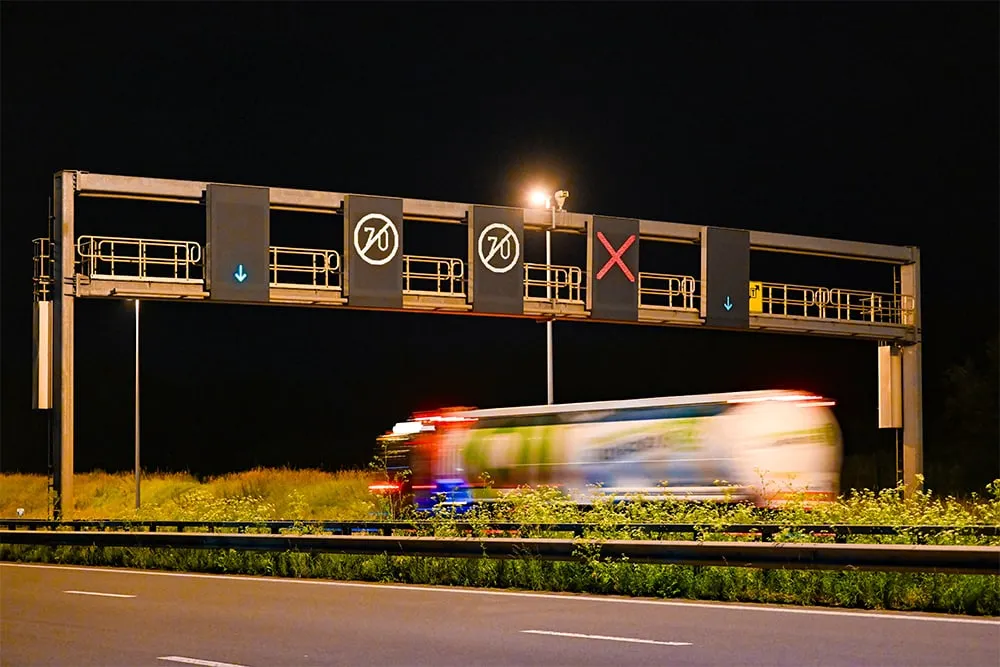
“Most motorists probably would not notice, but there are indeed differences in the types of structures used. In Brussels and Wallonia, sign gantries carrying LED signs are often built with a single beam, whereas in Flanders we use a twin-beam structure for this type of sign.”
An important element of the ZEKER ZINK campaign is the attention Zinkinfo gives to safe galvanising. Immersing steel structures in a bath of molten zinc at a temperature of +/-450 °C is an industrial process that requires perfect risk management. Standard EN-ISO 1461 states that ‘the design of articles to be hot-dip galvanised must be suitable for this process’. Another relevant standard is EN-ISO 14713-2, which sets out design guidelines and recommendations.
Is AWV aware of the design requirements for good, safe galvanising?
“Absolutely. A few years ago, I visited a large galvanising plant with several colleagues. We were given a tour and received information about the impact of structural stresses and the importance of vent and drain holes. These allow the molten zinc to flow freely through all hollow sections during galvanising. Any air or moisture present must be able to escape to prevent the risk of an explosion.”
“The visit really opened my eyes to the risks faced by the people working at the zinc bath if parts that have not been correctly designed and/or manufactured are galvanised. AWV has long used multi-year framework contracts to ensure that our contractors are familiar with the specific requirements for galvanised steel. Ultimately, this is also a process of continuous improvement, and it is important to keep the lines of communication open with all parties involved, both during production and during installation.”
We keep talking about ‘gantries’, but I assume there is more than one type?
“We have twin-beam gantries, to which we attach all the dynamic signs. We also regularly use so-called cantilever posts, which have just one support. Sometimes exceptional circumstances call for exceptional structures. In 2022, for example, two cantilever posts with an exceptionally long span were installed at the Leonardtunnel, specifically at both tunnel entrances. In some cases, there is simply no room for a central support, so you have to bridge a span of around 40 metres. Alongside the different types of structure, there are, of course, also major differences in the foundations. It all starts with the ground investigation, which determines the type of foundation required.”
Who ultimately designs the gantries?
“We determine the design requirements, which are set out in our specifications. However, the gantry fabrication drawings (detailed drawings) are produced by the manufacturer, in our case a subcontractor to the main contractor. The contractor is responsible for installing the foundations, taking measurements, designing the structure and installing it. It therefore makes sense for them to produce the fabrication drawings.”
Are you in regular contact with your Dutch counterpart, Rijkswaterstaat?
“I am not personally, but I understand that there is contact. In the Netherlands, they often opt for lightweight lattice structures, whereas AWV chooses heavier structures that a technician can move along using the handrails provided. Maintenance can be carried out from the top of the beam without using a mobile elevating work platform. In the Netherlands, work on lattice structures often requires mobile elevating work platforms, which increases maintenance costs.”
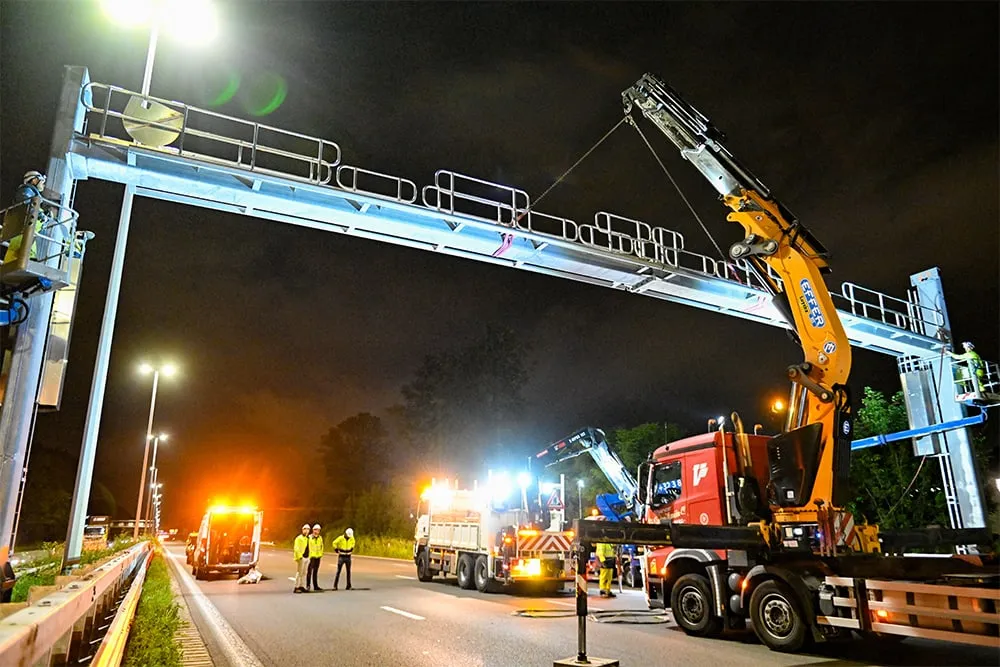
Let’s turn to the immediate ‘trigger’ for this interview: installing a reused steel gantry over the E40 between Bertem and Sterrebeek. How did it work?
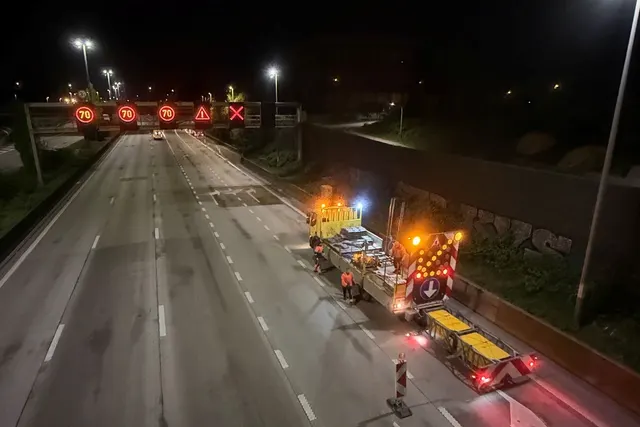
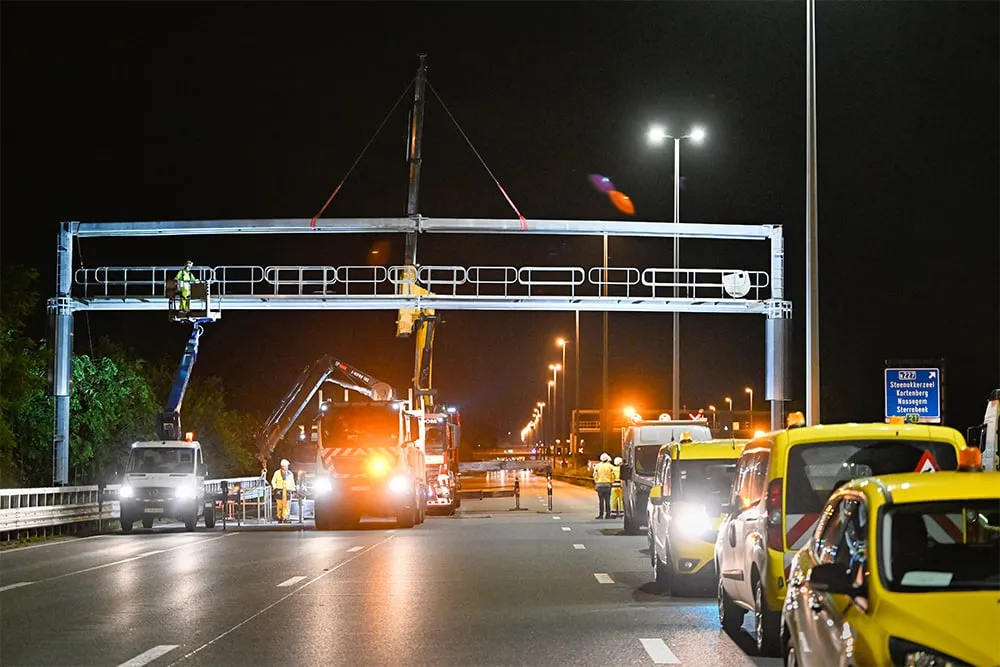
“It all began with the Oosterweelverbinding project. As part of the works on Linkeroever, AWV was asked to transfer some of its installations to Lantis. However, some of the existing gantries no longer fitted the new route and had to be removed. AWV suddenly found itself with a substantial stock of ‘old’ gantries. We then systematically looked at whether some of them could be reused in other investment projects where the dimensions would ‘fit’. Installing a reused gantry is different from installing a new one. Normally, we first install concrete plinths in the ground and then take measurements before manufacturing the gantries. With a reused gantry, we do it the other way round: the concrete plinths have to be installed with great precision, because the gantry must fit to the nearest millimetre.”
“The good news is that we have since reused three other gantries as well. Two have been in place on the hard shoulder running lane between Ham and Beringen on the E313 since 2023, and one was installed near the Leonardtunnel in 2022. We are quite proud of this. The approach also fits perfectly with the climate plan of MOW Vlaanderen (Mobiliteit en Openbare Werken).”
Were the old gantries reinstalled as they were, or did you refurbish them before putting them back into service?
“After dismantling, the gantries were stored at an AWV site in Zelzate. Whenever we had a project where a gantry could be reused, it was galvanised again and then installed on site.”
Have you compared the environmental costs of new steel with reuse?
“At present, we do not yet have a good tool for calculating this precisely, but we have mapped the entire process, including transport, refurbishment and installation. In our view, reuse performs better, but as I said, we still lack a suitable calculation tool to substantiate this.”
And what about the cost comparison? Does reuse come out on top?
“As a public authority, we have a duty to lead by example when it comes to reuse. I admit that initially we had some reservations. We had never done this before, so we were taking a step into the unknown. One issue we encountered was that the lower beams are always treated with a non-slip coating, which naturally had to be removed before they could be galvanised again, adding extra labour hours. Some minor modifications to the existing gantries were also needed, and it was not always possible to estimate these precisely in advance. But in the end, reuse turned out to be slightly cheaper than having new gantries made. Of course, the calculations can vary depending on the condition of the existing gantries. The more repairs needed, the less favourable the comparison will be.”
“We are very proud of the result. You are taking a certain risk, and you still have to stick to a strict installation schedule, even though some parameters have not been tested in advance. You also have to change your design process, which puts a certain amount of pressure on the contractors.”
A look to the future: how do you see traffic signage on our motorways developing?
“Technology is advancing rapidly at the moment. There are no concrete plans in the short term to stop installing new gantries altogether or to dismantle them, but we will soon have intelligent, self-driving vehicles, and there is a lot happening internally around intelligent road systems. Let’s face it, who still drives around without Waze, Flitsmeister, Google Maps or another navigation app? Our road infrastructure cannot afford to lag behind the technological advances affecting every aspect of mobility.”
Have a business enquiry for ZINKINFO BENELUX? Get in touch
Companies in this story

Keep following this
Get an email when a new story is published. No account needed.
- SubjectRoad construction
- CompanyZINKINFO BENELUX